Author: Cape Crazy

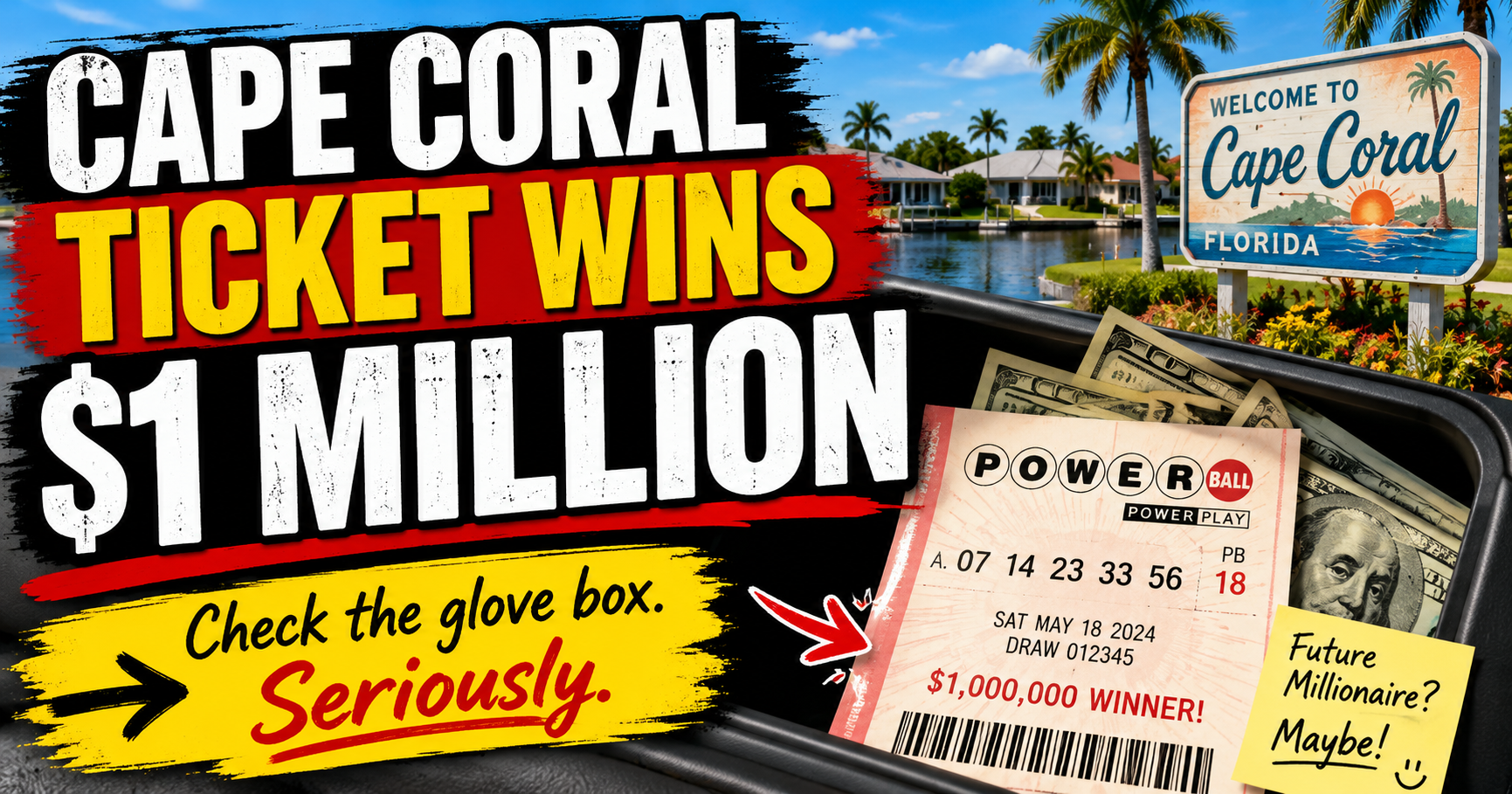
  • Cape Coral Powerball Ticket Wins $1 Million — So Check the Junk Drawer

    Cape Coral Powerball Ticket Wins $1 Million — So Check the Junk Drawer

    Someone in Cape Coral may be having a considerably better week than the rest of us.

    The Palm Beach Post reported that a Powerball ticket sold in Cape Coral won $1 million in the Aug. 12 drawing. The billion-dollar jackpot itself went to a single ticket sold in Illinois, while Florida was one of several states with a $1 million Match 5 winner. 

    So somewhere around Cape Coral, there may currently be a person casually going about their day with a piece of paper worth $1,000,000 sitting in:

    • a wallet
    • a glove box
    • a kitchen drawer
    • yesterday’s pants
    • or underneath six Publix receipts

    Cape Crazy Translation

    Powerball:

    “Congratulations, Cape Coral. Someone here won $1 million.”

    Every resident:

    “WHERE DID I PUT THAT TICKET?”

    Illinois winner:

    “I won the billion.”

    Cape Coral:

    “Nobody asked you.”

    The winning numbers for the Aug. 12 drawing were 4, 26, 66, 67, 69 and Powerball 9. 

    So if those numbers look familiar, stop reading Cape Crazy for approximately 30 seconds and go check your ticket.

    We’ll still be here.

    IS THIS CRAZY OR NOT?

    A $1 million Powerball ticket was sold in Cape Coral, and there’s always a chance the winner hasn’t even realized it yet.

    Crazy?

    Or just the best reason ever to clean out the center console?

    Tap an icon to vote.

    Sources

    The Palm Beach Post
    Reported that a $1 million Powerball ticket from the Aug. 12 drawing was sold in Cape Coral.

    Powerball
    Official drawing information for the Aug. 12, 2026 jackpot.

  • Cape Coral Gas Prices Jump Again — Because Apparently Driving Was Too Affordable

    Cape Coral Gas Prices Jump Again — Because Apparently Driving Was Too Affordable

    If you filled up in Cape Coral recently and thought:

    “Didn’t this cost less last week?”

    Yes.

    Yes, it did.

    WFTV, using AAA data compiled by Stacker, reported that regular gas in the Fort Myers–Cape Coral metro was averaging about $3.87 a gallon as of Aug. 10. That was up 10 cents in one week and a whopping 82 cents higher than a year ago.

    Cape Coral drivers:

    “Cool. Anything else getting more expensive?”

    Florida:

    “How much time do you have?”

    At Least We’re Only Slightly Worse Than Florida

    The statewide average was about $3.86, meaning Cape Coral was running approximately one penny more expensive. 

    So technically, we’re not getting uniquely punished.

    We’re getting Florida-standard punished.

    Progress.

    Diesel Drivers: Maybe Don’t Read This Part

    WFTV reported diesel averaging about $5.29 per gallon — up $1.68 from a year earlier, or roughly 46.5%. 

    Five dollars and twenty-nine cents.

    At that point, the fuel pump should probably ask:

    “Checking or savings?”

    It Could Be Worse

    For perspective, WFTV’s list showed some California markets pushing $5.70 to $5.86 per gallon for regular gas. 

    So whenever you feel bad paying $3.87 in Cape Coral, just remember:

    Somebody in California is currently looking at our gas prices with envy.

    That may be the most comforting thing anyone says today.

    Cape Crazy Translation

    Gas station sign:

    $3.87

    Driver:

    “I’ll wait until it comes back down.”

    Gas station:

    “That’s adorable.”

    IS THIS CRAZY OR NOT?

    Cape Coral gas is up 10 cents in a week and 82 cents from a year ago.

    Crazy?

    Or just another expense we’re supposed to stop noticing?

    Tap an icon to vote.

  • Cape Coral Already Built the Rowing Dock. Naturally, Now We Need Another Plan.

    Cape Coral Already Built the Rowing Dock. Naturally, Now We Need Another Plan.

    Cape Coral has encountered one of those uniquely governmental problems where the solution appears to have been completed before everyone decided they didn’t like the solution.

    The Cape Coral Rowing Club has spent months trying to secure a permanent home.

    The city, meanwhile, already built a large dock at Tropicana Park that earlier reporting says cost roughly $480,000 to $500,000 and was designed with rowing craft — including the club — specifically in mind. 

    So naturally…

    The rowing club isn’t going there.

    Welcome to Cape Coral.

    Step One: Build a Rowing Dock

    According to the Cape Coral Breeze, Tropicana Park’s planning included significant input related to rowing, and the finished park contains a large dock suitable for non-motorized watercraft. The Breeze reported that approximately $500,000 had been spent on the dock infrastructure intended, at least in part, to accommodate the Cape Coral Rowing Club. 

    This seems relatively straightforward.

    Need a place for rowers.

    Build a dock.

    Build park.

    Open park.

    Let rowers row.

    Roll credits.

    Unfortunately, Cape Coral apparently renewed the series for another season.

    Step Two: Don’t Let the Rowing Club Use the Rowing Dock

    Earlier this year, Cape Coral City Council deadlocked 4-4 on a proposed lease that would have allowed the Rowing Club to use part of Tropicana Park for boat storage and access.

    The lease therefore failed. 

    Later, Council voted 5-3 to direct city staff to find a “Plan B” somewhere other than Tropicana Park. 

    Which gives us the Cape Crazy municipal planning formula:

    Plan A: Spend nearly half a million dollars building the thing.

    Plan B: Don’t use the thing.

    Plan C: Figure out where to build another thing.

    Efficiency has entered the chat.

    Crystal Lake: Because Apparently One Dock Wasn’t Enough

    One alternative being discussed is Crystal Lake Park.

    There is one minor difference between Tropicana Park and Crystal Lake.

    Tropicana Park already has the dock.

    Crystal Lake does not.

    The Cape Coral Breeze previously reported that some council members questioned whether moving the Rowing Club to Crystal Lake would require substantial additional city spending because of the shoreline, grading and infrastructure needed. 

    Councilmember Laurie Lehmann has said private sponsors and contractors could potentially help cover or donate some of the work, with an earlier concept involving a much less expensive dock arrangement. 

    Rowing Club officials disagree strongly with that assessment.

    And by “strongly,” we mean very strongly.

    The Rowing Club President Has Some Thoughts

    In an Aug. 17 guest commentary published by the Cape Coral Breeze, Rowing Club president Saundra Westonargued that the alternative proposal being revisited by the city is fundamentally unworkable.

    Weston says she previously met with Lehmann and explained why she believes the plan would not work without significant shoreline preparation, permitting and a properly engineered dock system. She alleges that essentially the same proposal is now resurfacing despite those concerns. 

    Those are Weston’s assertions, and they should be treated as such.

    But even earlier straight-news coverage confirms that Lehmann acknowledged after meeting with Weston that she needed to reconsider aspects of her proposal. 

    So apparently the drawing board was visited.

    Whether anybody actually drew anything new on it is now part of the dispute.

    One Councilmember Already Asked the Obvious Question

    During the May council discussion, Councilmember Keith Long reportedly said he did not support spending additional city money to move the Rowing Club somewhere else.

    According to the Cape Coral Breeze, Long indicated that if relocating the club meant taxpayers paying for another facility, he might reconsider his opposition to Tropicana Park. 

    Which seems like a reasonable question:

    If taxpayers already bought a rowing dock… why are taxpayers shopping for another rowing dock?

    Cape Coral:

    “The first one isn’t being used by the rowers.”

    Taxpayer:

    “Why?”

    Cape Coral:

    “It’s complicated.”

    Taxpayer:

    “Did we pay for it?”

    Cape Coral:

    “Yes.”

    Taxpayer:

    “Could they use it?”

    Cape Coral:

    “Technically…”

    Taxpayer:

    “I’m going to stop you right there.”

    And There Are Actual Kids Caught in the Middle

    This is where the story becomes less funny.

    The Cape Coral Rowing Club says youth participants make up a large portion of its programming and revenue, and the organization has warned that without a stable long-term location it may not be able to maintain those programs. 

    At the opening of Tropicana Park, supporters protested the Council’s decision, and student rowers spoke publicly about uncertainty over where they would train. 

    These aren’t professional athletes demanding a taxpayer-funded luxury training center.

    They’re kids trying to row boats.

    And Cape Coral somehow turned that into a multimonth municipal saga involving:

    • a half-million-dollar dock;
    • an unsuccessful lease;
    • neighborhood opposition;
    • multiple council votes;
    • an alternate park;
    • possible private sponsors;
    • engineering questions;
    • permitting questions;
    • protests;
    • guest commentaries;
    • and something called Plan B.

    NASA got people to the moon with fewer plot twists.

    Why Is Tropicana Park Off the Table?

    Council members opposed to the Tropicana arrangement have raised concerns involving future boat traffic, safety and nearby development around the Seven Islands/Gulf Gateway area.

    Mayor John Gunter previously said he does not support placing the Rowing Club at Tropicana Park and considers Crystal Lake a viable alternative. 

    Those concerns deserve consideration.

    But they also lead directly back to the question critics keep asking:

    Then why was the rowing infrastructure built there in the first place?

    The Cape Coral Breeze reported that rowing use had been contemplated during the park’s planning and design. 

    It’s a little like building a dog park and then announcing:

    “After further review, we’re concerned dogs may be present.”

    Cape Crazy Translation

    Cape Coral:

    “The Rowing Club needs a permanent home.”

    Taxpayers:

    “Okay.”

    Cape Coral:

    “We built a roughly $500,000 dock.”

    Taxpayers:

    “Great.”

    Rowing Club:

    “We’ll use it.”

    Cape Coral:

    “Not so fast.”

    Rowing Club:

    “Why?”

    Cape Coral:

    “We need a Plan B.”

    Taxpayers:

    “What’s Plan B?”

    Cape Coral:

    “Possibly another dock somewhere else.”

    Taxpayers:

    “What was Plan A?”

    Cape Coral:

    “The $500,000 dock.”

    Taxpayers:

    “And what’s wrong with it?”

    Cape Coral:

    “Nothing. It’s open.”

    Taxpayer:

    “I’m going home.”

    The Serious Part

    There may be legitimate reasons Council ultimately decides Tropicana Park isn’t the best long-term location for the Rowing Club.

    Safety concerns can change.

    Development conditions can change.

    Neighborhood impacts deserve consideration.

    And if a privately funded alternative at Crystal Lake truly can provide the club with a safe, permanent home without additional taxpayer expense, that deserves a fair evaluation too.

    But Cape Coral has already spent substantial taxpayer money on infrastructure at Tropicana Park that was designed with rowing use in mind.

    Before spending more money — or allowing this dispute to drag on long enough to jeopardize the youth program — residents deserve a clear explanation of why the already-built solution isn’t the solution anymore.

    Because right now, the situation looks an awful lot like:

    We built the dock.

    The rowers need the dock.

    The rowers can’t use the dock.

    Now let’s talk about another dock.

    And if that isn’t worthy of the Crazy Index, we’re going to need to reconsider our standards.

    IS THIS CRAZY OR NOT?

    Cape Coral taxpayers already funded a roughly half-million-dollar dock at Tropicana Park designed in part with rowing in mind.

    The Rowing Club still doesn’t have a permanent home.

    And city officials continue exploring another location that may require new infrastructure.

    Is there something we’re missing here?

    Or is this exactly as crazy as it sounds?

    Tap an icon to vote.


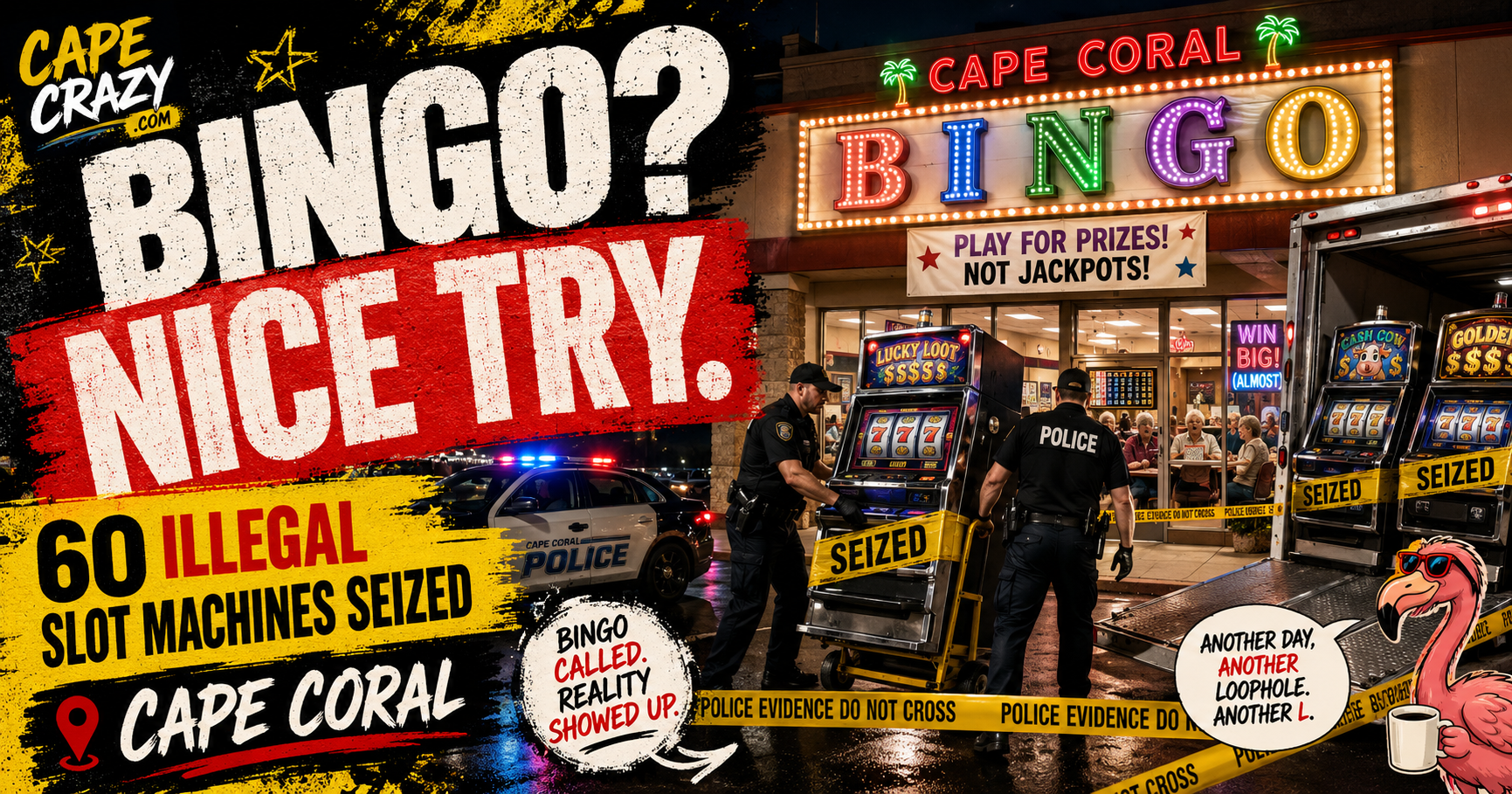
  • Cape Coral Bingo Hall Loses 60 ‘Bingo’ Machines — Regulators Say Nice Try

    Cape Coral Bingo Hall Loses 60 ‘Bingo’ Machines — Regulators Say Nice Try

    There are few things more Florida than trying to solve a legal problem with a label.

    According to WFTV, Florida gaming regulators and Cape Coral police recently seized 60 illegal slot machines from Uptown Bingo on Santa Barbara Boulevard during an enforcement effort called “Operation Going Downtown.”

    Yes.

    The business was called Uptown Bingo.

    Operation was called Going Downtown.

    Somewhere, a government employee was extremely pleased with that name.

    Apparently “Bingo” Is Not a Legal Force Field

    The Florida Gaming Control Commission says electronic machines that display bingo results through slot reels or other games of chance do not become legal simply because somebody calls them “bingo” or “instant bingo.” 

    Which is disappointing news for anyone whose legal strategy was:

    Step 1: Install slot machine.
    Step 2: Put “BINGO” sticker on it.
    Step 3: Become untouchable.

    Regulators, unfortunately, appear to have discovered Step 2.

    FGCC Commissioner Peter Cuderman said some operators use bingo themes on slot-style machines while falsely claiming the games are legal. 

    Cape Crazy translation:

    Machine:

    “I look exactly like a slot machine.”

    Operator:

    “No, no. You’re bingo.”

    Machine:

    “I have spinning reels.”

    Operator:

    “Bingo reels.”

    Regulator:

    “Everybody step away from the machine.”

    Sixty Machines Is Not Exactly an Accidental Bingo Night

    This wasn’t one suspicious machine sitting in a corner next to the coffee pot.

    Sixty machines were seized.

    At that point, you’re not really dealing with:

    “Oops, we misunderstood the rules.”

    You’re dealing with enough machines to make the phrase “bingo hall” do some very heavy lifting.

    You can almost imagine somebody walking through the building asking:

    “Where are the bingo cards?”

    Staff:

    “They’re… electronic.”

    “Where are the bingo balls?”

    “Also electronic.”

    “Why does everything say JACKPOT?”

    “Very enthusiastic bingo.”

    Florida Does Allow Bingo

    This is where the story gets slightly less ridiculous.

    The FGCC says legal bingo does exist in Florida. People 18 and older can participate in lawful bingo and instant bingo using paper cards, and traditional bingo can be offered by certain qualifying organizations such as charities, nonprofits, veterans’ groups and some residential organizations. 

    What Florida does not allow is taking a slot-style electronic gambling machine and declaring:

    “It’s bingo because we said so.”

    The commission specifically says electronic devices showing slot reels or other games of chance are prohibited as bingo. 

    Apparently semantics only gets you so far.

    Legal Slot Machines Are Pretty Limited in Florida

    WFTV reported that, according to the Gaming Control Commission, legal slot machines in Florida are restricted to eight licensed locations in Miami-Dade and Broward counties, along with facilities operated by the Seminole Tribe of Florida. 

    Cape Coral did not make that list.

    Which means Santa Barbara Boulevard has many attractions.

    Legal slot casino apparently isn’t one of them.

    Cape Coral Has Been Getting a Lot of Gambling Attention

    This also isn’t happening in isolation.

    The Florida Gaming Control Commission has been conducting a broader crackdown on illegal gambling statewide, while working with local law enforcement agencies. Its enforcement division describes itself as Florida’s only statewide law-enforcement agency dedicated specifically to investigating and dismantling illegal gambling operations. 

    And Southwest Florida has already seen other seizures this year.

    The Cape Coral Breeze, citing the Florida Attorney General’s Office, reported that statewide enforcement efforts in 2026 had already resulted in thousands of illegal machines being seized and more than $1 million in proceeds confiscated by June. 

    So regulators appear to be taking the position:

    If it spins, flashes, pays money and isn’t supposed to be there, somebody may eventually come pick it up.

    The Name of the Operation Deserves Recognition

    We need to return to this.

    Operation Going Downtown.

    At Uptown Bingo.

    Government operations don’t always get entertaining names.

    This one earned its paycheck.

    You can imagine the planning meeting:

    Agent:

    “We’re going after Uptown Bingo.”

    Supervisor:

    “We need an operation name.”

    Silence.

    One employee slowly raises a hand.

    “Going Downtown?”

    Everyone:

    “Pack it up. We’re done here.”

    The Serious Part

    Illegal gambling isn’t treated as harmless fun by state regulators.

    The FGCC says unlawful gaming can expose consumers to operations without the protections, oversight and accountability required of legal gambling businesses. The commission actively investigates suspected illegal casinos, bingo halls and other gaming operations statewide. 

    So the seizure itself isn’t really the crazy part.

    The crazy part is apparently believing that slot machine + bingo graphics = legal bingo.

    That formula did not survive inspection.

    IS THIS CRAZY OR NOT?

    Florida regulators and Cape Coral police seized 60 illegal slot machines from a business operating as a bingo hall.

    And regulators felt compelled to remind everyone:

    Calling a slot machine “bingo” does not make it bingo.

    Was that clarification really necessary?

    Apparently in Cape Coral, yes.

    Tap an icon to vote.


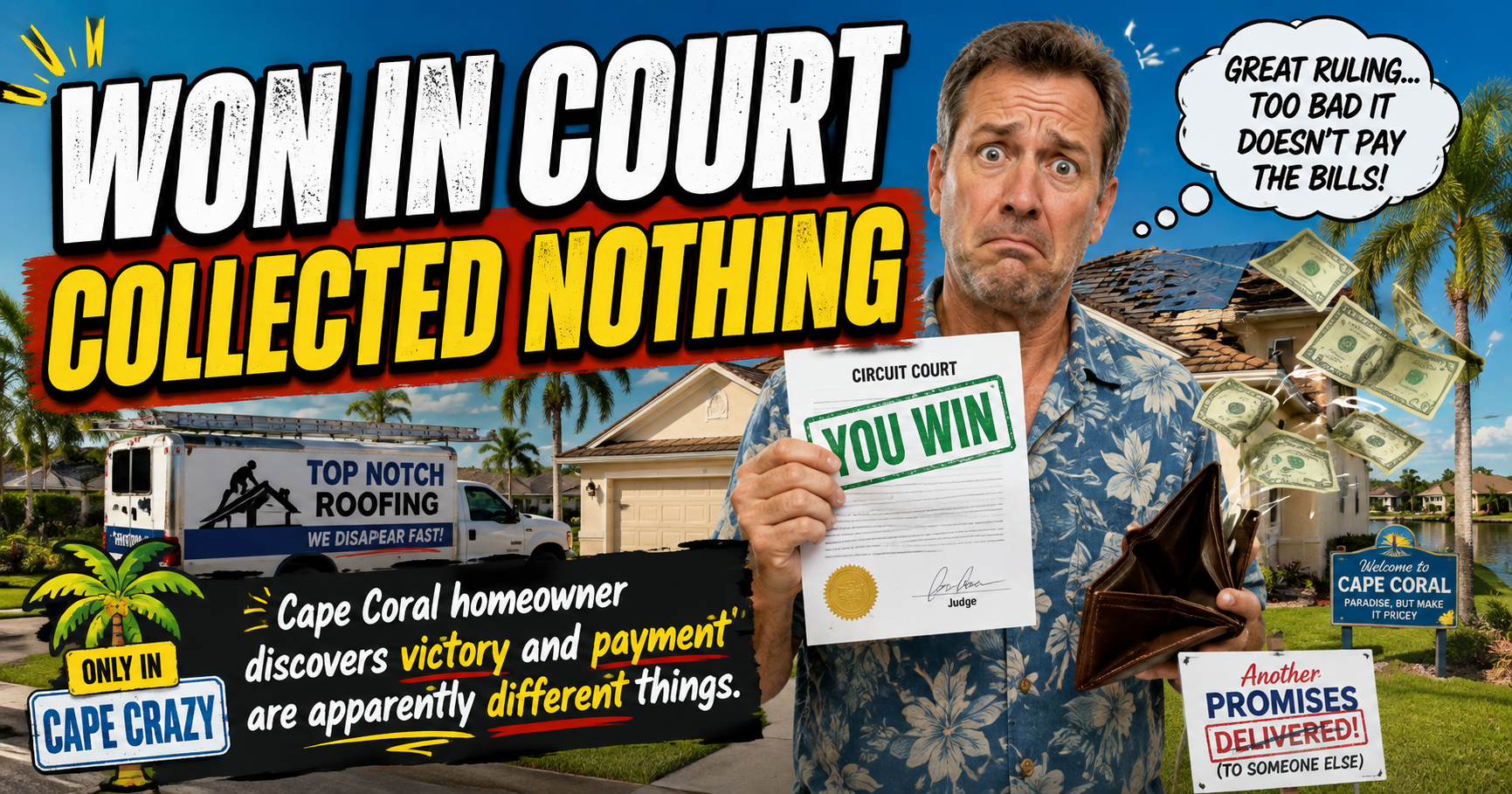
  • Cape Coral Homeowner Wins in Court Against Roofer — Collecting the Money Is Apparently the Bonus Round

    Cape Coral Homeowner Wins in Court Against Roofer — Collecting the Money Is Apparently the Bonus Round

    A Cape Coral homeowner took a roofing dispute to court and won.

    That sounds like the end of the story.

    It was not.

    WINK News reported that the homeowner obtained a court judgment against the roofer but still has not been able to collect the money owed.

    Which introduces an exciting feature of the civil justice system that many people do not discover until after they win:

    The judge can say you’re owed money.

    That does not necessarily mean somebody is standing outside the courtroom with a check.

    Congratulations. You Won.

    Imagine spending months dealing with a contractor dispute.

    Calls.

    Messages.

    Paperwork.

    Court filings.

    Hearings.

    Stress.

    Eventually, the judge rules in your favor.

    You walk out thinking:

    “Finally.”

    Then comes the next question.

    “So… where’s the money?”

    And apparently the answer can be:

    “That is now your problem.”

    WINK’s investigation highlights the frustrating gap between getting a judgment and actually collecting on it. A civil judgment establishes that money is owed, but enforcement can require additional steps if the losing party does not voluntarily pay.

    Translation:

    Court:

    “You win.”

    Homeowner:

    “Great. Can I have my money?”

    Court:

    “Whoa. We said you won. Let’s not get carried away.”

    A Judgment Is Not an ATM Receipt

    This is the part most normal people understandably find confusing.

    If a court says somebody owes you money, it seems reasonable to assume:

    They now have to give you the money.

    Legally, yes.

    Practically?

    Sometimes the person who won has to chase bank accounts, property, wages, liens or other assets before the judgment turns into actual dollars.

    That can mean more paperwork.

    More time.

    Potentially more legal costs.

    And considerably less enthusiasm about the phrase:

    “Justice prevailed.”

    General civil-judgment guidance explains that prevailing in court does not automatically cause payment to appear; a judgment creditor may still need to pursue collection methods such as bank levies, wage garnishment or liens when available. 

    So apparently there are two stages:

    Stage 1: Prove you were right.

    Stage 2: Good luck finding the money.

    Roofing Disputes Are Already Complicated Enough

    Southwest Florida homeowners have had no shortage of roofing problems in recent years.

    WINK News has repeatedly reported on local customers alleging that roofing companies took substantial payments while jobs remained unfinished, including earlier reports involving Cape Coral-area roofing operations and customers collectively claiming hundreds of thousands of dollars in unfinished work. 

    That context matters.

    A new roof is not a $200 appliance purchase.

    These jobs can involve tens of thousands of dollars, insurance claims, deposits and one of the most important systems protecting a Florida home.

    When something goes wrong, the financial consequences can be enormous.

    And apparently even after a homeowner successfully gets through court, the story still may not be over.

    The Most Expensive Piece of Paper in Cape Coral

    A court judgment is obviously valuable.

    It creates a legal obligation.

    It can potentially be used to pursue assets or other collection remedies.

    But if the debtor has no reachable assets, moved money, closed a business, declared bankruptcy or simply refuses to cooperate, collecting can become difficult.

    Which creates one of the strangest sentences imaginable:

    “I won the lawsuit, but I still lost the money.”

    There should probably be a warning label on the courthouse door:

    RESULTS MAY VARY. CASH NOT INCLUDED.

    Cape Crazy Translation

    Homeowner:

    “The roofer owes me money.”

    Roofer:

    “No.”

    Homeowner:

    “I’ll take you to court.”

    Court:

    “The homeowner wins.”

    Homeowner:

    “Excellent. Money please.”

    Roofer:

    “No.”

    Homeowner:

    “But the judge said—”

    System:

    “You appear to have confused a judgment with payment.”

    Homeowner:

    “So what did I win?”

    System:

    “A very official piece of paper.”

    The Serious Part

    This is genuinely frustrating for consumers.

    Going to court costs time and money, and most people reasonably believe that winning means the dispute has finally been resolved.

    But enforcement is a separate part of the civil process.

    That is one reason consumers should research contractors before handing over large deposits, verify licensing and insurance, read contracts carefully and understand what remedies may actually exist if the deal goes bad.

    It also illustrates why a contractor’s ability to pay can matter almost as much as whether you can prove your case.

    A judgment against someone with nothing collectible can be legally valid and financially disappointing at the same time.

    IS THIS CRAZY OR NOT?

    A Cape Coral homeowner goes to court against a roofer.

    Wins.

    Gets a judgment.

    And still can’t collect the money.

    Is that justice?

    Or did somebody forget to install the part of the system where the winner actually gets paid?

    Tap an icon to vote.


  • Four Mile Cove Preserve Closing for Repairs — Hurricane Damage Apparently Still Had a Punch List

    Four Mile Cove Preserve Closing for Repairs — Hurricane Damage Apparently Still Had a Punch List

    Cape Coral’s Four Mile Cove Ecological Preserve is about to become a little less accessible for a while.

    The City of Cape Coral says portions of the preserve will close from August 17 through September 30 so contractors can repair sections of boardwalk damaged by past hurricane-related storm surge. 

    And by “portions,” the city means quite a few of the parts people generally go there to use.

    The closure includes the:

    • boardwalk
    • piers
    • parking area
    • restrooms
    • visitor center
    • Veterans Memorial

    Park programs will also be postponed during the closure. 

    So if your Four Mile Cove plan was:

    “Park the car, use the restroom, walk the boardwalk, visit the pier, stop at the visitor center and see the memorial…”

    Cape Coral Parks & Recreation would currently like to suggest:

    “Perhaps kayaking?”

    The Good News: Not Everything Is Closing

    According to the City of Cape Coral, the kayak launch, docks and picnic area on Kayak Shack Road will remain open. 

    So the preserve is not completely shutting down.

    You just need to approach your outdoor recreation with a slightly more amphibious mindset.

    Walker:

    “Can I use the boardwalk?”

    City:

    “No.”

    Visitor:

    “The pier?”

    City:

    “No.”

    Visitor:

    “Visitor center?”

    City:

    “Also no.”

    Kayaker:

    “How about me?”

    City:

    “You’re good.”

    Somewhere, a kayak just became the VIP entrance.

    Hurricane Damage: The Gift That Keeps on Giving

    The city says the boardwalk was damaged by storm surge from past hurricanes, and contractors will use the closure to repair affected sections. 

    This is one of the strange realities of living in Southwest Florida.

    A hurricane blows through.

    The storm leaves.

    The weather improves.

    The cleanup begins.

    Then three years later someone says:

    “Oh yeah, we still need to fix that boardwalk.”

    Hurricanes apparently don’t just come with wind and rain.

    They come with a multiyear home-improvement list.

    Gulf Coast News Says the Same Thing: Most of the Land-Based Fun Is Taking a Break

    Gulf Coast News reported that the closure includes the preserve’s boardwalk, piers, parking, restrooms, visitor center and Veterans Memorial, while programs at the park will also be postponed. 

    That makes this less of a:

    “One little trail is closed.”

    and more of a:

    “Please enjoy this ecological preserve from the parts we haven’t surrounded with construction signs.”

    To be fair, repairing a damaged elevated boardwalk through mangroves is probably not the kind of project where you tell visitors:

    “Just step around the contractor.”

    Four Mile Cove Is Actually One of Cape Coral’s Better Nature Spots

    Four Mile Cove is one of the city’s significant preserved natural areas, known for its mangrove habitat, wildlife and elevated walking trail.

    That means repairing the boardwalk matters.

    The alternative is eventually reaching the point where your scenic nature walk includes:

    “Watch your step, this section survived a hurricane mostly through optimism.”

    A temporary closure is annoying.

    A surprise trip through a damaged boardwalk is considerably more annoying.

    Expected Reopening: September 30

    The city says all affected amenities are expected to reopen Wednesday, September 30. Signs will be posted to let visitors know about the temporary closure. 

    That gives the project roughly six weeks.

    Which means Cape Coral has officially created one of the most dangerous sentences in municipal government:

    “Expected to reopen…”

    We’re kidding.

    Mostly.

    Put September 30 on the calendar.

    Maybe use pencil.

    Cape Crazy Translation

    Hurricane:

    “I damaged the boardwalk.”

    Cape Coral:

    “We’ll fix it.”

    Hurricane:

    “When?”

    Cape Coral:

    “Eventually.”

    2026:

    “How about now?”

    Cape Coral:

    “Perfect.”

    Visitors & Snowbirds:

    “Can we still walk around?”

    Cape Coral:

    “Not really.”

    Visitors:

    “What can we do?”

    Cape Coral:

    “Do you own a kayak?”

    The Serious Part

    This is really a maintenance story more than a controversy.

    Four Mile Cove is an ecological preserve, and the boardwalk gives people access to sensitive mangrove habitat without having them tromping directly through it.

    If storm surge damaged portions of that structure, repairing it properly protects both visitors and the preserve.

    The inconvenience is temporary.

    The alternative — letting hurricane-damaged infrastructure continue deteriorating — would be considerably worse.

    So for once, Cape Crazy may have to admit:

    Closing something to repair hurricane damage is probably not crazy.

    The fact that Mother Nature can still be sending repair bills years later?

    That’s pretty Florida.

    IS THIS CRAZY OR NOT?

    Cape Coral is temporarily closing much of Four Mile Cove Preserve so crews can finally repair hurricane-damaged boardwalk sections.

    The kayak area stays open.

    Everything else?

    See you around September 30.

    Crazy?

    Or just another item on Southwest Florida’s never-ending hurricane repair list?

    Tap an icon to vote.

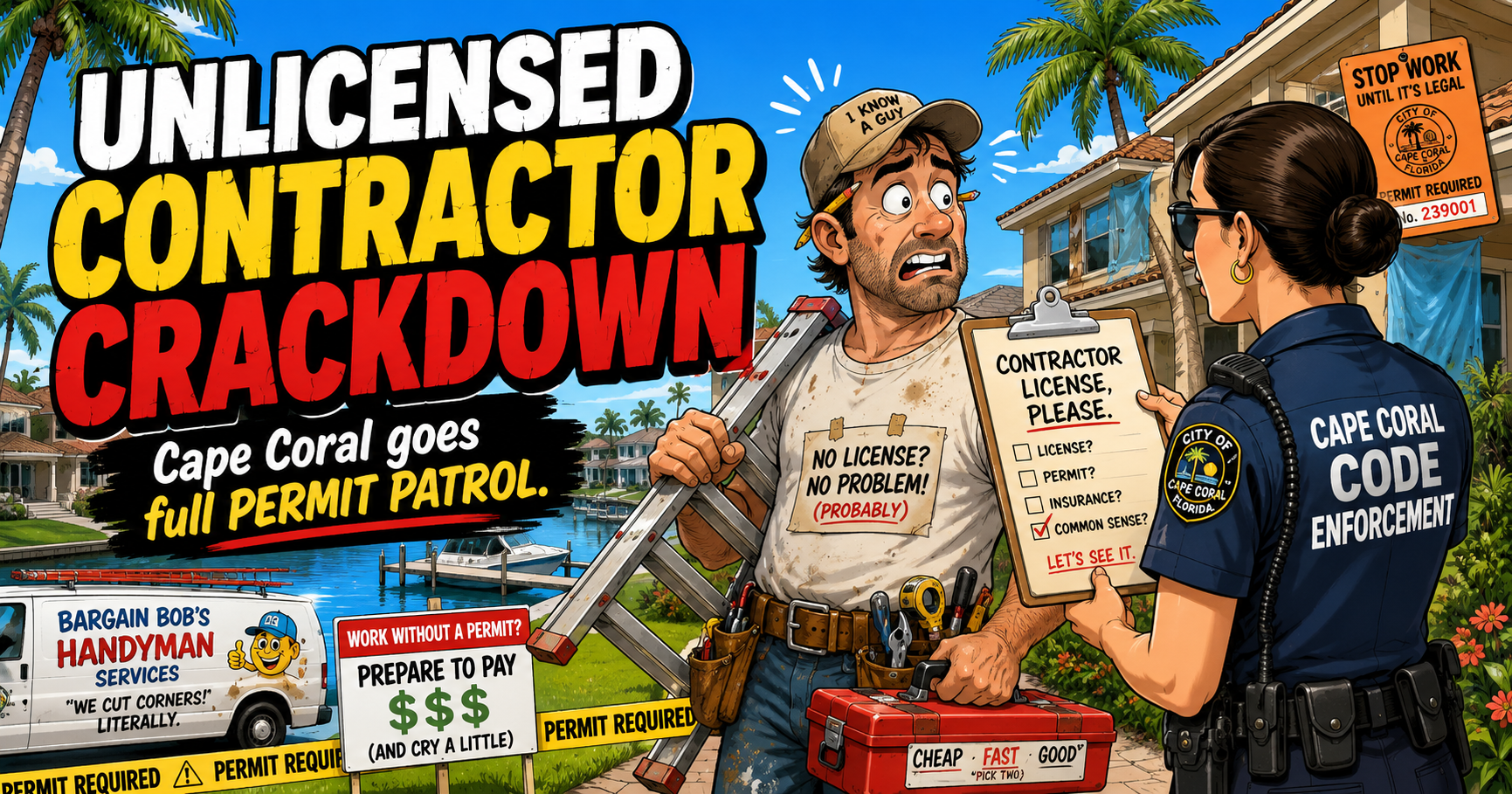
  • Cape Coral Plans Crackdown on Unlicensed Contractors — Because Apparently the Cheap Guy With a Ladder Has Had a Good Run

    Cape Coral Plans Crackdown on Unlicensed Contractors — Because Apparently the Cheap Guy With a Ladder Has Had a Good Run

    Cape Coral is preparing to get a little less friendly toward the guy who says:

    “Yeah, I can do that electrical work. My cousin has a permit somewhere.”

    The Cape Coral Breeze reports that City Council introduced Ordinance 49-26, a proposal aimed at cracking down on unlicensed contracting through code enforcement, civil citations, fines, and even sting operations. 

    In other words:

    Cape Coral has officially entered its “Show me your license” era.

    The Fines Could Get Expensive

    According to the Cape Coral Breeze, the proposed ordinance would allow a code enforcement officer to assess civil penalties of up to $2,000. A special magistrate could impose a penalty of up to $2,500 per violation. 

    That escalates quickly.

    Unlicensed contractor:

    “I can save you $800 on that job.”

    Cape Coral:

    “Excellent. We may have a $2,500 counteroffer.”

    The city defines an unlicensed contractor as someone who does not have the proper State of Florida license required for the type of work being performed. 

    Which means the classic:

    “I’ve been doing this for 20 years.”

    may soon be followed by:

    “That’s nice. Do you have a license?”

    And Yes, There May Be Stings

    The Breeze reports that City Manager Michael Ilczyszyn told council the city expects enforcement to begin reactively, with licensed contractors providing names of people they believe are doing unlicensed work. 

    Eventually, enforcement could become more proactive.

    That includes:

    stings

    and

    just driving around looking for suspicious activity.

    So somewhere in Cape Coral, there may eventually be an undercover operation that sounds like this:

    City employee:

    “Hi, I need my kitchen rewired.”

    Guy from Facebook Marketplace:

    “Sure. Cash only.”

    City employee:

    “Great. One more question.”

    “Can I see your license?”

    Guy:

    “…this feels like a trap.”

    Licensed Contractors May Become Informants

    This might be the most interesting part.

    Ilczyszyn said licensed contractors already know who is doing unlicensed work and that the city expects those names to provide the initial wave of cases. 

    Which means Cape Coral’s construction industry could soon have its own version of neighborhood watch.

    See something. Say something.

    Except instead of suspicious packages, it’s:

    “That guy is installing an electrical panel and I know damn well he isn’t licensed.”

    To be fair, licensed contractors pay for licenses, insurance, training, permits, and regulatory compliance.

    So watching somebody undercut them while skipping all of that probably does not inspire tremendous sympathy.

    Everybody Gets a $5 Souvenir

    To help pay for the enforcement effort, the proposed ordinance would add a $5 surcharge to permits, according to the Breeze. 

    So even the people doing everything correctly get to participate.

    Homeowner:

    “I hired a licensed contractor.”

    City:

    “Excellent.”

    Homeowner:

    “Pulled the proper permit.”

    City:

    “Wonderful.”

    Homeowner:

    “So I’m good?”

    City:

    “Almost. Five dollars, please.”

    Nothing says “thank you for following the rules” quite like an additional fee.

    Will Five Dollars Stop Unlicensed Contracting?

    Councilmember Rachel Kaduk raised a pretty reasonable question.

    The Breeze reports that Kaduk questioned whether a $5 surcharge would actually stop unlicensed work and emphasized that public education also needs to be part of the solution. 

    She also pointed out something painfully realistic:

    People will still hire the cheapest person.

    And therein lies the entire problem.

    Homeowner:

    Licensed contractor: $8,000

    Guy named Rick from Facebook: $3,200 and a case of beer

    Homeowner:

    “Rick seems experienced.”

    City Manager Ilczyszyn told council that enforcement and education need to work together, particularly because some unlicensed contractors prey on people who do not understand the risks. 

    That part is hard to argue with.

    Because Cheap Can Get Expensive Fast

    There is a serious reason for contractor licensing.

    Electrical work.

    Roofing.

    Plumbing.

    Structural work.

    HVAC.

    These are not exactly ideal places for:

    “I watched a YouTube video.”

    Hiring an unlicensed contractor can create problems involving safety, permits, inspections, insurance, warranties, and ultimately the homeowner’s wallet.

    A bad paint job is annoying.

    A bad electrical panel can burn your house down.

    There is a difference.

    So despite all the jokes, the city’s basic goal makes sense.

    The City Says This Will Cost About $150,000

    The Cape Coral Breeze reports that the city estimates the regulatory cost of the proposed program at about $150,000, with revenues expected to offset those costs. The city also estimated about 30,000 building permits could potentially be affected. 

    That is a significant number of permits.

    And a lot of opportunities for someone to ask:

    “Wait. Who exactly is doing this work?”

    The public hearing for Ordinance 49-26 is scheduled for Aug. 19. 

    So this is not final yet.

    Cape Coral residents still have time to weigh in before the city officially unleashes:

    Code Enforcement: Contractor Edition.

    Cape Crazy Translation

    City:

    “Unlicensed contractors are doing work.”

    Licensed contractors:

    “We know who they are.”

    City:

    “Give us the names.”

    Licensed contractors:

    “Gladly.”

    City:

    “Then we’ll do stings.”

    Unlicensed contractor:

    “Wait, what?”

    City:

    “Also fines up to $2,500.”

    Homeowner:

    “But he was cheaper.”

    City:

    “That may be why.”

    The Serious Part

    This one is funny on the surface, but there is a real consumer-protection issue behind it.

    People hire unlicensed contractors because the price is attractive, because they don’t know licensing requirements, or because they assume experience is enough.

    Sometimes it works out fine.

    Sometimes it really does not.

    If Cape Coral can target people performing work that legally requires licensing while also educating homeowners about how to verify contractors, the program could prevent expensive and potentially dangerous situations.

    The question is whether the new enforcement structure is effective enough to justify the additional bureaucracy and permit surcharge.

    IS THIS CRAZY OR NOT?

    Cape Coral wants to fight unlicensed contracting with code enforcement officers, fines up to $2,500, contractor tips, sting operations, and a new $5 permit surcharge.

    Is that smart consumer protection?

    Or are we about to get Cape Coral: Undercover Contractor Unit?

    Tap an icon to vote.

    Sources

    Cape Coral Breeze
    Reported the introduction of Ordinance 49-26, proposed fines, code-enforcement authority, contractor referrals, possible sting operations, the $5 permit surcharge, estimated regulatory costs, and the Aug. 19 public hearing.
    https://www.capecoralbreeze.com/news/local-news/2026/08/06/city-gears-up-for-unlicensed-contractor-crackdown/

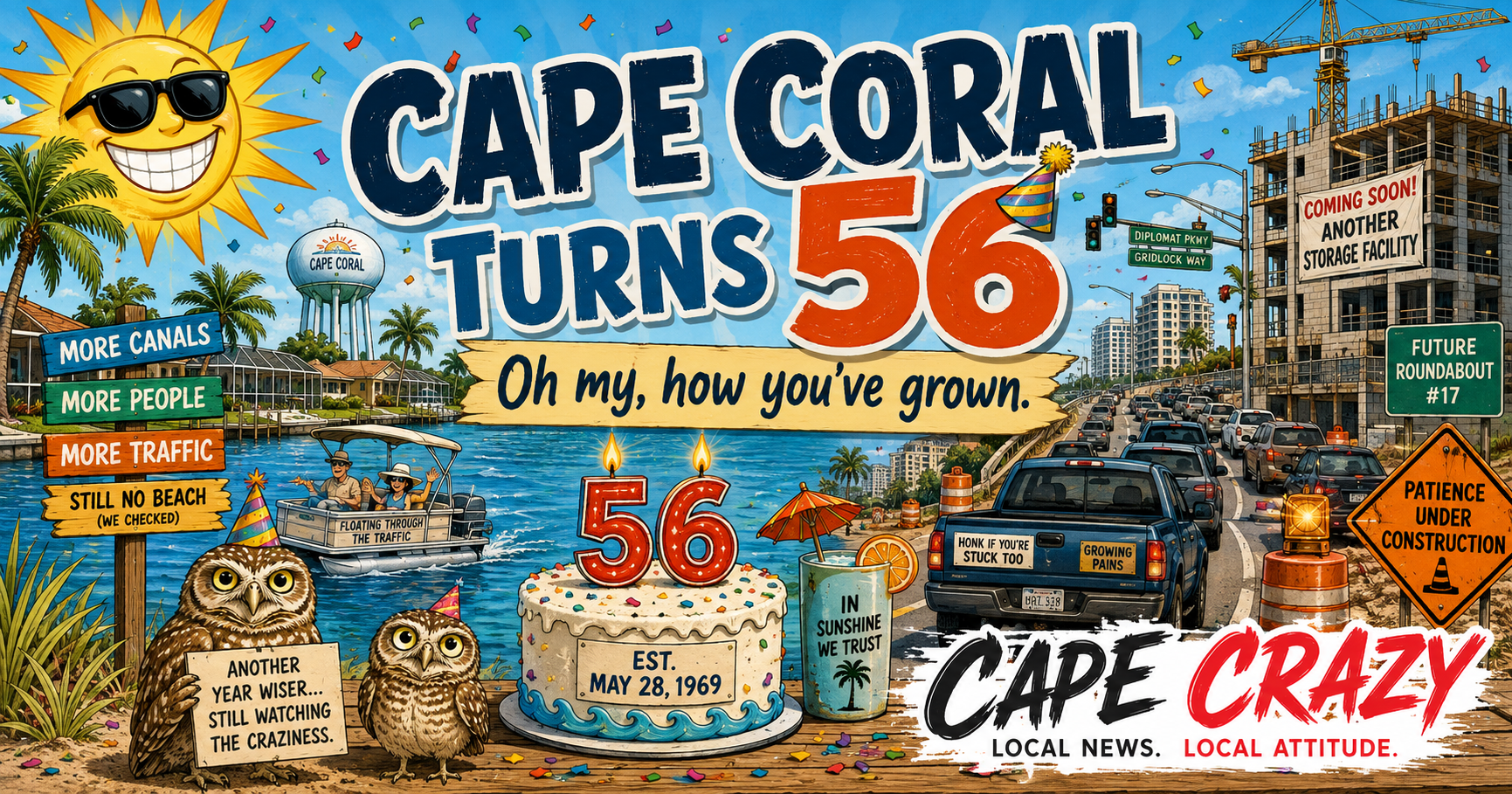
  • Cape Coral Turns 56 — And Apparently Nobody Told It to Stop Growing

    Cape Coral Turns 56 — And Apparently Nobody Told It to Stop Growing

    Happy birthday, Cape Coral.

    On August 18, 2026, Cape Coral officially turns 56 years old.

    According to the Cape Coral Museum of History, the city incorporated in 1970 with a population of just 10,193 people.

    Today?

    The U.S. Census Bureau estimates Cape Coral’s population at more than 236,000 residents.

    So in a little over half a century, Cape Coral went from:

    “Hey, maybe we should become a city.”

    to:

    “Why is everyone in Lee County on Pine Island Road at exactly the same time?”

    Happy 56th, Cape.

    You’ve grown.

    A lot.

    It Started With Two Brothers and a Very Large Florida Real-Estate Idea

    According to the Cape Coral Museum of History, modern Cape Coral traces its beginnings to brothers Jack and Leonard Rosen, who purchased land around Redfish Point during the 1950s.

    Their company eventually became Gulf American Land Corporation, and in 1958 the first Cape Coral sales office opened.

    The sales pitch was pretty attractive:

    Florida sunshine.

    Affordable land.

    Waterfront living.

    Palm trees.

    Canals.

    And presumably absolutely no discussion about what homeowners insurance might cost 68 years later.

    The Rosens marketed the community aggressively throughout the United States, helping transform what had been largely undeveloped Southwest Florida land into one of the country’s largest planned residential communities.

    Then Somebody Dug a Few Canals

    By “a few,” we mean a lot.

    The Cape Coral Museum of History documents how developers dredged enormous amounts of earth to create canals, lakes, yacht basins and waterfront lots throughout the city.

    Those waterways eventually became one of Cape Coral’s defining features and helped earn it the nickname:

    The Waterfront Wonderland.

    Today, asking a Cape Coral resident whether they live near a canal is somewhat like asking a Floridian whether they’ve ever seen a palm tree.

    Odds are pretty good.

    Then Cape Coral Decided It Needed to Become an Actual City

    By the late 1960s, residents were increasingly concerned about local services, government representation and the relationship between the community, Lee County and Gulf American Corporation.

    According to the Cape Coral Museum of History, residents eventually voted on whether Cape Coral should incorporate.

    The final vote:

    2,067 in favor
    1,798 against

    Not exactly unanimous.

    Which means Cape Coral officially began with one of its most enduring traditions:

    Residents passionately disagreeing about local government.

    Some things apparently come with the deed.

    Cape Coral officially became a city in August 1970.

    From About 10,000 People to More Than 236,000

    This may be the craziest number in the entire story.

    Cape Coral had roughly 10,193 residents when it incorporated.

    According to the U.S. Census Bureau, the city’s estimated population had reached 236,264 by July 1, 2025.

    That’s more than 23 times the population Cape Coral had when it became a city.

    Which explains several things.

    Traffic.

    Construction.

    Schools.

    Utilities.

    Hospitals.

    More construction.

    More traffic.

    And the occasional suspicion that everyone north of the Florida state line received the same brochure.

    Cape Coral’s population has also continued growing rapidly in recent years. The Census Bureau estimates the city grew more than 20% from its 2020 population base to 2025.

    Apparently Cape Coral never received the memo about middle-age slowing you down.

    Building a City After Selling the Lots

    Cape Coral’s unusual history created some long-term challenges.

    The Cape Coral Museum of History explains that enormous numbers of residential lots were platted and sold before much of the infrastructure associated with a mature city existed.

    Which essentially left future generations with:

    “Congratulations! Here’s your city.”

    City officials:

    “Where are the utilities?”

    Developers:

    “About that…”

    That history still echoes through Cape Coral today.

    Utility expansion.

    Road construction.

    Drainage.

    Schools.

    Public safety.

    Healthcare.

    As the population grows, the infrastructure has to keep chasing it.

    And sometimes it feels like the population has a pretty good head start.

    The City Is Still Growing

    Growth remains one of Cape Coral’s defining characteristics.

    New subdivisions continue appearing.

    Commercial development keeps expanding along corridors such as Pine Island Road.

    Healthcare capacity is increasing.

    Infrastructure projects continue moving into previously undeveloped parts of the city.

    And every vacant lot eventually seems to receive the same message:

    “Enjoy the grass while it lasts.”

    For longtime residents, the difference between Cape Coral decades ago and Cape Coral today can be enormous.

    What was once a relatively small waterfront community has become one of Florida’s larger cities.

    The Owls Have Been Along for the Ride

    Of course, humans aren’t the only residents.

    Cape Coral has become famous for its burrowing owls, which are so closely associated with the city that they’ve basically achieved celebrity status.

    The recent 2026 Cape Coral Burrowing Owl Census counted 7,828 owls across the city.

    So while Cape Coral celebrates 56 years, several thousand tiny residents are presumably observing the festivities from their front yards.

    They declined our request for comment.

    Mostly because they’re owls.

    The Museum Is Celebrating Too

    The Cape Coral Breeze reported that the Cape Coral Museum of History hosted a free open house on August 15 to celebrate the city’s 56th anniversary.

    That’s probably a good place to remember just how quickly Cape Coral changed.

    The canals.

    The Rosens.

    The early homes.

    The incorporation fight.

    The population boom.

    The hurricanes.

    The construction.

    The seemingly permanent road projects.

    All of it happened in just 56 years.

    In city terms, Cape Coral is still relatively young.

    In Florida-development years, apparently that means we’re already renovating everything.

    Cape Crazy Translation

    1950s:

    “Let’s build a waterfront community.”

    1970:

    “Let’s become a city.”

    Population:

    10,193

    2025:

    236,264

    Cape Coral:

    “Maybe we should build some infrastructure.”

    Residents:

    “YES.”

    Cape Coral:

    “Another hospital?”

    Residents:

    “YES.”

    Cape Coral:

    “More roads?”

    Residents:

    “YES.”

    Cape Coral:

    “How about 807 new speed-limit signs?”

    Residents:

    “WAIT. WHAT?”

    Happy birthday, Cape Coral.

    Never change.

    Actually…

    Maybe change a couple things.

    The Serious Part

    It is easy to make jokes about Cape Coral.

    Obviously.

    We built an entire website around the concept.

    But the city’s growth is also pretty remarkable.

    In 56 years, Cape Coral went from a relatively small planned community to a city of more than 236,000 people.

    Families have grown up here.

    Businesses have been built here.

    People have retired here.

    Others have moved here looking for a better life.

    And plenty of people who moved here five years ago now complain about all the new people moving here.

    That may actually be the final step in becoming a true Cape Coral resident.

    IS THIS CRAZY OR NOT?

    Cape Coral went from roughly 10,000 residents in 1970 to more than 236,000 today, while somehow maintaining hundreds of miles of canals, thousands of burrowing owls and an apparently unlimited supply of stories for this website.

    So here’s the birthday question:

    Is Cape Coral crazy?

    Or is that exactly why we love living here?

    Tap an icon to vote.

    Sources

    The News-Press
    Cape Coral turns 56 on Aug. 18. Oh my, how you’ve grown
    https://www.news-press.com/story/life/2026/08/16/cape-coral-turns-56-on-aug-18-oh-my-how-youve-grown/91095999007/

    Cape Coral Museum of History
    Historical information about Cape Coral’s development, the Rosen brothers, Gulf American Land Corporation, incorporation and the city’s early population.
    https://capecoralmuseum.org/history-of-cape-coral/

    U.S. Census Bureau
    Current population estimates and demographic information for Cape Coral, Florida.
    https://www.census.gov/quickfacts/fact/table/capecoralcityflorida/PST045225

    Cape Coral Breeze
    Coverage of the Cape Coral Museum of History’s 2026 celebration of the city’s 56th anniversary.
    https://www.capecoralbreeze.com/news/local-news/2026/08/13/cape-coral-museum-of-history-to-host-open-house-this-saturday-to-celebrate-capes-56th-anniversary/

  • BaconFest Returns to South Cape — Because Apparently Bacon Needed a Pub Crawl

    BaconFest Returns to South Cape — Because Apparently Bacon Needed a Pub Crawl

    Cape Coral has a lot of traditions.

    Some involve boats.

    Some involve owls.

    Some involve traffic.

    And some involve hundreds of adults wandering through South Cape dressed like bacon while sampling drinks and appetizers at 13 different locations.

    The South Cape Hospitality & Entertainment Association’s BaconFest Pub Crawl returns Saturday, Aug. 22, for its 12th year, running from 7 to 11 p.m. in the South Cape entertainment district. 

    Yes.

    Twelve years.

    At this point, BaconFest is not an event.

    It is an institution.

    Four Hours. Thirteen Stops. Bacon Everywhere.

    This year’s crawl includes 13 participating locations, each offering a bacon-themed appetizer and drink sample. Attendees also get to vote for their favorite food and drink creations, because apparently bacon needed a competitive judging component too. 

    The participating locations include:

    • Rack’em Spirits & Times
    • Hooked Island Grill
    • Seed and Bean Market
    • Ralph’s Place
    • Nevermind
    • Rusty’s Raw Bar & Grill
    • Dixie Roadhouse
    • Sage on 47th
    • The Dive
    • Monkey Bar
    • Cruiser’s
    • Dek Bar
    • Dolphin Key Tiki 

    That is a lot of bacon-related decision-making for one evening.

    There will be sweet bacon.

    Savory bacon.

    Possibly bacon in forms that should never have been approved by a responsible adult.

    And somewhere around stop nine, somebody will almost certainly say:

    “You know what this drink really needs? More bacon.”

    Limo Buses Are Involved, Which Is Probably Wise

    SCHEA is using limo buses to transport participants between four strategic areas, allowing people to walk between nearby establishments once they are dropped off. 

    This is one of those logistical decisions that makes complete sense.

    Because when your event description includes the words:

    pub crawl

    13 locations

    and

    four hours

    the phrase “everyone drives themselves” should probably not appear anywhere in the planning document.

    The Cost of Bacon-Based Happiness

    Advance tickets are $25 plus fees, while day-of tickets are $30 if available. Designated-driver tickets are $20. 

    A regular ticket includes:

    • a drink sample at each stop;
    • an appetizer sample at each stop;
    • access to the limo buses;
    • a location passport;
    • eligibility for prizes; and
    • access to the official photo booth. 

    Designated drivers receive food samples and non-alcoholic drink samples.

    Which means SCHEA has apparently found one of the few circumstances where saying:

    “I’m only here for the bacon.”

    is an entirely responsible life choice.

    There Is Also a Passport

    Participants can have their passport stamped at each location and enter to win a grand prize. The official photo booth at Dolphin Key Resort also offers a chance to win four tickets to the Spooktacular Pub Crawl on Oct. 24. 

    So technically, BaconFest can lead directly to another pub crawl.

    This is how ecosystems work.

    Costumes Are Encouraged

    Organizers are encouraging attendees to show up wearing their finest bacon- or pig-themed clothing.

    Bacon shirts.

    Bacon hats.

    Pig noses.

    Bacon suits.

    Whatever your closet has apparently been waiting its entire life for. 

    SCHEA says one of the fun parts of the event is seeing people fully embrace the theme, and after 12 years, there is apparently a dedicated population of Cape Coral residents who own enough pork-related clothing to make that possible. 

    There is something reassuring about living in a city where someone can ask:

    “Is the bacon suit too much?”

    and the answer is:

    “Not for this.”

    Check-In Details

    Regular check-in runs from 6 to 7:30 p.m. at Big John’s Plaza and Dolphin Key Resort.

    Late check-in continues until 10 p.m. at Dolphin Key Resort, 1502 Miramar St. 

    The event is 21 and older, and attendees need a valid photo ID at check-in. 

    The Eventbrite listing also confirms the Aug. 22 event date and 7–11 p.m. schedule. 

    It’s Actually Helping a Good Cause

    Underneath all the bacon jokes, there is a worthwhile piece to this.

    BaconFest is also a fundraiser for the Santa Life Foundation, so proceeds help support families and holiday assistance in the community. 

    That means you can theoretically eat bacon, ride around South Cape, wear a pig nose and still claim:

    “I’m doing this for charity.”

    And for once, that statement may actually be accurate.

    The Serious Part

    Events like this are also good for South Cape businesses.

    SCHEA describes itself as a nonprofit merchants association that promotes restaurants, bars, shops and entertainment venues throughout South Cape and organizes events intended to bring residents and visitors into the district. 

    BaconFest gets people moving between local establishments, introduces customers to places they may not have visited before and gives businesses a chance to compete creatively with themed food and drinks. 

    So beneath the obvious absurdity of adults wearing bacon costumes on limo buses, there is a legitimate local-business benefit.

    But fortunately, the absurdity remains.

    Cape Crazy Translation

    SCHEA:

    “We should organize an event to support South Cape businesses.”

    Someone:

    “Great. What theme?”

    SCHEA:

    “Bacon.”

    Someone:

    “Okay.”

    SCHEA:

    “Thirteen bars.”

    Someone:

    “Sure.”

    SCHEA:

    “Limo buses.”

    Someone:

    “Makes sense.”

    SCHEA:

    “Pig costumes.”

    Cape Coral:

    “Now you’re speaking our language.”

    IS THIS CRAZY OR NOT?

    A four-hour pub crawl featuring 13 locations, bacon-themed food and drinks, limo buses and adults encouraged to dress like pigs.

    Is this crazy?

    Or has Cape Coral finally achieved perfection?

    Tap an icon to vote.

    Sources

    Cape Coral Breeze
    Reported the Aug. 22 BaconFest details, including 13 participating venues, ticket pricing, samples, transportation, check-in locations, costume contest elements and the Santa Life Foundation fundraiser. 

    Eventbrite
    Official event listing confirms South Cape’s BaconFest Pub Crawl 2026 for Saturday, Aug. 22, from 7 to 11 p.m. 

    South Cape Hospitality & Entertainment Association
    SCHEA’s official site describes the organization as a Cape Coral nonprofit merchants association that hosts events and promotes South Cape restaurants, bars, retail and entertainment businesses.

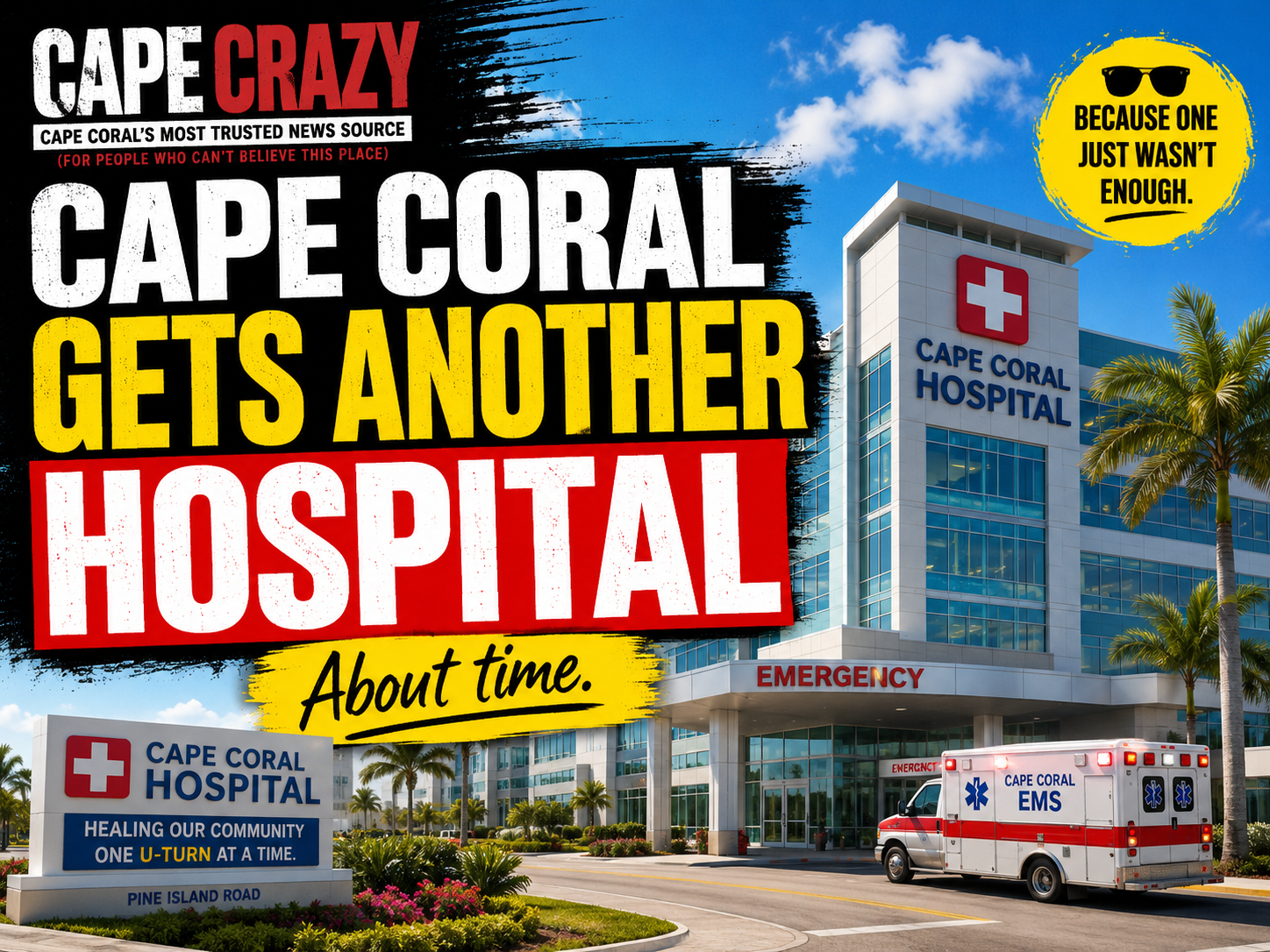
  • Cape Coral Is Getting a Second Hospital — Yes, an Actual Hospital

    Cape Coral Is Getting a Second Hospital — Yes, an Actual Hospital

    Cape Coral is about to get something residents have been asking for for years:

    another full-service hospital.

    HCA Florida Healthcare and the City of Cape Coral announced plans for HCA Florida Cape Coral Hospital, a new hospital to be built at 322 SW Pine Island Road, where HCA Florida Cape Coral Emergency currently operates. 

    The project represents an estimated $300 million investment and is expected to include about 200,000 square feet, three stories, and up to 100 acute-care beds in its first phase. Construction is expected to begin in 2027, with an anticipated opening in 2029. 

    Which means Cape Coral residents can finally say:

    “We’re getting another hospital.”

    And not immediately follow it with:

    “Eventually. Maybe. Somewhere.”

    This Is More Than an Emergency Room

    The existing HCA facility on Pine Island Road is a freestanding emergency room.

    The new project would expand that site into a full hospital offering inpatient and outpatient care, emergency services, operating rooms, cardiovascular services, imaging, and a cardiac catheterization lab. 

    So this is not:

    “We added three more exam rooms and called it a hospital.”

    This is planned to be an actual acute-care hospital.

    The first phase is expected to include up to 100 beds, with room to expand later as Cape Coral continues to grow. 

    Cape Coral Has Been Growing Faster Than Its Healthcare Options

    Cape Coral’s population and development have expanded significantly, but hospital access has not exactly kept pace.

    The city currently relies heavily on Cape Coral Hospital and facilities across the river in Fort Myers for a lot of acute and specialized care.

    The new HCA hospital is intended to give residents another option closer to home and reduce some of that dependence on crossing bridges for care. The city specifically cited improved access to emergency and acute-care services as one of the reasons for supporting the project. 

    Anyone who has ever tried getting across the river during rush hour while dealing with a medical problem may appreciate the concept of:

    “Maybe the hospital could just be on this side.”

    The Mayor Has Been Pushing for This

    Cape Coral Mayor John Gunter said bringing a second hospital to the city has been one of his priorities.

    He described the project as a way to expand healthcare access while also creating jobs and economic-development opportunities. 

    According to Business Observer, the hospital is expected to employ roughly 330 to 350 full-time workers once complete. 

    So this is not just a healthcare project.

    It is also a fairly significant economic-development project for the city.

    $300 Million Is a Pretty Serious Commitment

    HCA’s estimated investment is about $300 million. 

    That is a lot of money.

    By Cape Crazy standards, that is approximately:

    • 5,000 extremely expensive dumpsters
    • several million new speed-limit signs
    • or enough money to buy every burrowing owl in Cape Coral a very respectable starter home

    Possibly with granite countertops.

    The hospital would become the 19th hospital in HCA Healthcare’s West Florida Division once completed. 

    The Timeline

    The announced schedule is:

    2027: Construction expected to begin
    2029: Hospital expected to open 

    That means we’re still a few years away from seeing patients admitted there.

    And, because this is Cape Coral construction, everyone may want to bookmark this article and check back in 2029.

    No reason.

    Just experience.

    Cape Crazy Translation

    Cape Coral:

    “We have a lot more people now.”

    Residents:

    “Yes.”

    Cape Coral:

    “Maybe we should have another hospital.”

    Residents:

    “That would be helpful.”

    HCA:

    “We’ll build one.”

    Cape Coral:

    “Wait… seriously?”

    HCA:

    “$300 million. Up to 100 beds.”

    Residents:

    “Well, that was unexpectedly reasonable.”

    For once, this may be one of those stories where the Crazy vote should probably lean toward:

    Not Crazy.

    The Serious Part

    More hospital capacity in Cape Coral could be a major benefit.

    Additional emergency capacity, inpatient beds, surgical services, cardiovascular services and imaging can mean shorter travel times and more choices for patients.

    That matters in a city this large and this fast-growing.

    The project also creates competition in the local healthcare market, which can be beneficial if it leads to more access, more services and better options for patients.

    There will obviously be questions as the project develops — traffic, infrastructure, staffing and exactly which services are available when the hospital opens.

    But as announcements go, this one looks like a pretty substantial win for Cape Coral.

    IS THIS CRAZY OR NOT?

    Cape Coral is getting a $300 million second hospital with up to 100 beds on Pine Island Road.

    Is this one of the rare cases where Cape Coral is doing something that makes complete sense?

    Tap an icon to vote.

    Sources

    City of Cape Coral
    Announced the HCA Florida Cape Coral Hospital project, location, planned services, construction timeline and expected 2029 opening. 

    HCA Florida Healthcare
    Announced the planned $300 million hospital expansion at the existing Cape Coral Emergency site. 

    Business Observer
    Reported additional project details, including approximately 200,000 square feet, up to 100 beds and an expected workforce of roughly 330–350 employees.