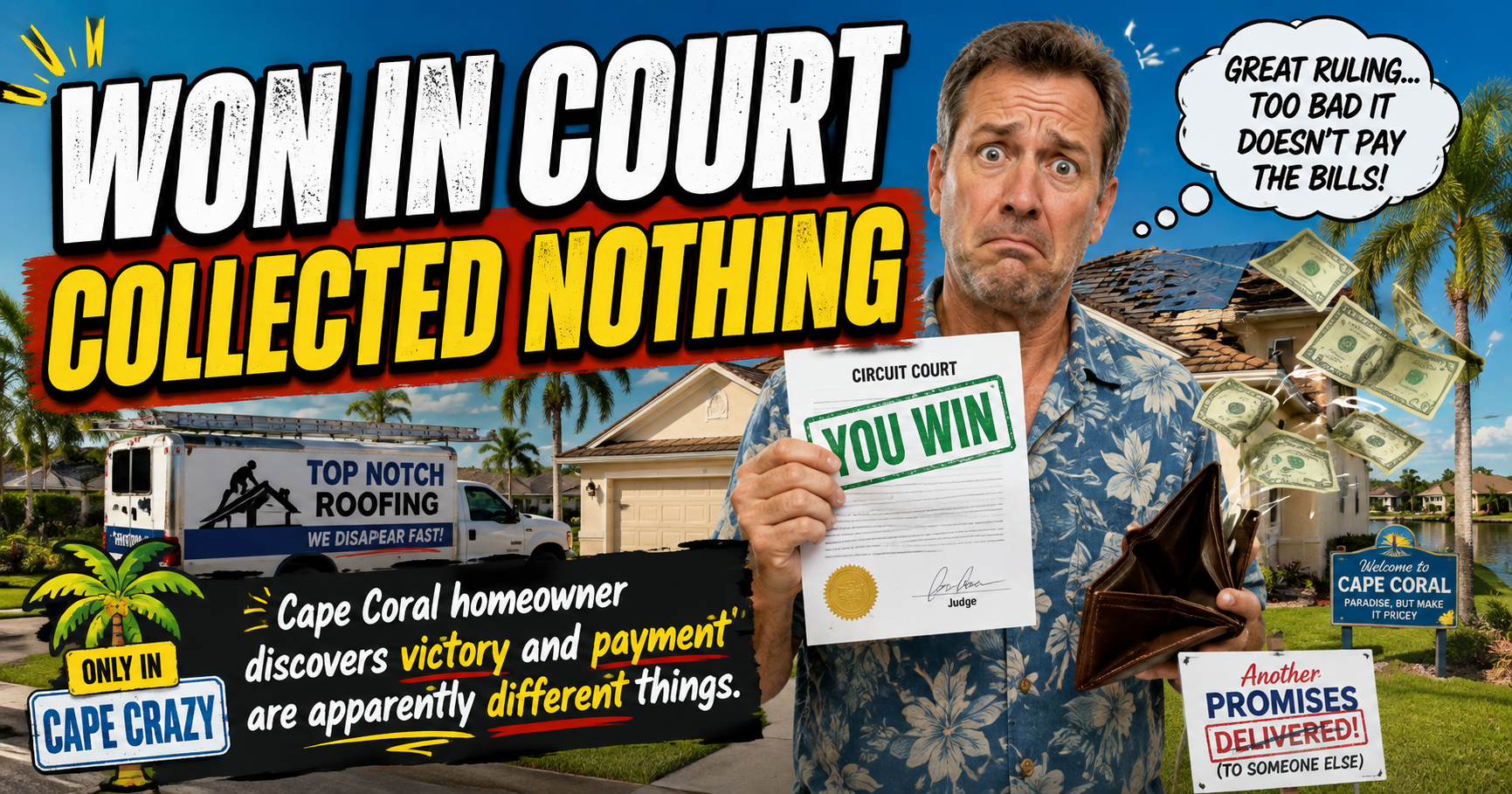



A Cape Coral homeowner took a roofing dispute to court and won.
That sounds like the end of the story.
It was not.
WINK News reported that the homeowner obtained a court judgment against the roofer but still has not been able to collect the money owed.
Which introduces an exciting feature of the civil justice system that many people do not discover until after they win:
The judge can say you’re owed money.
That does not necessarily mean somebody is standing outside the courtroom with a check.
Congratulations. You Won.
Imagine spending months dealing with a contractor dispute.
Calls.
Messages.
Paperwork.
Court filings.
Hearings.
Stress.
Eventually, the judge rules in your favor.
You walk out thinking:
“Finally.”
Then comes the next question.
“So… where’s the money?”
And apparently the answer can be:
“That is now your problem.”
WINK’s investigation highlights the frustrating gap between getting a judgment and actually collecting on it. A civil judgment establishes that money is owed, but enforcement can require additional steps if the losing party does not voluntarily pay.
Translation:
Court:
“You win.”
Homeowner:
“Great. Can I have my money?”
Court:
“Whoa. We said you won. Let’s not get carried away.”
A Judgment Is Not an ATM Receipt
This is the part most normal people understandably find confusing.
If a court says somebody owes you money, it seems reasonable to assume:
They now have to give you the money.
Legally, yes.
Practically?
Sometimes the person who won has to chase bank accounts, property, wages, liens or other assets before the judgment turns into actual dollars.
That can mean more paperwork.
More time.
Potentially more legal costs.
And considerably less enthusiasm about the phrase:
“Justice prevailed.”
General civil-judgment guidance explains that prevailing in court does not automatically cause payment to appear; a judgment creditor may still need to pursue collection methods such as bank levies, wage garnishment or liens when available.
So apparently there are two stages:
Stage 1: Prove you were right.
Stage 2: Good luck finding the money.
Roofing Disputes Are Already Complicated Enough
Southwest Florida homeowners have had no shortage of roofing problems in recent years.
WINK News has repeatedly reported on local customers alleging that roofing companies took substantial payments while jobs remained unfinished, including earlier reports involving Cape Coral-area roofing operations and customers collectively claiming hundreds of thousands of dollars in unfinished work.
That context matters.
A new roof is not a $200 appliance purchase.
These jobs can involve tens of thousands of dollars, insurance claims, deposits and one of the most important systems protecting a Florida home.
When something goes wrong, the financial consequences can be enormous.
And apparently even after a homeowner successfully gets through court, the story still may not be over.
The Most Expensive Piece of Paper in Cape Coral
A court judgment is obviously valuable.
It creates a legal obligation.
It can potentially be used to pursue assets or other collection remedies.
But if the debtor has no reachable assets, moved money, closed a business, declared bankruptcy or simply refuses to cooperate, collecting can become difficult.
Which creates one of the strangest sentences imaginable:
“I won the lawsuit, but I still lost the money.”
There should probably be a warning label on the courthouse door:
RESULTS MAY VARY. CASH NOT INCLUDED.
Cape Crazy Translation
Homeowner:
“The roofer owes me money.”
Roofer:
“No.”
Homeowner:
“I’ll take you to court.”
Court:
“The homeowner wins.”
Homeowner:
“Excellent. Money please.”
Roofer:
“No.”
Homeowner:
“But the judge said—”
System:
“You appear to have confused a judgment with payment.”
Homeowner:
“So what did I win?”
System:
“A very official piece of paper.”
The Serious Part
This is genuinely frustrating for consumers.
Going to court costs time and money, and most people reasonably believe that winning means the dispute has finally been resolved.
But enforcement is a separate part of the civil process.
That is one reason consumers should research contractors before handing over large deposits, verify licensing and insurance, read contracts carefully and understand what remedies may actually exist if the deal goes bad.
It also illustrates why a contractor’s ability to pay can matter almost as much as whether you can prove your case.
A judgment against someone with nothing collectible can be legally valid and financially disappointing at the same time.
IS THIS CRAZY OR NOT?
A Cape Coral homeowner goes to court against a roofer.
Wins.
Gets a judgment.
And still can’t collect the money.
Is that justice?
Or did somebody forget to install the part of the system where the winner actually gets paid?
Tap an icon to vote.
Leave a Reply