Author: Cape Crazy

  • Cape Coral Lowers Florida’s Largest Flag for Dolly Parton—Because a Regular Tribute Would Be Too Small

    Cape Coral Lowers Florida’s Largest Flag for Dolly Parton—Because a Regular Tribute Would Be Too Small

    Cape Coral has lowered the enormous American flag at Bernice Braden Park to half-staff following the death of country music legend Dolly Parton.

    It is a touching tribute.

    It is also a very Cape Coral tribute, because when this city decides to honor someone, apparently it does so with a flag large enough to have its own weather system.

    The 6,000-square-foot American flag normally flies atop Florida’s tallest freestanding flagpole, rising 250 feet beside the Cape Coral Bridge.

    At half-staff, it is still higher than nearly every other flag in Florida.

    Dolly would probably appreciate the commitment to being just a little more noticeable than everyone else.

    A Tribute That Can Be Seen From Tennessee

    Parton died Tuesday, August 25, at age 80 following a brief battle with cancer. Her family said she died peacefully in Nashville surrounded by loved ones.

    President Donald Trump subsequently ordered American flags lowered to half-staff nationwide through sunset on September 1.

    That includes Cape Coral’s enormous flag, which is not particularly skilled at doing anything quietly.

    Most communities lowered flags outside government buildings.

    Cape Coral lowered enough fabric to cover a small dealership.

    The flag measures approximately 80 by 75 feet and weighs about 300 pounds. When fully extended, it occupies 6,000 square feet—roughly the size of a large luxury home, except without four bathrooms and an inexplicable monthly HOA fee.

    Lowering something that large to half-staff is less like adjusting a flag and more like repositioning a commercial sail.

    Finally, the Perfect Celebrity for This Flag

    If Cape Coral’s giant flag was ever going to honor an entertainer, Dolly Parton may be the ideal choice.

    She was enormously talented.

    The flag is enormous.

    She was instantly recognizable from a great distance.

    So is the flag.

    She believed in making a grand entrance.

    The flag can be seen before some motorists have technically entered Cape Coral.

    Parton built a remarkable career from humble beginnings in Tennessee’s Smoky Mountains. She became one of the most successful and beloved performers in American music, recording classics including “Jolene,” “9 to 5,” “Coat of Many Colors” and “I Will Always Love You.”

    She also wrote thousands of songs, appeared in movies, won 11 Grammy Awards and sold more than 100 million records.

    Cape Coral, meanwhile, built the tallest flagpole in Florida.

    Every city contributes according to its abilities.

    Much More Than a Country Singer

    Parton’s popularity stretched far beyond country music.

    She possessed the rare ability to be beloved by people who agreed on almost nothing else. Country fans adored her. Rock musicians respected her. Children received books from her. Politicians from both parties wanted to honor her.

    She remained largely above political battles and treated people with warmth, humor and kindness.

    In modern America, that may be a more impressive accomplishment than selling 100 million records.

    Her Imagination Library, founded in 1995, has distributed hundreds of millions of free books to young children. What began as a program serving her home county in Tennessee eventually expanded across the United States and into several other countries.

    Parton also supported health care, education, disaster relief and numerous charitable causes throughout her life.

    She could sing, act, write, make people laugh and quietly accomplish more charitable work before breakfast than most of us manage in a lifetime.

    The rest of us occasionally remember to round up at the grocery-store register.

    Cape Coral’s Flag Has Already Lived a Full Life

    The giant flag and its pole were officially dedicated on July 4, 2026, in celebration of America’s 250th birthday.

    The community-funded project cost approximately $420,000 and gave Cape Coral the tallest freestanding flagpole in the state.

    It also gave residents something new to argue about, which may be the city’s most dependable recreational activity.

    The flag survived only a few weeks before an attachment point failed in July, leaving part of it hanging improperly. City crews removed it for inspection, coordinated repairs and eventually returned a flag to the pole.

    Therefore, in less than two months, Cape Coral’s giant flag has:

    • Celebrated America’s 250th birthday
    • Become Florida’s largest flag
    • Generated arguments on social media
    • Experienced a mechanical problem
    • Disappeared temporarily
    • Returned to service
    • Been lowered to honor Dolly Parton

    That is more character development than some television shows achieve in six seasons.

    This time, however, the flag is lowered intentionally.

    That distinction feels important.

    Dolly Never Did Anything Halfway

    There is something fitting about using an oversized flag to remember Dolly Parton.

    She never seemed particularly interested in being ordinary.

    Her voice was unmistakable. Her appearance was unmistakable. Her personality could fill an arena, yet she could deliver a song with enough tenderness to make the same arena fall silent.

    Even her generosity operated on a massive scale.

    A small tribute would have been sincere.

    A dignified tribute would have been appropriate.

    But Cape Coral happened to have 6,000 square feet of American flag available, and this did not seem like the moment to practice restraint.

    Somewhere, Dolly may be looking down at Florida’s tallest flagpole and thinking:

    “Needs more rhinestones.”

    A Giant Flag for a Giant Legacy

    The death of Dolly Parton has prompted tributes from musicians, actors, political leaders and fans around the world.

    Tennessee is considering renaming Nashville International Airport in her honor. Music fans have returned to her recordings in enormous numbers. Others are celebrating her charitable work and the millions of children introduced to books through her Imagination Library.

    Cape Coral’s contribution is simpler.

    The city lowered its flag.

    It just happens to be the largest one in Florida.

    For once, Cape Coral’s tendency to make everything bigger than necessary feels entirely appropriate.

    Dolly Parton lived a big life, possessed a big heart and left behind a legacy too large to measure.

    If anyone deserved a 6,000-square-foot goodbye, it was her.

    Sources: The News-Press — Cape Coral’s giant flag at half-staff after Dolly Parton’s death, City of Cape Coral — Raise the Flag project and Dolly Parton’s official memorial announcement

    Cape Crazy commentary is satire based on publicly reported information. The tribute—and our admiration for Dolly Parton—are entirely sincere.

    Is This Crazy or Not?

    • Crazy: Cape Coral owns a flag approximately the size of a small commercial building.
    • Not Crazy: Lowering it to honor an American icon whose music and generosity touched millions.
    • You Decide: Is 6,000 square feet enough for Dolly, or should somebody locate a rhinestone cannon?
  • Cape Coral Cat Jumps From Bridge, Summons Full Emergency Response, Offers No Explanation

    Cape Coral Cat Jumps From Bridge, Summons Full Emergency Response, Offers No Explanation

    A cat was rescued from the river beneath the Cape Coral Bridge after a good Samaritan tried to help it Monday morning.

    That is the official version.

    The more likely explanation is that the cat orchestrated an elaborate multi-agency training exercise, used one of its nine lives and then refused to answer questions.

    According to the Cape Coral Fire Department, a passing motorist spotted the cat along the side of the bridge and stopped to move it away from traffic.

    The cat evaluated the offer of assistance, rejected the proposed rescue plan and fell from the bridge into the river below.

    It then swam to the first bridge piling, climbed onto it and waited for professionals.

    Typical cat.

    “I Didn’t Ask You to Touch Me”

    The driver deserves credit for stopping. Seeing an animal stranded on a busy bridge is frightening, and most compassionate people would want to help.

    Unfortunately, cats do not recognize compassion as a valid form of authorization.

    Anyone who has attempted to move a cat from somewhere it has chosen to sit understands the process:

    1. Approach carefully.
    2. Speak in a soothing voice.
    3. Extend one hand.
    4. Discover the cat has activated its emergency departure system.

    During the attempted rescue, the animal went over the side of the bridge and landed in the river.

    Most creatures would consider this a dramatic setback.

    The cat apparently considered it a change of venue.

    After entering the water, it swam to the nearest bridge piling and held onto the structure until emergency crews arrived.

    This suggests the cat either possessed strong survival instincts or had already reviewed the bridge’s emergency evacuation map.

    Cape Coral’s Newest Marine Mammal

    Cats are not generally famous for their enthusiasm toward water.

    Most react to a spray bottle as if they have been attacked with industrial chemicals. A bath can require protective clothing, advance medical directives and written consent from everyone in the house.

    This cat, however, fell from a bridge, entered a river, swam to a piling and climbed to safety.

    Michael Phelps has declined to comment on the emerging competition.

    The cat’s exact swimming style was not disclosed. Witnesses did not say whether it used the breaststroke, dog paddle or the lesser-known “I am going to murder someone when I reach land.”

    Whatever the technique, it worked.

    The animal remained on the piling while authorities assembled a rescue team.

    Multi-Agency Response Requested by One Cat

    The Cape Coral Fire Department responded along with a Lee County Sheriff’s Office deputy and Cape Coral Police Department volunteers.

    Firefighters trained in water rescue entered the river, reached the cat, secured it and brought it safely back to land.

    That means one cat managed to mobilize:

    • The fire department
    • The sheriff’s office
    • Police volunteers
    • Trained water-rescue personnel
    • At least one concerned motorist

    Most Cape Coral residents cannot get that many agencies involved without submitting three forms, attending a council meeting and waiting six months for a permit.

    The cat merely jumped off a bridge.

    There was no report of the animal thanking anyone.

    Cats traditionally express gratitude by staring silently, knocking an object off a counter or depositing a partially dismantled lizard somewhere inconvenient.

    Officials released photographs showing firefighters holding the rescued animal. The cat reportedly maintained the expression of someone deeply disappointed in the performance of its staff.

    Eight Lives Remaining—Probably

    The cat was transferred to Lee County Domestic Animal Services, where it could be examined and receive medical care if necessary.

    Authorities did not report any injuries to firefighters, law-enforcement personnel or members of the public.

    They also did not explain how the cat reached the bridge in the first place.

    No owner had been publicly identified at the time of the report.

    This leaves several possibilities:

    • The cat escaped from a vehicle.
    • It wandered onto the bridge.
    • Was conducting an unauthorized structural inspection.
    • It was attempting to leave Cape Coral without paying the toll.
    • Heard Fort Myers had better tuna.

    Investigators have not ruled out any explanation—mainly because the cat is refusing to cooperate.

    During questioning, the animal reportedly requested an attorney, a can of food and immediate access to a windowsill.

    A Florida Rescue With a Happy Ending

    All jokes aside, the situation could easily have ended tragically.

    The driver saw an animal in danger and tried to help. The cat survived the fall, successfully reached a piling and held on until rescuers arrived. Firefighters then entered the water and brought it safely to shore.

    Cape Coral’s emergency responders deserve genuine credit for taking the call seriously and completing the rescue without anyone being injured.

    Officials also reminded residents that emergency services can be contacted when an animal’s situation may place people in danger. For animal rescues without an immediate public-safety threat, residents can contact non-emergency dispatch.

    That is the safer choice.

    Stopping on a major bridge and attempting to capture a frightened animal can create a dangerous situation for the rescuer, passing motorists and the animal itself.

    It may also cause the cat to leap into a river and order the full Cape Coral emergency-services package.

    Cat Declines Press Conference

    The rescued cat’s future remains unclear.

    Perhaps its owner will be located. Perhaps it will become available for adoption. Perhaps the fire department will recruit it for water-rescue training.

    What is clear is that the animal survived a fall from a bridge, swam through the river, climbed onto a piling and waited for help.

    It used one life, inconvenienced three agencies and became a local celebrity before lunch.

    Cat is safe.

    Firefighters are heroes.

    The motorist tried to do the right thing.

    And somewhere at Lee County Domestic Animal Services, one extremely tired cat is telling everyone that the entire incident was their fault.

    Source: Florida News — Firefighters rescue cat after fall from Cape Coral Bridge

    Cape Crazy commentary is satire based on publicly reported information. No cats were interviewed because they rarely cooperate with the media.

    Is This Crazy or Not?

    • Crazy: A cat survived falling from a bridge and swimming to a piling.
    • Not Crazy: Cape Coral firefighters entered the water and brought it safely back.
    • You Decide: Was this a rescue—or did the cat simply summon its transportation?
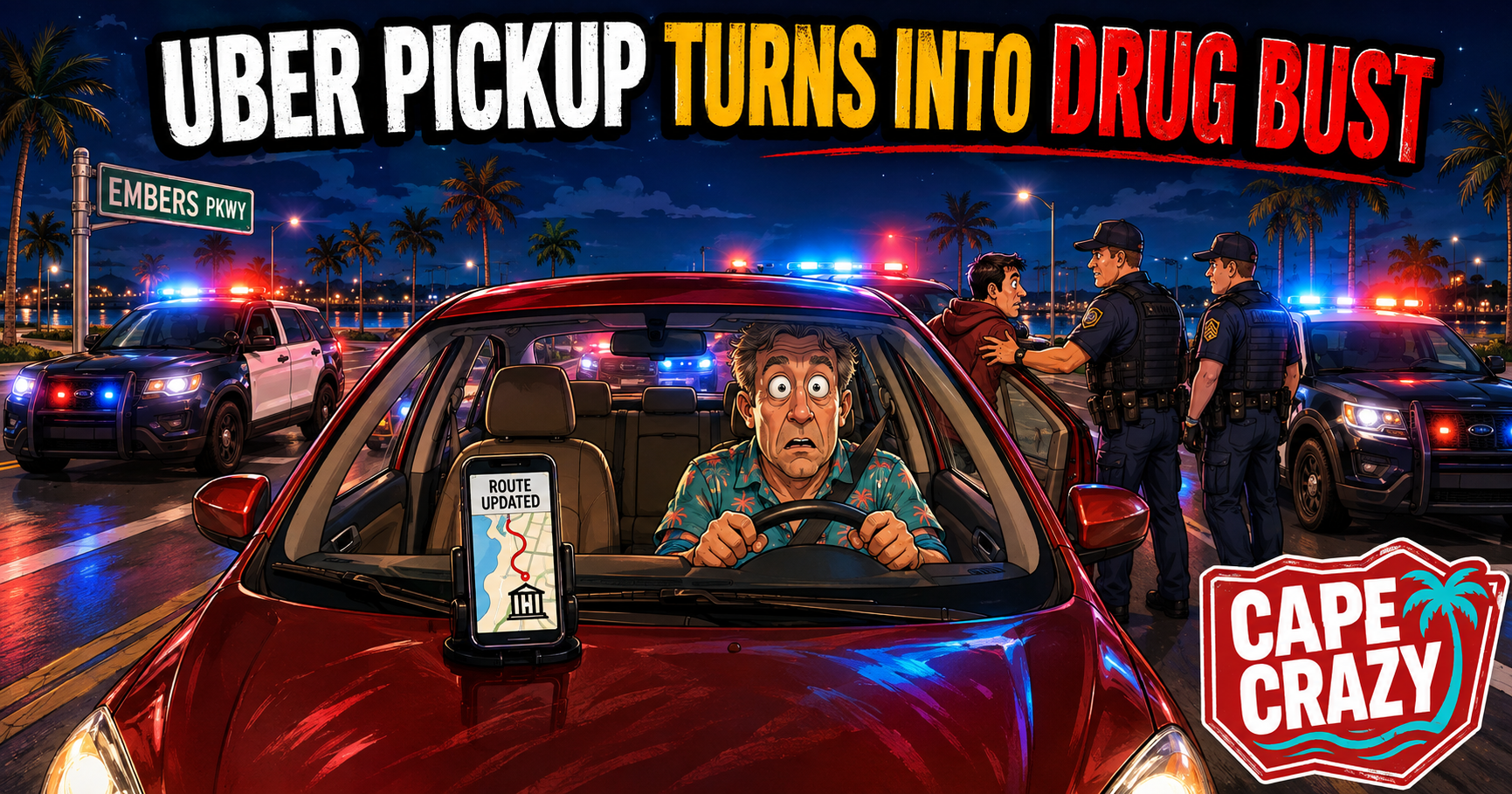
  • Cape Coral Uber Driver Accepts Ride, Accidentally Joins Drug Bust

    Cape Coral Uber Driver Accepts Ride, Accidentally Joins Drug Bust

    Every Uber driver expects the occasional difficult passenger.

    Some talk too much. Some slam the door. Some insist they know a faster route despite having no idea where they are.

    One Cape Coral driver encountered a slightly more complicated situation: His passenger was reportedly the target of an undercover narcotics investigation.

    According to WINK News, Uber driver Daniel Markham had just picked up a passenger and turned onto Embers Parkway when a Cape Coral police officer pulled him over near Northwest 17th Place.

    Then more police vehicles arrived.

    And more.

    Within moments, Markham’s routine Uber ride had been upgraded—at no additional charge—to a full-scale police takedown.

    Your Driver Has Arrived—Along With the Police

    Markham told WINK that officers surrounded his vehicle to arrest the passenger, identified in the report as Michael Hennessy.

    Police reportedly had been conducting an undercover narcotics investigation targeting the passenger. Hennessy now faces more than a dozen charges, including drug trafficking.

    Markham was not accused of participating in the alleged criminal activity. He appears to have simply accepted a ride request and arrived at one of the worst possible pickup locations at exactly the wrong time.

    Uber’s app probably described the trip as something like:

    Pickup: Cape Coral
    Destination: Unknown
    Unexpected stop: Surrounded by police
    Passenger status: No longer needs ride

    There is currently no button in the Uber app for “My passenger has been removed by a narcotics unit.”

    Perhaps there should be.

    Please Confirm Your Passenger

    Imagine the situation from the driver’s perspective.

    You accept a routine fare.

    You arrive.

    A passenger gets into your vehicle.

    You begin driving.

    Then your mirrors fill with flashing lights, police vehicles surround you and officers conduct a takedown of the person sitting in your back seat.

    At that moment, several questions probably enter your mind:

    • Did I use the correct pickup address?
    • Is this going to affect my acceptance rate?
    • Am I still supposed to complete the trip?
    • Does the passenger get charged a cancellation fee?
    • Should I ask the officers to leave a five-star review?

    Markham was reportedly caught entirely by surprise. That seems reasonable. Most drivers would not anticipate that their next passenger comes bundled with an undercover investigation and a police motorcade.

    Uber warns customers that fares may increase during periods of high demand.

    It says considerably less about surge law enforcement.

    The Most Cape Coral Rideshare Experience Possible

    Cape Coral is a large city, and rideshare drivers encounter all kinds of passengers. But this trip deserves its own service category.

    UberX gets you an everyday vehicle.

    Uber-Comfort gives you extra room.

    Uber-Black provides a luxury ride.

    Uber Bust apparently includes multiple police cars and an immediate change of destination.

    The app could even provide status updates:

    Your driver is approaching.

    Driver has arrived.

    Passenger has entered the vehicle.

    Cape Coral Police have also arrived.

    Your trip has ended earlier than expected.

    The only thing missing was the app asking Markham whether the pickup area felt safe and well-lit.

    A Driver’s Worst-Case Pickup

    The funny part of this story is the unbelievable situation—not the alleged drug activity itself.

    Drug trafficking is serious, and the criminal charges against the passenger will be resolved through the legal system. The allegations should not be treated as proof of guilt unless established in court.

    Markham, meanwhile, appears to have been an uninvolved driver doing exactly what rideshare drivers do: picking up the person the app told him to pick up.

    Drivers rarely know much about their passengers before they arrive. They receive a name, location and destination—not a full criminal-background report or advance notification that detectives may be following the customer.

    That creates an uncomfortable reality for rideshare workers. A driver may unknowingly transport someone involved in criminal activity and suddenly find themselves in the middle of a dangerous police encounter.

    Fortunately, this incident ended with officers arresting their intended passenger and the driver being recognized as the person caught in the middle—not part of the investigation.

    Would You Like to Add a Tip?

    After an experience like this, Markham deserves more than the standard fare.

    He deserves hazard pay, a complimentary car cleaning and perhaps a permanent exemption from accepting any future pickup on Embers Parkway.

    He should also be allowed to add a new reason for canceling a ride:

    • Passenger did not arrive
    • Vehicle problem
    • Unsafe pickup location
    • Passenger surrounded by narcotics officers

    Cape Coral drivers already navigate canals, construction, confusing addresses and motorists who treat red lights as optional suggestions.

    Now they apparently need to check whether their next passenger is being followed by an undercover police unit.

    The rideshare economy promises that anyone can get a convenient ride with the tap of a button.

    It does not promise where the ride will end.

    Source: WINK News — Uber driver caught in middle of drug bust on Embers Parkway

    Cape Crazy commentary is satire based on publicly reported information. Criminal charges are allegations, and defendants are presumed innocent unless proven guilty.

    Is This Crazy or Not?

    • Crazy: Accepting an ordinary Uber request and becoming surrounded by police.
    • Not Crazy: The driver had no apparent reason to know who he was picking up.
    • You Decide: Does Uber give loyalty points when the destination unexpectedly changes to jail?
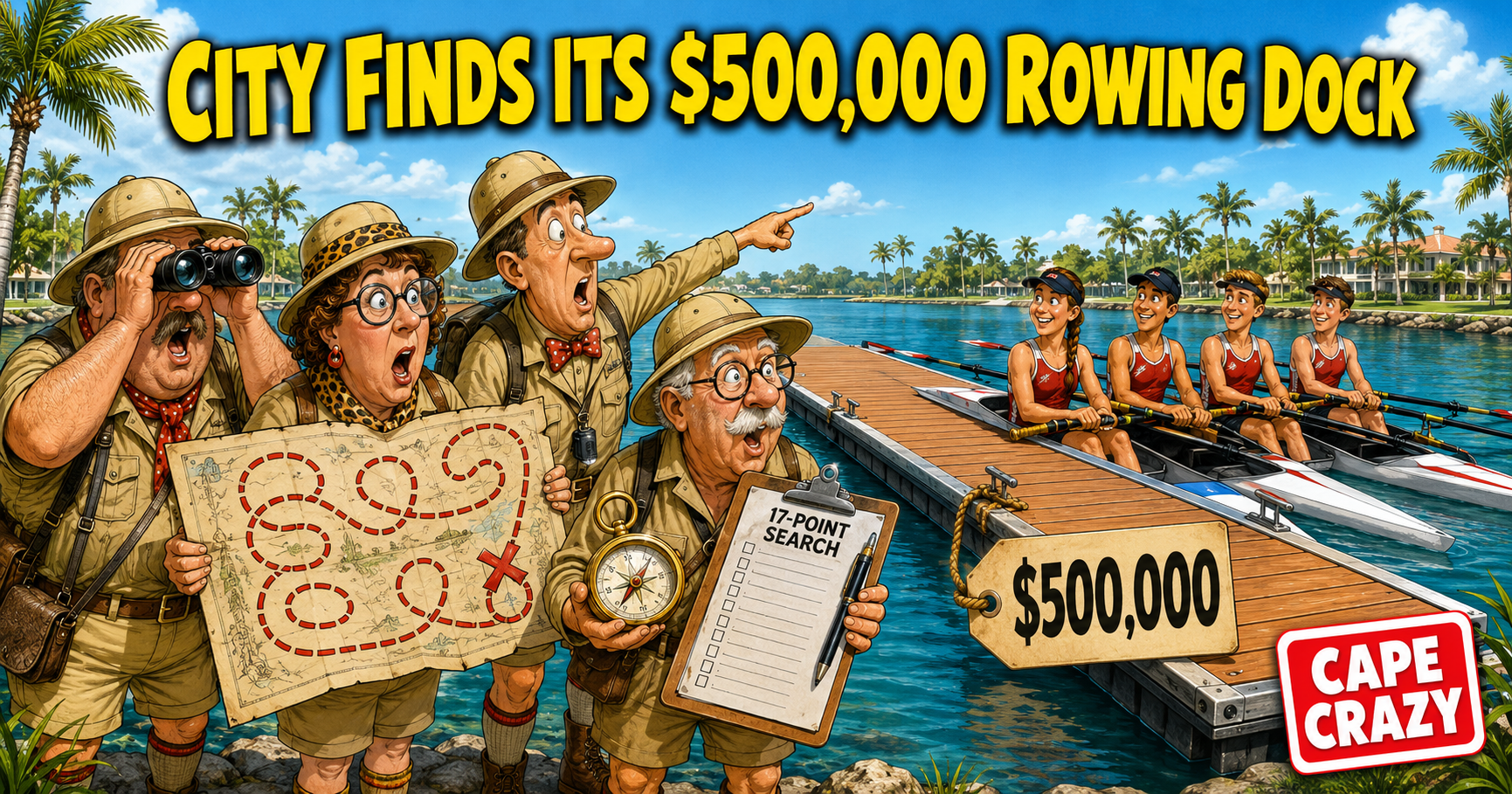
  • Cape Coral Spends Months Searching for Rowing Site, Eventually Discovers the $500,000 Rowing Dock

    Cape Coral Spends Months Searching for Rowing Site, Eventually Discovers the $500,000 Rowing Dock

    Cape Coral has finally solved the mystery of where to put its rowing club.

    The answer, following months of debate, multiple meetings, two alternative locations and a 17-point site-selection matrix, is apparently:

    At the park where the city already spent approximately $500,000 building a dock for rowing.

    In a 6–1 vote, Cape Coral City Council approved an agreement allowing the Cape Coral Rowing Club to operate from Tropicana Park—the same location originally proposed before council deadlocked on the agreement in April.

    Sometimes government takes the scenic route.

    Previously on “Where Should the Rowing Club Row?”

    Earlier this week, we discussed the city’s search for an alternative home for the Cape Coral Rowing Club.

    The club has been temporarily operating from property at Seven Islands, but that site is slated for development. Without another workable location, club officials warned that the nonprofit—which has served youth and adult rowers since 2007—could be forced to dissolve.

    Fortunately, the city had already planned for this.

    Tropicana Park had access to the North Spreader Waterway, room for the club’s equipment and a roughly $500,000 floating dock built specifically with rowing in mind.

    Unfortunately, Cape Coral City Council voted 4–4 on the proposed agreement in April.

    That meant the rowing club could not move to the park containing the rowing dock constructed for the rowing club.

    Cape Coral then began looking for other places where the club might row.

    This is similar to purchasing a new refrigerator, refusing to put food in it and forming a committee to investigate whether the milk could be stored in the garage.

    Bring Out the 17-Point Matrix

    The city eventually developed a 17-point matrix to evaluate possible rowing sites.

    The criteria included water access, canal width, dock clearance, boat-storage space, parking, utilities, electricity and the angle of the launch.

    City officials presented two alternatives: Flagstone Canal and Gator Slough.

    The rowing club responded that neither location would work.

    Club President Saundra Weston said Flagstone Canal could require hundreds of thousands of dollars in improvements and years of permitting. She said Gator Slough was not suitable for rowing because the freshwater canal system was not wide enough and contained weirs.

    There was also a slight mathematical problem with one of the city’s measurements.

    The analysis called for a minimum canal width of 24 feet.

    The rowing club uses boats that can be approximately 60 feet long.

    Anyone who has attempted to turn a sofa in a hallway may recognize the challenge.

    The city had now created two potential alternatives to the original site. One could cost hundreds of thousands of dollars and take years. The other was a body of water the rowing club said it could not properly use.

    Meanwhile, the completed rowing dock at Tropicana Park continued its successful career as a very expensive place to stand near water.

    Then Someone Suggested the Original Plan

    At Wednesday’s council meeting, young rowers and adult supporters spoke about what the club meant to them.

    Weston urged the council to end the uncertainty surrounding the club’s future. She also pointed out the unusual situation of developing rowing proposals without meaningfully involving the person who runs the rowing program.

    Councilmember Jennifer Nelson-Lastra then made a motion to approve the original Tropicana Park agreement instead of proceeding with the two alternatives.

    After a recess so council members could review the agreement, the motion passed 6–1.

    Councilmember Laurie Lehmann, who had worked on the alternative-location proposals, cast the only opposing vote. Mayor John Gunter was absent—which, as Cape Crazy readers may remember, has recently become something of a recurring visual at City Hall.

    And just like that, the city rediscovered Tropicana Park.

    No new canal had to be engineered.

    No 60-foot boat had to be folded into a 24-foot space.

    No additional rowing dock had to be constructed while the existing rowing dock contemplated the meaning of its existence.

    The rowing club would use the rowing facility.

    Government innovation at its finest.

    The Agreement

    The approved agreement gives the Cape Coral Rowing Club an initial 10-year term at Tropicana Park, with the possibility of three additional five-year renewals if both sides agree and the club remains in compliance.

    The club will pay the city a use fee of $10 per year, plus any applicable sales tax.

    Before anyone panics about the fee, the club is a nonprofit providing rowing instruction, camps, classes and community programs for youth and adults. The agreement is about activating a public park through recreational programming, not renting waterfront property to a private luxury resort.

    The park and docks will also remain open to the public. City Attorney Aleksandr Boksner confirmed that the agreement does not give the rowing club exclusive possession of the docks.

    So residents may still fish, tie up their boats and use the park.

    The rowing club will simply be allowed to row there, using the dock built for rowing.

    A Happy Ending—After Several Unnecessary Chapters

    This is ultimately good news.

    The Cape Coral Rowing Club gets a stable home. Young athletes no longer have to wonder whether their program is about to disappear. The city’s substantial investment at Tropicana Park will finally serve its intended purpose.

    Council also deserves credit for reconsidering the issue and reaching a practical decision.

    But Cape Coral did take an impressively complicated journey to arrive at the obvious destination.

    The city:

    1. Planned a home for the rowing club.
    2. Spent approximately $500,000 on a rowing dock.
    3. Deadlocked on letting the rowing club use it.
    4. Studied other locations.
    5. Proposed two alternatives the club said were unworkable.
    6. Returned to the original location.
    7. Approved it 6–1.

    If the rowing club demonstrated that much difficulty moving in a straight line, it would lose every race.

    Fortunately, the rowers appear to know exactly where they are going.

    It was City Hall that needed a few extra laps.

    Sources: Cape Coral Breeze — Rowing club gets Tropicana Park OK and Cape Coral Breeze — City tenders two alternative rowing-club locations

    Cape Crazy commentary is satire based on publicly reported government actions and statements.

    Is This Crazy or Not?

    • Crazy: Spending $500,000 on a rowing dock and then searching for somewhere else to put the rowing club.
    • Not Crazy: Council reconsidered the issue and eventually approved the practical solution.
    • You Decide: Did the city solve the problem—or merely stop creating it?
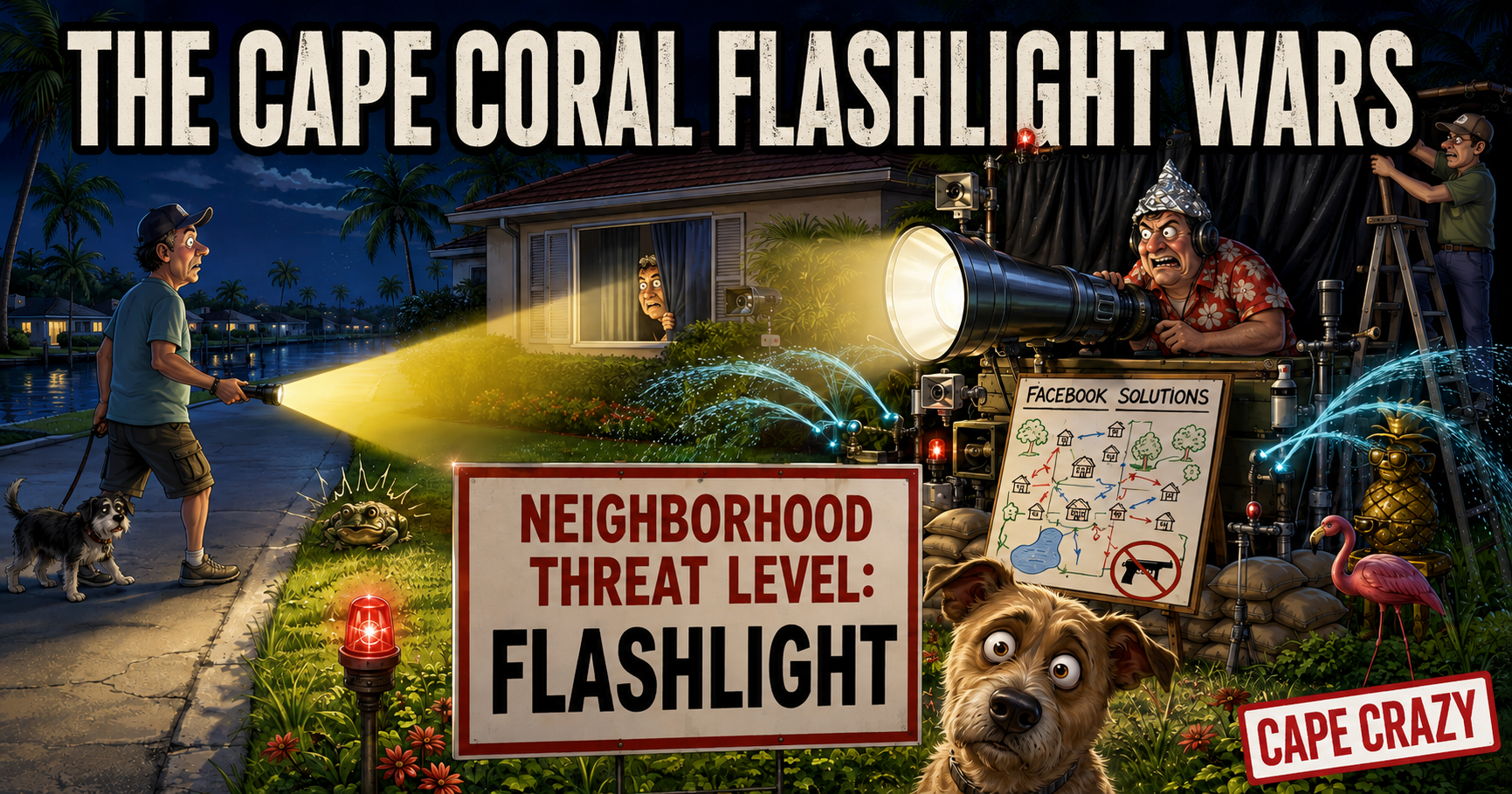
  • Cape Coral Flashlight Dispute Escalates to Sprinklers, Pit Bulls and Pellet Guns

    Cape Coral Flashlight Dispute Escalates to Sprinklers, Pit Bulls and Pellet Guns

    A Cape Coral resident went online with what seemed like a fairly ordinary neighborhood problem.

    According to a post shared in a public Cape Coral Facebook forum, a neighbor repeatedly shines a flashlight into the resident’s windows while walking her dog at night. The poster said the light wakes up the children and asked whether shining it into someone’s home is allowed.

    It was a reasonable question.

    The internet responded with a completely unreasonable selection of answers.

    Within hours, the discussion had progressed from “talk to your neighbor” to motion-activated sprinklers, retaliatory flashlights, pit bulls and a pellet gun.

    Because apparently, the shortest distance between two Cape Coral neighbors is no longer a conversation. It is a fully armed homeowners-association dispute with outdoor irrigation.

    It Started With a Flashlight

    The original complaint was simple: A woman walks her dog at night and repeatedly shines a flashlight toward—or possibly directly into—a neighboring home.

    If the light is regularly waking sleeping children, that would understandably become frustrating. Nobody wants their bedroom unexpectedly transformed into a lighthouse.

    But there may also be an innocent explanation.

    Several commenters pointed out that walking a dog after dark in Southwest Florida can require some surveillance. Cane toads can be poisonous to dogs. Snakes exist. Alligators occasionally appear where alligators were not formally invited.

    One resident explained that she checks her yard with a powerful flashlight before letting her dog outside because alligators have rested alongside her fence.

    That is an extremely Florida sentence.

    In most states, a nighttime dog walk requires a leash and perhaps a plastic bag. In Southwest Florida, it may require tactical lighting, wildlife identification and the situational awareness of a Navy SEAL.

    The dog walker may be scanning for danger and have no idea that her flashlight is entering the neighbor’s home. Or she may have terrible aim. Either way, a polite conversation would probably be a sensible first step.

    Fortunately, several commenters suggested exactly that.

    Unfortunately, this was Facebook, so sensible advice was quickly escorted from the premises.

    Cape Coral’s Department of Conflict Escalation Arrives

    One commenter recommended motion-activated sprinklers.

    That solution would presumably protect the windows by soaking the dog walker, the dog and possibly an innocent Amazon driver.

    Another suggested shining a bright flashlight back at her.

    This would create a neighborhood version of laser tag, except nobody is having fun and someone will eventually call the police.

    Then came the suggestion involving a pit bull and the neighbor’s dog—a remark so needlessly ugly that another commenter could respond only with “wow.”

    Finally, someone suggested that a pellet gun “works good also.”

    And there it was.

    A dispute that began with an unwanted beam of light had completed the full Facebook journey from mild annoyance to implied gunfire.

    No information was provided about whether the pellet gun was supposedly intended for the flashlight, the dog walker, the dog or the concept of neighborly communication itself.

    To be perfectly clear: Firing a pellet gun at a person or animal is not an acceptable response to an irritating flashlight. It should not need to be said, but the comment section brought us here.

    Have We Considered Speaking to Each Other?

    Hidden among the neighborhood battle plans were several people offering a dangerously radical idea:

    Talk to her.

    Not through Facebook. Not through a coded series of sprinklers. Not by purchasing a brighter flashlight and initiating Cape Coral’s first residential searchlight war.

    Simply walk over during daylight and say:

    “Hey, I’m not sure whether you realize it, but your flashlight has been shining into our children’s windows and waking them up. Would you mind pointing it away from the house?”

    That conversation may solve the entire problem in less time than it takes to write a Facebook post.

    The dog walker might apologize and explain that she was checking for cane toads. The homeowner might better understand why the flashlight is being used. Both people could adjust their behavior slightly and continue living near each other without installing defensive water cannons.

    Of course, there is also a chance the neighbor is intentionally shining the flashlight into the windows. We do not know. We have one side of the story contained in a social-media post and no response from the dog walker.

    That is why the original claim should be treated as a neighbor’s account—not as an established fact.

    The Flashlight Wasn’t the Craziest Part

    The initial complaint may be legitimate. Repeatedly waking children with a light through their bedroom window would bother most parents.

    Using a flashlight while walking a dog in Florida is also perfectly understandable.

    The crazy part is how quickly strangers turned a potentially innocent misunderstanding into a suburban retaliation strategy.

    Cape Coral residents already contend with hurricanes, flooding, cane toads, alligators, rising insurance premiums and drivers who regard turn signals as confidential information.

    We do not need to add armed flashlight disputes to the list.

    Sometimes a flashlight is just a flashlight.

    Sometimes a neighbor does not realize what she is doing.

    And sometimes the most dangerous thing in the neighborhood is the Facebook comment section.

    Editor’s note: The names and profile photographs of the people involved have been withheld. The original complaint represents one resident’s account and has not been independently verified.

    Is This Crazy or Not?

    • Crazy: Repeatedly shining a flashlight into someone’s windows.
    • Crazier: Suggesting sprinklers, dogs or pellet guns before suggesting a conversation.
    • You Decide: Are we still allowed to knock on a neighbor’s door, or has Facebook officially replaced human interaction?
  • Bid, Win and Help Save a Life: Cape Coral Animal Shelter Auction Is Underway

    Bid, Win and Help Save a Life: Cape Coral Animal Shelter Auction Is Underway

    If you have ever wanted to take an African safari, enjoy a local getaway, pamper yourself at a spa or simply spoil your pet a little more than you already do, the Cape Coral Animal Shelter has found a way for you to do it while helping animals in need.

    The shelter’s fifth annual Online Auction for the Animals is now underway, with bidding scheduled to close at 4 p.m. Friday, August 21.

    This is not a small collection of donated candles and mystery gift baskets assembled in somebody’s garage. Shelter officials say this year’s auction features more than 600 items and packages, offering everything from major travel experiences to artwork, pet supplies, dining, wellness services and locally handcrafted items.

    Among the featured offerings are an African photo safari for two, round-trip JetBlue tickets, resort stays, spa packages, artwork and a special “Pine Island Experience.”

    There are items for different interests and budgets, so participation does not require a private jet, a trust fund or the ability to explain an impulse purchase to your spouse.

    Every Bid Helps an Animal

    The auction is the Cape Coral Animal Shelter’s largest annual fundraiser. Last year’s event raised more than $65,000, and the shelter hopes to break that record in 2026.

    Every donated item means more of the money raised can go directly toward caring for animals. Auction proceeds help provide food, medications, veterinary treatment, supplies, enrichment and specialized care for animals preparing for adoption.

    Some arrive needing far more than a routine examination and a bowl of food. The shelter is currently caring for neonatal kittens requiring around-the-clock attention, mothers nursing puppies and animals with serious medical conditions.

    Veterinary expenses continue to increase, and some animals require thousands of dollars in treatment before they are healthy enough to begin looking for permanent homes.

    That is what makes this auction more than an opportunity to score a vacation or win a bidding war over a gift basket. Every bid helps give an abandoned, neglected or homeless animal a second chance.

    Big Plans for More Cats and Dogs

    The fundraiser arrives as the Cape Coral Animal Shelter prepares for a major expansion.

    Phase II of its expansion project is expected to launch in fall 2026. Plans include a new 19,000-square-foot shelter facility with 50 additional dog kennels and eight spacious cat condos.

    The shelter’s current building will also be renovated to expand its low-cost veterinary clinic, allowing it to assist hundreds more pets and families each month.

    The larger campus will give the organization more room to care for animals while helping address the growing demand for affordable veterinary services in the community.

    Since opening in 2020, the Cape Coral Animal Shelter has helped more than 6,400 animals find homes.

    That represents thousands of dogs and cats that received food, medical care, safety and another opportunity to become someone’s spoiled family member who sleeps sideways across the bed.

    How to Participate

    The auction is entirely online, so you can browse and bid without leaving home—or disturbing the animal currently occupying your favorite chair.

    Participants first register for a bidder account and then log in using a secure link sent by email or text. Items can be browsed by category, saved as favorites and tracked under “My Bids.”

    The auction also allows bidders to enter a maximum bid. The system will then bid automatically on their behalf, up to that amount.

    Winning bidders will be contacted after the auction closes to arrange pickup details. Anyone bidding on an item that requires shipping will be responsible for the shipping cost.

    Bidding ends at 4 p.m. EDT on Friday, August 21, so there is not much time left to participate.

    You might win a memorable trip, discover a unique local experience or find the perfect gift.

    Even if someone outbids you, the money still helps an animal—making this one of the rare occasions when losing an auction can still feel pretty good.

    Browse the auction and place a bid:
    Cape Coral Animal Shelter’s 2026 Online Auction for the Animals

    Learn more about the fundraiser:
    Cape Coral Animal Shelter Online Auction

    Original reporting:
    Pine Island Eagle — Cape Coral Animal Shelter’s fifth annual online fundraising auction underway

    The Cape Coral Animal Shelter is located at 325 SW 2nd Avenue in Cape Coral.

    Is This Crazy or Not?

    • Crazy: Waiting until the final five minutes to bid on the item you have been watching all week.
    • Not Crazy: Buying something enjoyable while helping homeless animals.
    • You Decide: Your dog already knows which answer to choose.
  • Cape Coral Senior Community Sells for $10.5 Million—Bingo Schedule Reportedly Unaffected

    Cape Coral Senior Community Sells for $10.5 Million—Bingo Schedule Reportedly Unaffected

    Another piece of Cape Coral has been sold to a company from New York.

    This time it’s Atrium at Liberty Park, a 130-unit assisted-living and memory-care community located at 1321 NE 24th Avenue. According to Lee County property records reported by the Business Observer, New York-based National Healthcare Properties paid $10.45 million for the facility.

    The transaction was reportedly completed entirely in cash, proving once again that somewhere in New York, somebody has considerably more money sitting around than the rest of us.

    For comparison, $10.45 million would also buy approximately:

    • 41,800 early-bird dinners at $250 each
    • Enough shuffleboard equipment to cover most of Cape Coral
    • Roughly three modest waterfront homes after closing costs
    • One month of homeowners insurance in Florida

    Those numbers are satire, of course—except possibly the insurance estimate.

    Please Include 130 Units and a Cashier’s Check

    Atrium at Liberty Park opened in 2019 and includes approximately 120,500 square feet. A previous property listing said the facility has 135 beds, including 108 for assisted living and 27 dedicated to memory care.

    That works out to about $77,400 per bed.

    In today’s real-estate market, that may make it one of the few places in Cape Coral where $77,400 still gets you a roof, walls and possibly access to scheduled activities.

    The seller was American Lending Center, which reportedly wanted to “exit the senior housing sector.”

    That is professional corporate language for, “Thanks, but we would now like our $10.45 million.”

    The commercial real-estate firm Matthews represented the seller and announced the all-cash transaction. Before Matthews marketed the facility, it had been listed by Hilco Global.

    Hilco’s listing said the property was cash-flow positive and generated approximately $2 million in annual revenue. In other words, this wasn’t someone unloading a rusty duplex with a blue tarp on the roof and calling it “full of potential.”

    It was an operating senior-care facility with residents, employees and real revenue.

    Cape Coral Real Estate: Now Available by the Facility

    The buyer, National Healthcare Properties, focuses on healthcare-related real estate. That makes considerably more sense than selling it to a company that specializes in car washes, storage units or mattress stores—although Cape Coral has proven willing to put those nearly anywhere.

    For residents and their families, the important question is not whether the buyer came from New York or arrived with $10.45 million in cash.

    It is what happens next.

    A real-estate transaction may look clean and simple on paper, but an assisted-living and memory-care community is not just another commercial property. It is home to the people living there and a workplace for the people caring for them.

    The Business Observer report did not announce any operational changes, staffing changes or changes affecting residents. For now, the headline is about a change in ownership—not necessarily a change in daily life inside the facility.

    Still, it must be slightly strange to learn that the building you call home was just purchased by someone you have probably never met.

    Most homeowners at least get to pack before their property changes hands.

    Sold! What Happens Now?

    Cape Coral continues to grow, and senior housing will remain a valuable part of that growth. Florida is, after all, the place where many Americans eventually arrive after spending years complaining about Florida.

    The sale shows that investors continue to see money in caring for an aging population—and in owning the buildings where that care happens.

    Hopefully, the new owner treats Atrium at Liberty Park as more than a line on an investment spreadsheet. When a property contains 135 senior-care beds, the people in those beds matter far more than the capitalization rate.

    So yes, a New York company just bought a Cape Coral senior community for $10.45 million in cash.

    The building has a new owner.

    The residents presumably still have dibs on the good chairs.

    Source: Business Observer — Cape Coral senior community sold for $10.5 million

    Cape Crazy commentary is satire based on publicly reported information. The financial figures and property details above come from the cited report; the shuffleboard and homeowners-insurance calculations should not be presented to a lender.

    Is This Crazy or Not?

    • Crazy: A 130-unit senior community sells for less than some luxury estates.
    • Not Crazy: Healthcare properties are bought and sold like other commercial real estate.
    • You Decide: Ask again after we see whether anything changes for residents.
  • Cape Coral Mayor Loses Primary, Apparently Activates His Out-of-Office Reply

    Cape Coral Mayor Loses Primary, Apparently Activates His Out-of-Office Reply

    Cape Coral Mayor John Gunter lost Tuesday’s primary election—and judging by what happened next, he may have also lost the directions to City Hall.

    According to Gulf Coast News Now, Gunter has been absent from public appearances and City Council meetings since voters decided they would like to try a different mayor.

    That includes Wednesday night’s City Council meeting, where the mayor’s chair sat empty just one day after the election.

    Now, to be fair, losing an election has to sting. Nobody expects the man to wake up the next morning, whistle “Zip-a-Dee-Doo-Dah,” and skip merrily into City Hall carrying doughnuts for everyone.

    But there is usually a short, awkward period between losing an election and actually leaving office. It’s commonly known as “finishing the job.”

    Gunter finished third in the six-candidate primary, receiving 5,665 votes. Rick Erickson led the race with 12,160 votes, followed by Lisa Cohen-Adkinson with 9,280. Erickson and Cohen-Adkinson will now face each other in the November general election.

    Cape Coral voters may have handed Gunter his political eviction notice, but they did not say he needed to vacate the premises before breakfast.

    The Mysterious Case of the Missing Mayor

    An empty chair at a government meeting is not normally shocking. In fact, depending on the meeting, it may be the most productive participant in the room.

    But when the empty chair belongs to the mayor—and appears immediately after he loses an election—it does raise a few questions.

    Is he taking some personal time?

    Is he updating his résumé?

    Is he driving slowly past City Hall while playing sad music?

    Or did he simply decide that if Cape Coral doesn’t want him as its next mayor, Cape Coral can practice not having him as its current mayor?

    We don’t know.

    What we do know is that an election loss does not come with an automatic “skip the rest of your shift” coupon. Most people who learn they’re being replaced are still expected to show up until their final day.

    Try telling your boss, “I didn’t get the promotion, so I’ll no longer be attending meetings,” and see how quickly security begins packing your desk.

    Cape Coral’s Fastest Transition of Power

    Traditionally, outgoing elected officials congratulate the winners, thank their supporters and promise an orderly transition.

    Cape Coral may be pioneering a more efficient approach:

    1. Lose election.
    2. Disappear.
    3. Let everyone else figure it out.

    It eliminates unnecessary paperwork, farewell speeches and the uncomfortable experience of sitting through a council meeting while everyone in the room knows your political career has an expiration date.

    Government efficiency has finally arrived in Cape Coral. It just took the form of an empty chair.

    Maybe Gunter had a legitimate reason for missing the meeting and recent public appearances. If so, the public deserves to hear it. Until then, the timing is difficult to ignore.

    Cape Coral residents did vote for a new direction—but the next mayor has not taken office yet. The current one still has a city to help run.

    Losing gracefully is optional.

    Showing up for work generally isn’t.

    Source: Gulf Coast News Now — Cape Coral mayor absent after primary loss

    Cape Crazy commentary is satire based on publicly reported information. Any speculation above is clearly intended as humor—not a claim that anyone is literally driving around City Hall listening to sad music.

    Is This Crazy or Not?

    • Crazy: You’re still the mayor. Go to the meeting.
    • Not Crazy: Give the guy a day to lick his political wounds.
    • You Decide: Maybe someone should check whether his out-of-office message has a return date.
  • Seven Islands Mangrove Restoration Begins — Because Apparently We’re Undoing the Landscaping Now

    Seven Islands Mangrove Restoration Begins — Because Apparently We’re Undoing the Landscaping Now

    Cape Coral’s Seven Islands project is entering a new phase.

    Not construction.

    Not demolition.

    Not another hearing.

    Restoration.

    Gulf Coast News reported that stabilization work is beginning at the Seven Islands property in preparation for replanting mangroves that were removed earlier this summer. 

    So after a couple months of:

    “Those mangroves weren’t supposed to come out.”

    we have officially reached:

    “Okay, put them back.”

    How We Got Here

    Back in June, the Cape Coral Breeze reported that the U.S. Army Corps of Engineers stopped shoreline clearing at the Seven Islands property after protected red mangroves were removed. The developer said the contractor had been authorized to remove invasive species such as Australian pine and Brazilian pepper, but mangroves were mistakenly removed in the process. 

    Cape Coral resident and geologist David Scott told the Breeze that more than 570 feet of mangrove shoreline had been disturbed. 

    That is a fairly ambitious “oops.”

    Most people accidentally take out:

    • the wrong shrub
    • a sprinkler head
    • maybe half the flower bed

    This apparently involved hundreds of feet of protected shoreline vegetation.

    The Developer Says It Was an Accident

    Gulf Gateway Resort & Marina LLC said in a statement published by the Cape Coral Breeze that protecting the mangroves had been a central part of the Seven Islands planning process and that the removal was inadvertent. 

    The developer said the contractor was supposed to remove only non-native invasive vegetation.

    Which gives us the Cape Crazy landscaping conversation:

    Supervisor:

    “Remove the invasive plants.”

    Contractor:

    “Got it.”

    Later:

    “Why are the mangroves gone?”

    Contractor:

    “Define invasive.”

    Now Comes the Restoration

    According to Gulf Coast News, the next step is stabilization work designed to prepare the shoreline for mangrove replanting. The broader project is intended to create mangrove islands, oyster reefs and other habitat features that can improve water quality and support wildlife. 

    The developer previously said restoration plans had been submitted to the South Florida Water Management Districtand the U.S. Army Corps of Engineers, and that replacement mangroves and restoration materials had already been located. 

    So we have progressed from:

    remove vegetation

    to

    stop work

    to

    write restoration plan

    to

    stabilize shoreline

    to

    replant vegetation

    This may be the longest possible route to getting mangroves exactly where they started.

    Seven Islands Has Bigger Plans

    The Seven Islands property is not exactly a minor development.

    The City of Cape Coral describes it as roughly 48 acres, including seven islands and adjoining properties along the North Spreader Waterway. 

    Earlier reporting on the project described plans for a major mixed-use waterfront destination with residences, a hotel, marina, dining, retail and public amenities. 

    Which means environmental issues here matter.

    This isn’t somebody clearing brush behind a shed.

    It’s a large waterfront development sitting next to sensitive habitat.

    Mangroves Are Not Decorative Shrubs

    The Florida Department of Environmental Protection describes mangroves as native coastal vegetation adapted to salty environments. They provide important shoreline and habitat functions. 

    They are also regulated.

    Which is why:

    “We’ll just put some new ones back”

    is not quite the same thing as replacing a dead hibiscus at Home Depot.

    Restoration involves agencies, permits, shoreline stabilization and actual environmental planning.

    Cape Crazy Translation

    Developer:

    “We’re protecting the mangroves.”

    Contractor:

    “We removed the mangroves.”

    Regulators:

    “Stop.”

    Developer:

    “That was not the plan.”

    Regulators:

    “Correct.”

    Developer:

    “We’ll restore them.”

    Mangroves:

    “We would have preferred option one.”

    The Serious Part

    The restoration work is good news.

    Mistakes happen on large construction projects, but when protected habitat is damaged, the important question is what happens next.

    In this case, regulators stopped the clearing, restoration plans were developed, and shoreline stabilization and replanting are now moving forward. 

    That does not erase what happened.

    But fixing the damage is better than pretending it didn’t happen.

    And if the restoration ultimately improves shoreline habitat with mangroves, oyster reefs and other features, Seven Islands may eventually end up with a stronger environmental plan than it had before.

    Still, the whole sequence is undeniably Cape Crazy:

    Remove protected mangroves.

    Get stopped by federal regulators.

    Then launch a project to put mangroves back.

    That qualifies.

    IS THIS CRAZY OR NOT?

    Mangroves were mistakenly removed at Cape Coral’s Seven Islands development.

    Now crews are beginning stabilization work so the shoreline can be restored and replanted.

    Crazy mistake with a responsible fix?

    Or just an extremely expensive way to learn which plants not to remove?

    Tap an icon to vote.

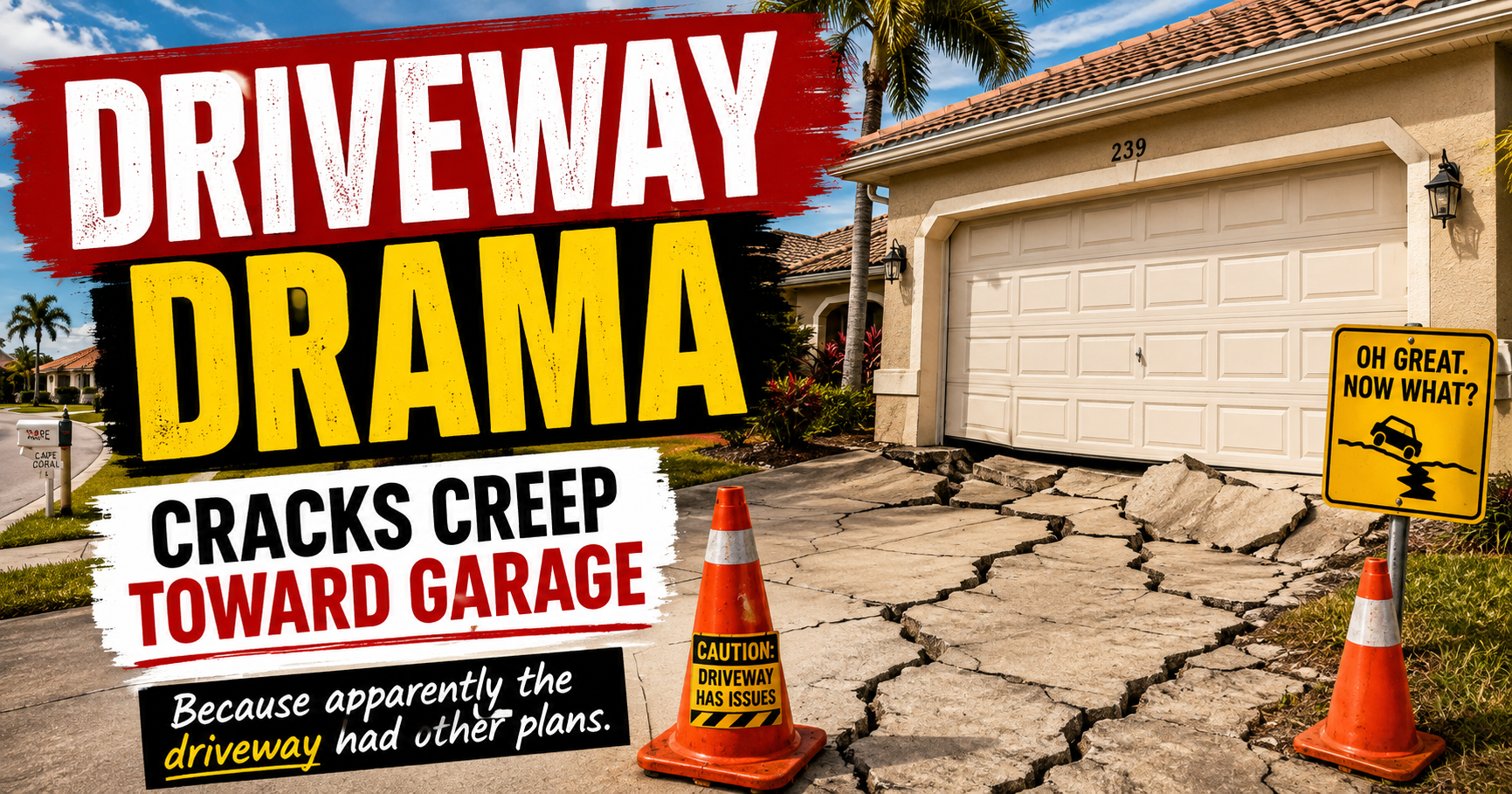
  • Cape Coral Couple Watches Cracks Creep Toward Garage — Because Apparently the Driveway Is Migratin

    Cape Coral Couple Watches Cracks Creep Toward Garage — Because Apparently the Driveway Is Migratin

    Most homeowners worry about:

    Roof leaks.

    Air conditioners.

    Insurance premiums.

    Maybe the occasional canal problem.

    A Cape Coral couple is dealing with something a little more dramatic:

    their driveway is cracking, sinking, and the damage appears to be creeping toward the garage.

    Gulf Coast News reported that the homeowners on NW 16th Terrace are increasingly concerned as cracks continue spreading near their home while the City of Cape Coral investigates a nearby dip in the roadway. 

    Which is one of those sentences that makes you immediately look outside at your own driveway.

    “It’s Almost Up to the Garage”

    In video shared by Gulf Coast News, the homeowner points out a crack and says:

    “It’s almost up to the garage.”

    He also says the crack was not there until recently. 

    That is not usually what you want your driveway doing.

    A driveway should ideally remain:

    • flat
    • boring
    • stationary

    It should not develop a storyline.

    The House Has Reportedly Sunk Nearly Two Feet

    Gulf Coast News also reported that the homeowner says the property has sunk nearly two feet as the cracking continues along NW 16th Terrace. 

    Nearly two feet.

    At that point, we’re no longer talking about:

    “Maybe we should patch that crack.”

    We’re approaching:

    “Should the house have its own elevation certificate?”

    The couple believes nearby construction may be contributing to the problem, but Gulf Coast News says the city has not yet identified the cause. 

    That distinction matters.

    The homeowners have a theory.

    The city is still investigating.

    So nobody gets to declare:

    “Case closed. It was definitely the construction.”

    Not yet.

    This Problem Did Not Start Yesterday

    This appears to be part of an ongoing issue.

    Back in June, Gulf Coast News reported that the same Cape Coral couple feared nearby drilling could cause further damage after discovering their driveway had sunk nearly two feet. 

    So this is not:

    Monday: Crack appears.

    Tuesday: Call the news.

    It is more like:

    June: “Something is wrong.”

    August: “Something is still wrong, and now it is closer to the garage.”

    Which is not the sort of progress report anybody wants.

    Cape Coral Translation

    Homeowner:

    “My driveway is sinking.”

    City:

    “We’re investigating.”

    Homeowner:

    “The cracks are spreading.”

    City:

    “Still investigating.”

    Homeowner:

    “They’re almost at the garage.”

    Driveway:

    “I’ll keep you posted.”

    Honestly, if the crack starts asking for mail delivery, we may need to reassess.

    Nearby Road Dip Is Also Under Investigation

    Gulf Coast News reported that the City of Cape Coral is investigating a dip in the roadway near the property. 

    That makes the situation considerably more interesting.

    One cracked driveway?

    Could be a property issue.

    A cracked driveway plus a road dip nearby?

    Now everyone starts staring at the ground suspiciously.

    Homeowners:

    “Is the street supposed to do that?”

    Street:

    “Define supposed.”

    The Serious Part

    Cracking and settlement can happen for a variety of reasons in Florida, including soil movement, erosion, drainage problems, poor compaction or construction-related disturbance.

    But at this point, the actual cause at this property remains unresolved.

    That is why the city’s investigation matters.

    If nearby work contributed to the problem, that needs to be established.

    If something else is happening beneath the property or roadway, that needs to be identified too.

    Because a crack moving toward a garage isn’t just cosmetic if the ground itself is shifting.

    IS THIS CRAZY OR NOT?

    A Cape Coral couple says their property has sunk nearly two feet.

    Cracks are spreading toward the garage.

    There’s a dip in the road.

    And the city is still trying to determine why.

    Is this crazy?

    Or is the ground around Cape Coral now joining the list of things we need to keep an eye on?

    Tap an icon to vote.