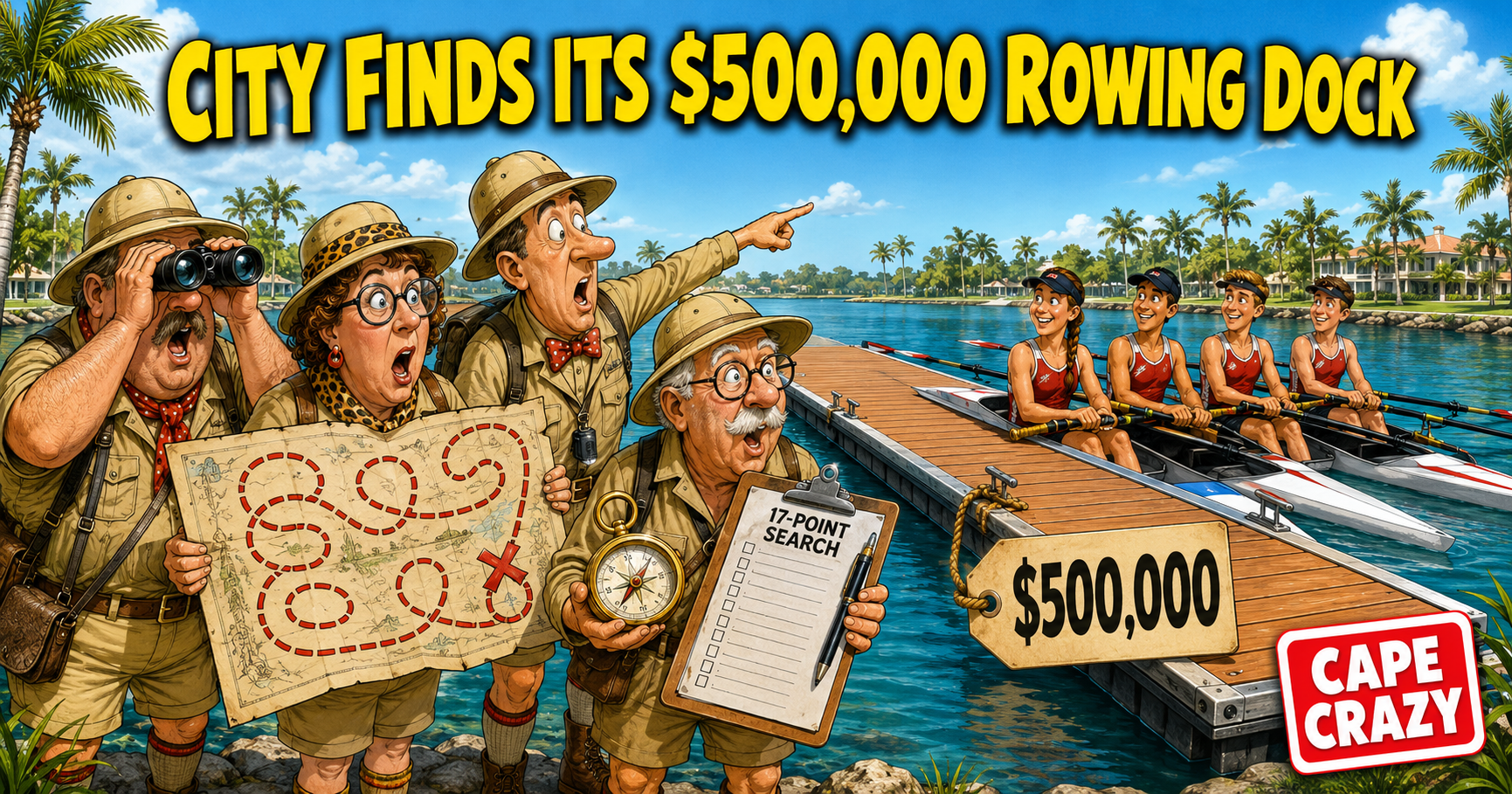



Cape Coral has finally solved the mystery of where to put its rowing club.
The answer, following months of debate, multiple meetings, two alternative locations and a 17-point site-selection matrix, is apparently:
At the park where the city already spent approximately $500,000 building a dock for rowing.
In a 6–1 vote, Cape Coral City Council approved an agreement allowing the Cape Coral Rowing Club to operate from Tropicana Park—the same location originally proposed before council deadlocked on the agreement in April.
Sometimes government takes the scenic route.
Previously on “Where Should the Rowing Club Row?”
Earlier this week, we discussed the city’s search for an alternative home for the Cape Coral Rowing Club.
The club has been temporarily operating from property at Seven Islands, but that site is slated for development. Without another workable location, club officials warned that the nonprofit—which has served youth and adult rowers since 2007—could be forced to dissolve.
Fortunately, the city had already planned for this.
Tropicana Park had access to the North Spreader Waterway, room for the club’s equipment and a roughly $500,000 floating dock built specifically with rowing in mind.
Unfortunately, Cape Coral City Council voted 4–4 on the proposed agreement in April.
That meant the rowing club could not move to the park containing the rowing dock constructed for the rowing club.
Cape Coral then began looking for other places where the club might row.
This is similar to purchasing a new refrigerator, refusing to put food in it and forming a committee to investigate whether the milk could be stored in the garage.
Bring Out the 17-Point Matrix
The city eventually developed a 17-point matrix to evaluate possible rowing sites.
The criteria included water access, canal width, dock clearance, boat-storage space, parking, utilities, electricity and the angle of the launch.
City officials presented two alternatives: Flagstone Canal and Gator Slough.
The rowing club responded that neither location would work.
Club President Saundra Weston said Flagstone Canal could require hundreds of thousands of dollars in improvements and years of permitting. She said Gator Slough was not suitable for rowing because the freshwater canal system was not wide enough and contained weirs.
There was also a slight mathematical problem with one of the city’s measurements.
The analysis called for a minimum canal width of 24 feet.
The rowing club uses boats that can be approximately 60 feet long.
Anyone who has attempted to turn a sofa in a hallway may recognize the challenge.
The city had now created two potential alternatives to the original site. One could cost hundreds of thousands of dollars and take years. The other was a body of water the rowing club said it could not properly use.
Meanwhile, the completed rowing dock at Tropicana Park continued its successful career as a very expensive place to stand near water.
Then Someone Suggested the Original Plan
At Wednesday’s council meeting, young rowers and adult supporters spoke about what the club meant to them.
Weston urged the council to end the uncertainty surrounding the club’s future. She also pointed out the unusual situation of developing rowing proposals without meaningfully involving the person who runs the rowing program.
Councilmember Jennifer Nelson-Lastra then made a motion to approve the original Tropicana Park agreement instead of proceeding with the two alternatives.
After a recess so council members could review the agreement, the motion passed 6–1.
Councilmember Laurie Lehmann, who had worked on the alternative-location proposals, cast the only opposing vote. Mayor John Gunter was absent—which, as Cape Crazy readers may remember, has recently become something of a recurring visual at City Hall.
And just like that, the city rediscovered Tropicana Park.
No new canal had to be engineered.
No 60-foot boat had to be folded into a 24-foot space.
No additional rowing dock had to be constructed while the existing rowing dock contemplated the meaning of its existence.
The rowing club would use the rowing facility.
Government innovation at its finest.
The Agreement
The approved agreement gives the Cape Coral Rowing Club an initial 10-year term at Tropicana Park, with the possibility of three additional five-year renewals if both sides agree and the club remains in compliance.
The club will pay the city a use fee of $10 per year, plus any applicable sales tax.
Before anyone panics about the fee, the club is a nonprofit providing rowing instruction, camps, classes and community programs for youth and adults. The agreement is about activating a public park through recreational programming, not renting waterfront property to a private luxury resort.
The park and docks will also remain open to the public. City Attorney Aleksandr Boksner confirmed that the agreement does not give the rowing club exclusive possession of the docks.
So residents may still fish, tie up their boats and use the park.
The rowing club will simply be allowed to row there, using the dock built for rowing.
A Happy Ending—After Several Unnecessary Chapters
This is ultimately good news.
The Cape Coral Rowing Club gets a stable home. Young athletes no longer have to wonder whether their program is about to disappear. The city’s substantial investment at Tropicana Park will finally serve its intended purpose.
Council also deserves credit for reconsidering the issue and reaching a practical decision.
But Cape Coral did take an impressively complicated journey to arrive at the obvious destination.
The city:
- Planned a home for the rowing club.
- Spent approximately $500,000 on a rowing dock.
- Deadlocked on letting the rowing club use it.
- Studied other locations.
- Proposed two alternatives the club said were unworkable.
- Returned to the original location.
- Approved it 6–1.
If the rowing club demonstrated that much difficulty moving in a straight line, it would lose every race.
Fortunately, the rowers appear to know exactly where they are going.
It was City Hall that needed a few extra laps.
Sources: Cape Coral Breeze — Rowing club gets Tropicana Park OK and Cape Coral Breeze — City tenders two alternative rowing-club locations
Cape Crazy commentary is satire based on publicly reported government actions and statements.
Is This Crazy or Not?
- Crazy: Spending $500,000 on a rowing dock and then searching for somewhere else to put the rowing club.
- Not Crazy: Council reconsidered the issue and eventually approved the practical solution.
- You Decide: Did the city solve the problem—or merely stop creating it?
Leave a Reply