


For most of Cape Coral’s history, the city’s unofficial development plan has been relatively simple:
Build houses.
Add canals.
Construct another shopping plaza.
Make sure every resident has access to at least three Publix stores, two car washes and a dentist located beside a vape shop.
Cape Coral Grove is supposed to be something significantly different.
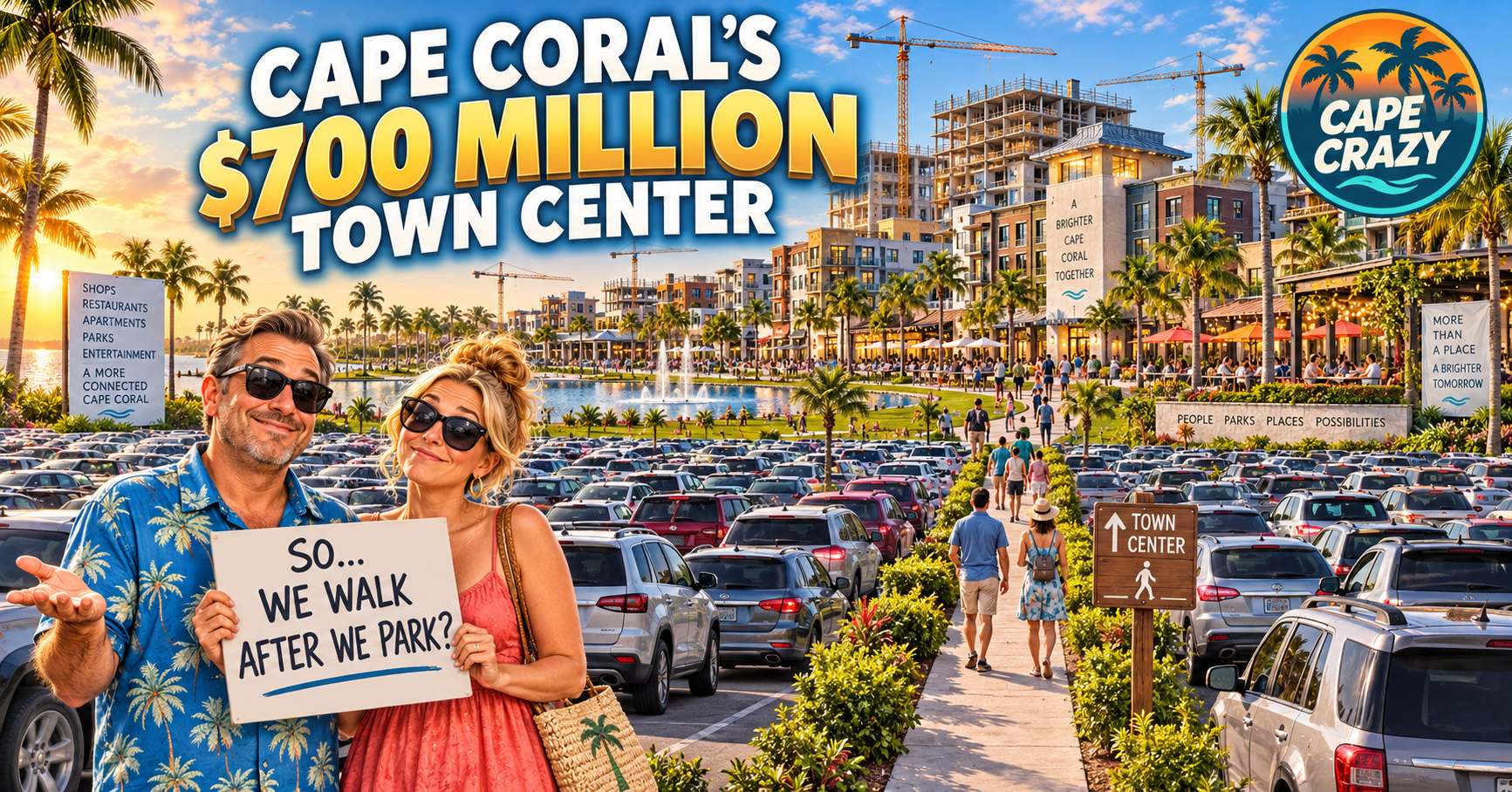
The planned $700 million mixed-use development along Pine Island Road promises apartments, shopping, restaurants, entertainment, a luxury hotel and public parks spread across approximately 131 acres.
Instead of driving from one parking lot to another, visitors may theoretically park once and walk between destinations.
Walking between businesses without relocating the car would be an important cultural milestone for Cape Coral.
What Is Cape Coral Grove?
Cape Coral Grove is planned for 2301 SW Pine Island Road, between Chiquita Boulevard and Burnt Store Road.
Developer L&L Development Group describes it as an outdoor town center combining stores, restaurants, entertainment, hospitality and residential apartments. The company says the project will include more than 350,000 square feet of leasable commercial space. L&L Development lists Cape Coral Grove in its official portfolio.
The proposed development reportedly includes:
- 1,234 market-rate apartments
- A 125-room luxury hotel
- More than 350,000 square feet of shopping, dining and entertainment
- Movie theater
- Bowling alley
- Comedy club
- Two public parks
- Approximately 5,412 free parking spaces
The project’s website also advertises a national grocery store, local retailers, national brands, restaurants, hospitality businesses and community programming. Cape Coral Grove’s project website describes the town-center concept.
That is considerably more ambitious than another strip mall containing a nail salon, insurance office and restaurant that changes names every nine months.
Construction Is Planned in Phases
A recent HomeQwest Realty article reports that ground infrastructure work began during the first quarter of 2026.
That early work reportedly includes:
- Site grading
- Underground utilities
- Stormwater infrastructure
- Road improvements
- Connections to Pine Island Road
The article says vertical construction—the point at which actual buildings begin rising from the site—was targeted for the third quarter of 2026.
Because the third quarter ends in September, that timeline is worth watching closely.
The developer’s publicly available website confirms the project and its overall vision but does not provide a detailed, current construction schedule. As of this article’s publication, we did not find an independent announcement confirming that vertical construction had begun.
That does not mean the project has stalled. Construction targets regularly shift because of permitting, infrastructure, financing, weather and contractor availability.
It does mean residents should treat “targeted for Q3” as a goal, not a guaranteed opening date.
Cape Coral has seen enough impressive renderings to understand the difference between “planned,” “approved,” “under construction” and “now open.”
Those are four entirely different stages of development.
Sometimes separated by several years and at least one hurricane.
When Will Cape Coral Grove Open?
There is no single grand-opening date for the entire development.
Cape Coral Grove is expected to be built in multiple phases, with early businesses and residential buildings opening before the full project is completed.
HomeQwest suggests that residents could see early tenant openings within 12 to 24 months, while the complete development may not be finished until later in the decade.
That means Cape Coral Grove will not suddenly appear one morning with 350,000 square feet of shopping, more than 1,200 apartments and a fully operational comedy club.
The project will arrive piece by piece.
This is probably best for Pine Island Road, which should be allowed time to process what is happening.
Cape Coral May Finally Get a Town Center
The most interesting part of the proposal is not its size.
It is the design.
Cape Coral is geographically enormous but does not have a traditional downtown core serving the entire city. The South Cape has an entertainment district, restaurants and redevelopment activity, but residents in northwest and northeast Cape Coral can live many miles away from it.
Most commercial activity elsewhere is spread along major roads in plazas separated by wide streets and large parking areas.
Cape Coral Grove promises a more concentrated destination where residents can live, eat, shop and attend entertainment without driving to a separate property for each activity.
The project website emphasizes sidewalks, green space, parks and gathering areas.
If completed as promoted, the Grove could give northern Cape Coral something residents have requested for years: a substantial commercial and entertainment destination closer to home.
It could also give residents a place to say, “Meet me at the Grove,” instead of, “Turn left after the storage facility, and if you reach the fourth Dollar General, you went too far.”
The Traffic Question
A development with 1,234 apartments, a hotel, entertainment venues, hundreds of thousands of square feet of commercial space and more than 5,000 parking spaces will generate traffic.
Lots of it.
Cape Coral Grove sits along a corridor already handling residential growth and increasing commercial activity.
Road improvements are reportedly part of the infrastructure work, but residents should watch for details concerning:
- New or modified intersections
- Traffic signals
- Turn lanes
- Pedestrian crossings
- Access from surrounding roads
- Bicycle connections
- Emergency access
- Effects on Pine Island Road congestion
A walkable development is helpful once people reach it.
Most Cape Coral residents will still arrive by car.
Five thousand parking spaces do not fill themselves.
What About Jobs and Economic Impact?
The HomeQwest article cites projections of:
- Approximately $1.3 billion in total economic impact
- 6,500 direct construction jobs
- More than 1,000 permanent jobs
- Additional commercial tax revenue for Cape Coral
Those figures are projections, not completed results.
Permanent jobs could eventually include positions in retail, restaurants, entertainment, hospitality, property management and administration.
The development should also expand Cape Coral’s commercial tax base if completed and successfully occupied.
That matters because Cape Coral has historically depended heavily on residential property. More commercial development can diversify the local economy and generate revenue from businesses and visitors.
However, claims that commercial growth will “ease the tax burden” on homeowners should be evaluated carefully.
A larger commercial tax base can improve the city’s financial position, but it does not automatically produce lower residential tax bills. That depends on property values, city spending, tax rates and future council decisions.
Economic-impact projections are not coupons redeemable at the property-tax office.
Will It Increase Nearby Home Values?
The linked article argues that properties near Cape Coral Grove are positioned for appreciation and encourages buyers and investors to act before vertical construction begins.
That portion should be understood for what it is: real-estate marketing.
A large, successful development can make nearby neighborhoods more desirable by adding restaurants, stores, jobs and entertainment. It can also increase traffic, noise and construction activity.
Property values are affected by many factors, including:
- Interest rates
- Insurance costs
- Flood risk
- Housing inventory
- The overall economy
- Utility assessments
- The project’s eventual tenants
- How long construction takes
- Whether the completed development matches the renderings
Nobody can guarantee that purchasing a house near Cape Coral Grove will produce a specific return.
The Grove may become a major selling point for surrounding neighborhoods. It may also take years before its full effect can be measured.
Anyone considering a real-estate purchase should evaluate the property on its own financial merits—not because an advertisement promises a “pre-construction value lift.”
If appreciation were guaranteed, the developer would probably keep all the nearby houses.
The Tenant List Will Matter
Renderings show buildings.
Tenants create destinations.
The long-term success of Cape Coral Grove will depend heavily on which businesses commit to the project.
A movie theater, bowling alley, comedy club, luxury hotel and national grocer would fill several gaps in Cape Coral’s entertainment and hospitality market.
But those uses remain part of the announced plan until leases are signed and tenants are publicly identified.
Residents should watch for:
- Named anchor tenants
- Executed leases
- Building permits
- Construction commencement announcements
- Road and utility milestones
- Opening dates for individual phases
The difference between a transformative town center and a very attractive collection of apartment buildings may ultimately be the commercial lineup.
Cape Coral residents have plenty of housing.
The promise of the Grove is everything surrounding it.
A Potentially Transformative Project—With an Asterisk
Cape Coral Grove could become one of the most important developments in the city’s history.
Its scale is substantial. Its location places it near some of Cape Coral’s fastest-growing neighborhoods. Its mix of homes, businesses, entertainment and public space could create the kind of destination the city has long lacked.
There is reason for optimism.
There is also reason to keep the promotional language in perspective.
The $700 million figure describes the planned investment. The $1.3 billion economic-impact number is a projection. The employment figures are estimates. The predicted increase in surrounding property values is a marketing claim.
The project should be judged by visible milestones:
Infrastructure installed.
Buildings rising.
Tenants announced.
Businesses opening.
Parks completed.
Sidewalks filled.
Cape Coral has the plans.
The next step is replacing the renderings with reality.
And if the development really allows residents to park once, walk to dinner, see a movie and attend a comedy show without returning to their vehicle, Cape Coral Grove may have achieved something more impressive than its $700 million price tag.
It may have taught Cape Coral to walk.
Sources: HomeQwest Realty — Cape Coral Grove: $700M Town Center Breaks Ground in 2026, L&L Development Group — Cape Coral Grove and the official Cape Coral Grove project website.
Cape Crazy commentary is satire and opinion based on publicly available development plans. Project components, tenants, schedules, costs and economic projections may change as construction progresses.
Is This Crazy or Not?
- Not Crazy: Building a genuine mixed-use destination in one of Florida’s largest cities.
- Potentially Crazy: Adding more than 5,000 parking spaces and calling the result walkable.
- You Decide: Will Cape Coral Grove become the city center residents have been waiting for—or another beautiful rendering waiting for its buildings?
Leave a Reply