Category: Government

  • Scammers Impersonate Cape Coral Planning and Zoning, Apparently Approve Themselves Without a Public Hearing

    Scammers Impersonate Cape Coral Planning and Zoning, Apparently Approve Themselves Without a Public Hearing

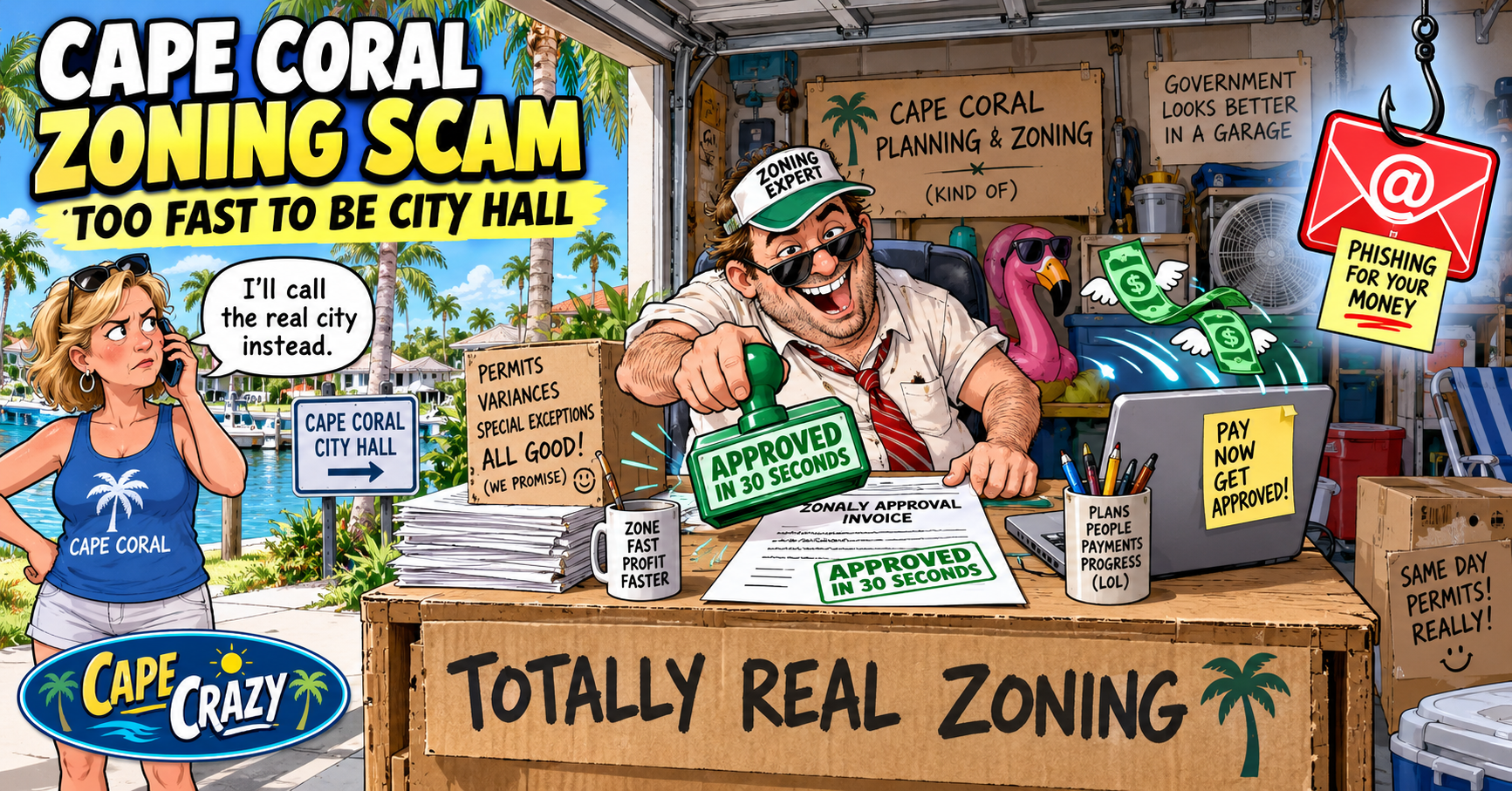
    The City of Cape Coral is warning residents and businesses about fraudulent emails impersonating its Planning and Zoning staff.

    The messages may appear to involve legitimate city business, but they originate from nongovernment email addresses and attempt to persuade recipients to respond, click a link or make a payment.

    This is alarming for several reasons.

    First, scammers are trying to steal people’s money.

    Second, someone has discovered how to complete a Cape Coral development-related transaction without scheduling a meeting, commissioning a traffic study or attending a six-hour City Council hearing.

    That alone should have raised suspicion.

    Welcome to the Department of Fraudulent Planning

    The latest warning was posted by the city on social media.

    Cape Coral says fraudulent messages are circulating that impersonate Planning and Zoning personnel. Anyone receiving a suspicious email should avoid responding or clicking links and verify the message directly with the city.

    Cape Coral’s Zoning Division can be reached at 239-574-0553 or Zoning@capecoral.gov.

    Do not use the phone number or email address supplied inside a suspicious message. Look up the city’s contact information independently or use the official information above.

    A legitimate City of Cape Coral employee will communicate through an address ending in @capecoral.gov.

    An email from an address such as:

    CapeCoralSuperOfficialPlanningDepartmentDefinitelyReal@usa.com

    is probably not being sent from City Hall.

    It may contain the words “Cape Coral.”

    May include a city seal.

    Even may use professional language.

    But adding a municipal logo to an email does not make someone a city employee any more than wearing a pirate hat makes someone the harbormaster.

    Scammers Have Discovered Zoning

    This is not Cape Coral’s first warning involving fraudulent municipal emails.

    Earlier in 2026, the city alerted residents about fake invoices made to look as though they came from the city. Those messages reportedly requested payment by wire transfer and were sent from nongovernment email accounts.

    The city later warned of emails impersonating the Planning Commission. Those messages referenced an “invoice settlement” and sometimes used free email domains such as @usa.com to appear official.

    The latest alert again involves scammers pretending to represent Planning and Zoning.

    Apparently, ordinary phishing has become too competitive.

    Criminals are now specializing.

    Some scammers impersonate banks.

    Others pose as delivery companies.

    Cape Coral’s scammers have selected municipal land-use administration.

    That is an extraordinarily specific career path.

    One imagines the criminal training program:

    “Today we will cover password theft. Tomorrow: conditional-use permits and the proper deployment of a fraudulent site-plan invoice.”

    Why These Emails Can Look Convincing

    Municipal scams work because residents and businesses may reasonably expect to receive official-looking communications involving permits, applications, inspections, zoning cases or invoices.

    A contractor may have several projects moving through the city at once.

    Property owner may be waiting for information about a permit.

    A developer may receive legitimate requests for plans, corrections, fees and supporting documents.

    Then an email arrives claiming immediate payment is required.

    The message may contain:

    • A city logo or seal
    • Official-sounding terminology
    • Property or project information
    • A payment deadline
    • A link or attachment
    • Instructions to send money
    • A threat that the application will be delayed or canceled

    That last threat is especially clever.

    Nothing motivates a Cape Coral applicant quite like the possibility of adding more time to the permitting process.

    The scammer hopes the recipient will be sufficiently worried—or sufficiently accustomed to complicated government correspondence—that they will follow the instructions without independently checking them.

    The First Clue: Unusual Payment Instructions

    The City of Cape Coral has previously stated that it does not request payment by wire transfer or third-party payment applications such as PayPal, Venmo or Zelle.

    Therefore, a message stating:

    “Your rezoning application will be approved after you send $4,800 through Zelle to PlanningDirector1978”

    should not be treated as a normal step in the development process.

    The city does charge legitimate fees.

    Those payments should be made only through an official city process or after confirming the invoice directly with city staff.

    Scammers often create urgency because urgency prevents people from slowing down and asking questions.

    They may claim payment is overdue, a permit is about to expire or a project will be suspended unless money is transferred immediately.

    Real government may occasionally move faster than expected.

    But when a zoning department demands money within 30 minutes using a gift card, skepticism remains appropriate.

    Never Trust the Display Name

    An email inbox may show a friendly name such as:

    Cape Coral Planning Department

    That name can be typed by anyone.

    The actual email address matters.

    Expand the sender details and look closely at the address after the @ symbol.

    Legitimate city email should come from capecoral.gov.

    Lookalike addresses can be deceptive:

    None of those is the official capecoral.gov domain.

    Scammers may replace a letter with a number, add a hyphen or register a domain that looks believable at a glance.

    They rely upon recipients reading quickly.

    This is why every suspicious message deserves the same level of scrutiny normally reserved for a proposed high-rise appearing next to a neighborhood of single-family homes.

    Do Not Click the Helpful Button

    Fraudulent emails often include buttons labeled:

    • View Invoice
    • Submit Payment
    • Review Documents
    • Resolve Account
    • Open Permit
    • Prevent Immediate Zoning Catastrophe

    The button may lead to a fake login page designed to steal a username and password. It could also download malicious software or direct the victim to fraudulent payment instructions.

    Attachments can be dangerous as well.

    A file named Cape_Coral_Invoice.pdf may be legitimate.

    It may also be the digital equivalent of accepting an unlabeled package from someone hiding behind a palm tree.

    If the message is unexpected, do not open the attachment.

    Call the department using a verified number and ask whether the email is genuine.

    A two-minute phone call is considerably less inconvenient than explaining to the bank why the “Planning Department” now has your money and your Microsoft 365 password.

    Scammers Appreciate Teamwork

    Businesses are particularly vulnerable because one employee may receive an invoice while another controls payment.

    The person processing the bill may assume someone else requested the work.

    Scammers sometimes study public records, planning agendas, permit databases and company websites to identify active projects and the people involved.

    They can then create a message containing real information.

    A legitimate project name does not make the sender legitimate.

    Cape Coral conducts much of its government business publicly. Agendas, applications, property records and development information may be available online.

    That transparency is valuable.

    It also gives criminals enough details to produce a reasonably convincing costume.

    Businesses should require independent verification before changing payment instructions or sending money to a new account.

    If an email requests a wire transfer, changes banking information or demands an unusual form of payment, call a known city contact.

    Do not call the number in the email.

    That merely gives the scammer an opportunity to impersonate two departments instead of one.

    What to Do If You Receive One

    If a suspicious message claims to come from Cape Coral Planning and Zoning:

    1. Do not reply.
    2. Don’t click links.
    3. Do not open attachments.
    4. Do not send money.
    5. Check the sender’s complete email address.
    6. Contact Cape Coral Zoning independently at 239-574-0553 or Zoning@capecoral.gov.
    7. Preserve the email in case the city or law enforcement requests it.

    If you already clicked a link or entered a password, change that password immediately using the legitimate website—not the link in the message.

    If the same password was used elsewhere, change it there too.

    Enable multifactor authentication where available.

    If money was transferred, contact the bank immediately. Fast reporting may improve the possibility of stopping or recovering a fraudulent payment.

    The incident may also be reported to law enforcement and the Federal Trade Commission at ReportFraud.ftc.gov.

    The Real City Already Has Your Paperwork

    Cape Coral residents should remember that scammers thrive on confusion.

    Government processes involve many departments, unfamiliar terms and official documents. Criminals exploit that complexity by creating messages that feel plausible enough to avoid immediate rejection.

    The safest response is simple:

    Stop and verify.

    City employees will not be offended because someone called an official number to confirm an invoice or request.

    In fact, the city is specifically asking people to do that.

    A genuine employee would rather answer a verification call than help investigate why someone transferred thousands of dollars to a stranger operating the fictional Department of Emergency Zoning Settlements.

    Cape Coral Planning and Zoning may review land uses, development applications and property regulations.

    It does not conduct business through mystery email accounts.

    It does not need payment through your cousin’s Venmo.

    And it will not approve a zoning change in exchange for six Apple gift cards—no matter how efficiently the sender promises to process it.

    Sources: City of Cape Coral on X — Scam Alert: Fake City Emails, City of Cape Coral — Planning Commission email scam warning and City of Cape Coral — Fraudulent invoice warning

    Cape Crazy commentary is satire based on official City of Cape Coral fraud warnings. The scam itself is real, and suspicious communications should be verified directly with the city.

    Is This Crazy or Not?

    • Crazy: Sending money to a stranger because an email contains a city logo.
    • Not Crazy: Calling the official department to verify the request.
    • You Decide: Was the first warning sign the fake address—or a zoning transaction moving suspiciously fast?
  • Cape Coral Invites Residents to Adopt a Median Because Apparently Roads Need Parents Too

    Cape Coral Invites Residents to Adopt a Median Because Apparently Roads Need Parents Too

    Have you ever driven through Cape Coral, looked at the strip of grass separating traffic and thought:

    “I would like to become financially and emotionally responsible for that”?

    Good news.

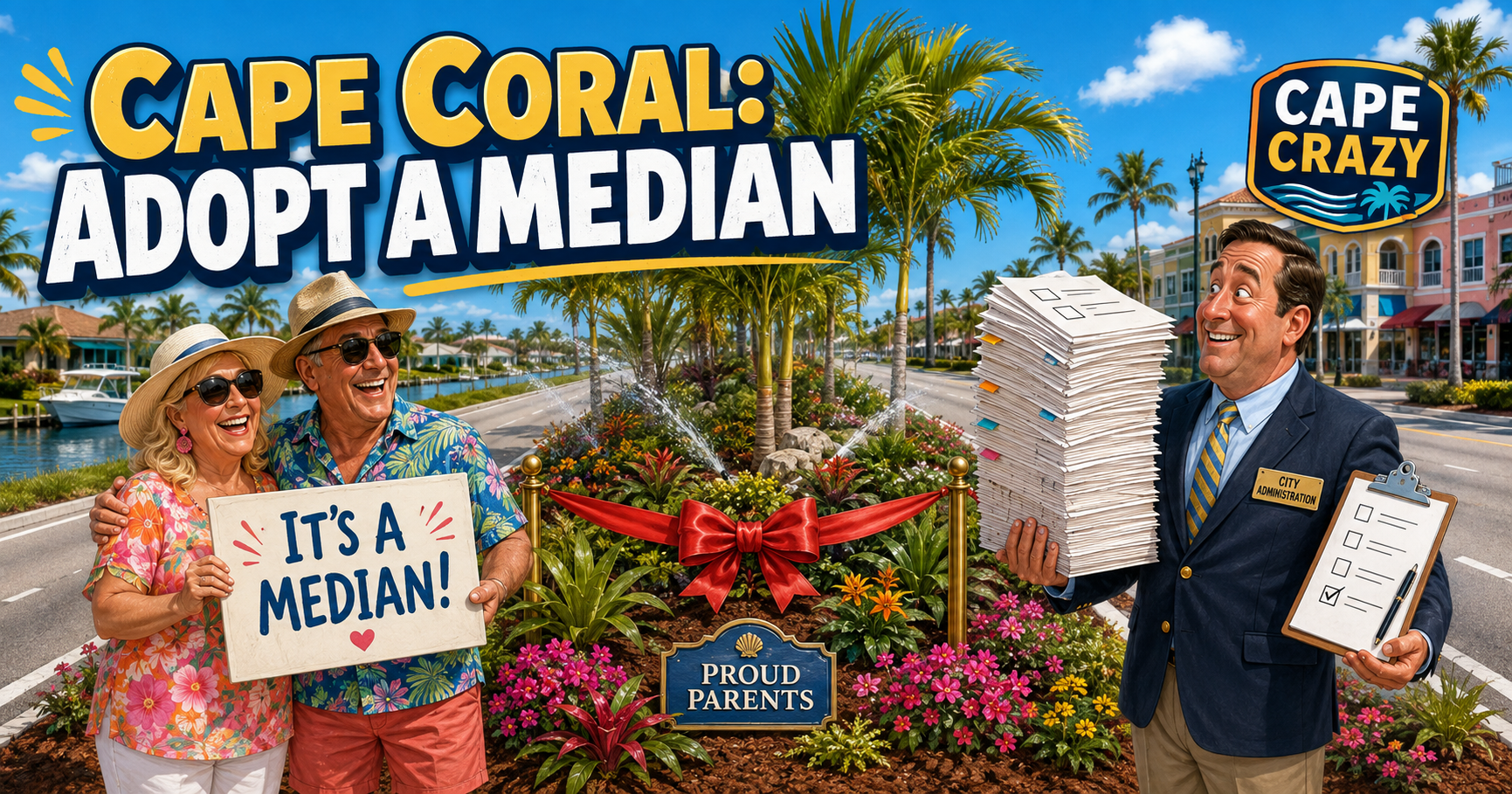
    The City of Cape Coral is reminding residents, businesses and organizations that they can participate in its Median Beautification Program—an opportunity to fund landscaping in a roadway median and receive recognition for the contribution.

    It is basically an adoption program, except the adoptee is several hundred feet of municipal dirt, does not wag its tail and may require an irrigation plan.

    Once the landscaping is installed and accepted, the city will maintain it perpetually.

    Until then, congratulations.

    You have a median.

    Find Your Forever Median

    Cape Coral contains more than 400 miles of canals, approximately 1,800 miles of roadways and a substantial number of medians sitting between them.

    Some are beautifully landscaped.

    Others contain a combination of grass, weeds and one palm tree that appears to have lost the will to continue.

    Through the Median Beautification Program, community members can pay to transform one of those overlooked strips into something more attractive.

    The city describes this as “adopting” a median.

    That terminology raises several questions.

    Will applicants be evaluated to ensure they can provide a stable home?

    Does the median come with its vaccination records?

    Can the city perform a home visit?

    And if two businesses want the same median, does the city decide which one has the larger yard?

    Fortunately, the program does not require anyone to bring the median inside.

    That would be impractical and probably violate several zoning regulations.

    Adoption Requires More Than Love

    Residents should not arrive at City Hall carrying three hibiscus plants and announce that they are ready to become a median parent.

    The process is slightly more involved.

    Prospective participants must first review the city’s landscaping standards, which cover approved design templates, plant palettes, roadway themes and intensity levels.

    They must then schedule a meeting with the Public Works Department before completing the application.

    Required documentation may include:

    • Median landscape and irrigation application
    • An applicant affidavit
    • Detailed description of the work
    • A vicinity map
    • Utility locations within 20 feet
    • A planting plan
    • Plant sizes and species
    • Hardscape locations
    • An irrigation plan
    • The proposed water source
    • A landscape plan placed over the city’s sight-distance study

    This is more documentation than some people provide when adopting an actual child.

    The plants cannot simply be attractive.

    They must be attractive in a manner that has been properly mapped, irrigated, dimensioned and approved by Public Works.

    Your bougainvillea may be beautiful, but does it comply with the roadway theme and approved intensity level?

    If not, it can take its unauthorized color elsewhere.

    Two Phases of Median Parenthood

    Applicants may complete the project all at once or divide it into no more than two phases.

    Phase One must include items such as curbing, soil amendments, irrigation, trees or palms, sod and mulch.

    Phase Two may include ground cover, shrubs, irrigation revisions, additional theming and even more mulch.

    Cape Coral apparently recognizes that no major public project is truly complete until somebody has approved additional mulch.

    Each stage must be finished before the next one begins. Inspections may also generate “punch list” items that must be corrected before the project can move forward.

    Until the landscaping receives final approval and acceptance, the applicant is responsible for maintaining the median.

    So yes, you can adopt a median.

    But for a while, you must also feed it, water it and drive past occasionally to make sure it has not joined a rough crowd.

    Once the city officially accepts the completed landscaping, municipal crews assume perpetual maintenance.

    At that point, the median has successfully graduated, moved out and obtained a government job.

    For $10,000, Your Logo Can Watch Traffic

    The city provides recognition signs for qualifying sponsors.

    Beautified medians shorter than approximately 400 feet may receive one sign. Medians measuring 400 feet or longer may qualify for two—presumably because motorists traveling in both directions deserve to know who paid for the shrubbery.

    A minimum contribution of $10,000 is required for a sponsor to receive recognition on the sign.

    That means the median-adoption package includes:

    • The satisfaction of improving Cape Coral
    • A professionally approved collection of plants
    • Perpetual municipal maintenance after acceptance
    • A sign bearing your name or business logo
    • Thousands of daily impressions from motorists attempting to remember whether they needed to turn left

    This could be a worthwhile opportunity for a local business.

    Traditional advertising disappears after the campaign ends.

    A landscaped median remains in place, steadily reminding everyone:

    “Someone cared enough about this intersection to spend at least $10,000 on plants.”

    The sign will remain as long as the recognized business maintains an active Florida business license or the individual sponsor continues residing in Cape Coral.

    If you move away, the city apparently takes custody of your sign.

    Shared median parenting is complicated.

    Please Resist the Urge to Customize It Yourself

    Residents should not treat this program as permission to perform midnight median renovations.

    You cannot quietly plant tomatoes on Del Prado Boulevard, install a garden gnome on Cape Coral Parkway and submit an adoption application afterward.

    All designs must comply with the city’s approved standards.

    That is understandable.

    Landscaping in a roadway median affects visibility, utilities, drainage, irrigation and traffic safety. An enormous decorative hedge may look impressive until it prevents drivers from seeing approaching vehicles.

    The city also needs plant selections capable of surviving Florida heat, intense rain, hurricanes, irrigation failures and the occasional motorist who interprets “median” as “emergency turning lane.”

    Standardized plans help ensure that the landscaping is attractive, safe and maintainable.

    They also prevent Cape Coral’s medians from gradually becoming a citywide exhibition of personal lawn ornaments.

    No inflatable flamingos.

    12-foot skeletons probably not.

    No handwritten political signs.

    No miniature replica of the giant flagpole—unless, presumably, it appears on the approved plant palette.

    This Is Actually a Pretty Good Program

    Beneath the jokes, the Median Beautification Program is a reasonable public-private partnership.

    Businesses and community organizations can improve highly visible public spaces. Residents get more attractive roadways. Sponsors receive recognition, and the city assumes long-term maintenance after the project has been properly completed.

    The city may even contribute toward especially valuable projects if City Council reviews and approves the request.

    That does not mean every resident will be eager to spend thousands of dollars landscaping public property.

    Most of us still have areas of our own yards that look like they are waiting for FEMA assistance.

    But companies, neighborhood organizations and civic groups may find the program appealing—particularly if they want their contribution to remain visible in the community.

    The process is deliberately detailed because the landscaping will occupy a public roadway, not someone’s backyard.

    Still, there is something wonderfully Cape Coral about needing an affidavit, utility map, irrigation source, sight-distance overlay, phased construction plan and multiple inspections before being allowed to donate a shrub.

    Your Median Is Waiting

    Anyone interested in participating must contact the Public Works Department before submitting an application.

    The city recommends reviewing the approved design elements and program requirements first. Questions can be directed to City Arborist Omar Leon at 239-242-3216 or oleon@capecoral.gov.

    Potential applicants should remember that adopting a median is a long-term emotional commitment.

    Choose carefully.

    Visit several medians.

    Spend time together.

    Make sure your personalities are compatible.

    One day, after the meetings, affidavits, utility maps, irrigation plans, inspections and final acceptance, you may drive past a beautiful stretch of landscaping and proudly tell your passengers:

    “That’s ours.”

    They will probably respond:

    “Please watch the road.”

    Sources: City of Cape Coral — Median Beautification Program announcement and City of Cape Coral — Adopt-a-Median Program

    Cape Crazy commentary is satire based on the City of Cape Coral’s published program requirements.

    Is This Crazy or Not?

    • Crazy: Completing a minor engineering thesis before donating plants to the middle of a road.
    • Not Crazy: Businesses and community groups helping make Cape Coral more attractive.
    • You Decide: If you adopt two medians, can you claim them as dependents?
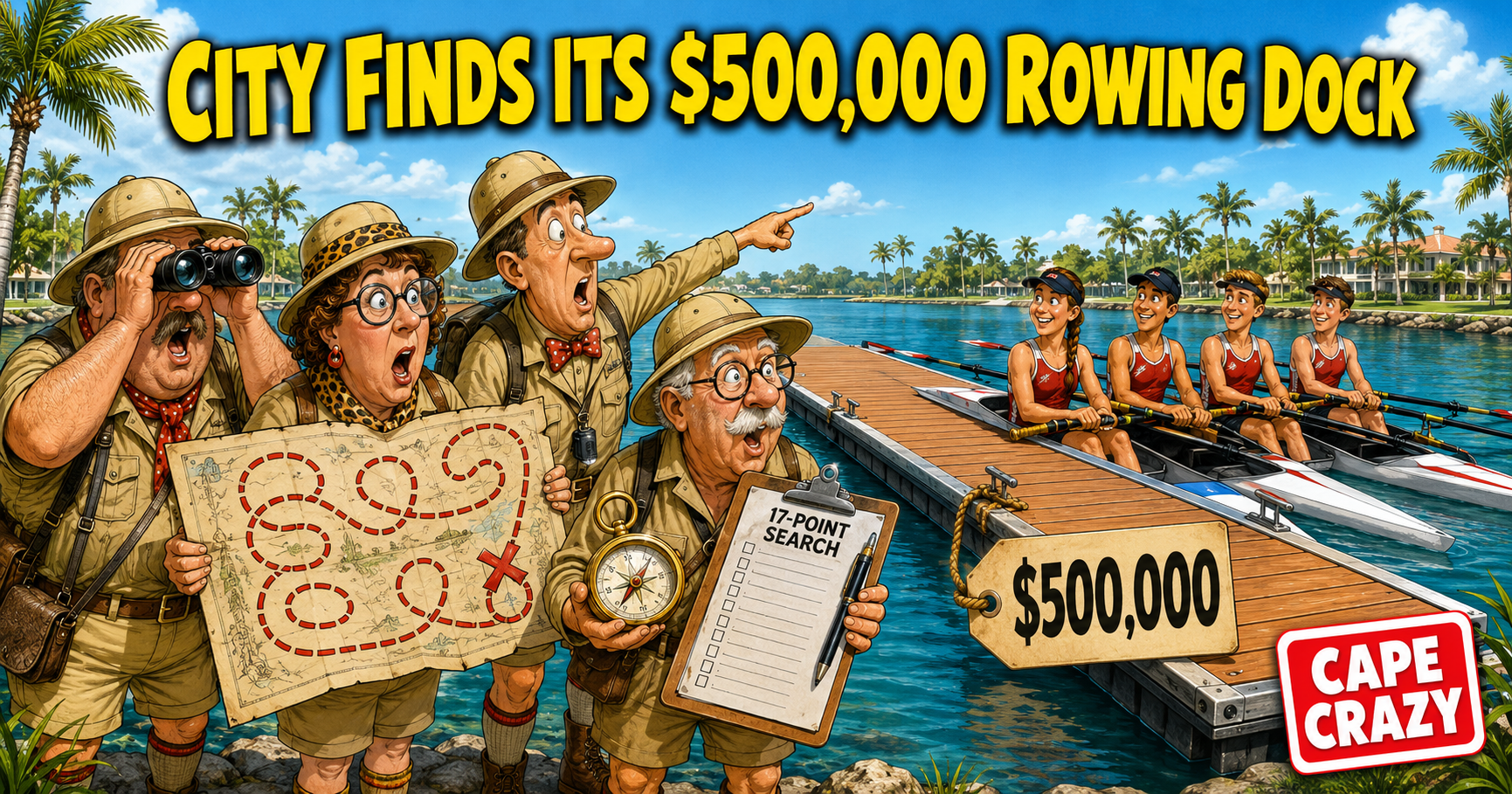
  • Cape Coral Spends Months Searching for Rowing Site, Eventually Discovers the $500,000 Rowing Dock

    Cape Coral Spends Months Searching for Rowing Site, Eventually Discovers the $500,000 Rowing Dock

    Cape Coral has finally solved the mystery of where to put its rowing club.

    The answer, following months of debate, multiple meetings, two alternative locations and a 17-point site-selection matrix, is apparently:

    At the park where the city already spent approximately $500,000 building a dock for rowing.

    In a 6–1 vote, Cape Coral City Council approved an agreement allowing the Cape Coral Rowing Club to operate from Tropicana Park—the same location originally proposed before council deadlocked on the agreement in April.

    Sometimes government takes the scenic route.

    Previously on “Where Should the Rowing Club Row?”

    Earlier this week, we discussed the city’s search for an alternative home for the Cape Coral Rowing Club.

    The club has been temporarily operating from property at Seven Islands, but that site is slated for development. Without another workable location, club officials warned that the nonprofit—which has served youth and adult rowers since 2007—could be forced to dissolve.

    Fortunately, the city had already planned for this.

    Tropicana Park had access to the North Spreader Waterway, room for the club’s equipment and a roughly $500,000 floating dock built specifically with rowing in mind.

    Unfortunately, Cape Coral City Council voted 4–4 on the proposed agreement in April.

    That meant the rowing club could not move to the park containing the rowing dock constructed for the rowing club.

    Cape Coral then began looking for other places where the club might row.

    This is similar to purchasing a new refrigerator, refusing to put food in it and forming a committee to investigate whether the milk could be stored in the garage.

    Bring Out the 17-Point Matrix

    The city eventually developed a 17-point matrix to evaluate possible rowing sites.

    The criteria included water access, canal width, dock clearance, boat-storage space, parking, utilities, electricity and the angle of the launch.

    City officials presented two alternatives: Flagstone Canal and Gator Slough.

    The rowing club responded that neither location would work.

    Club President Saundra Weston said Flagstone Canal could require hundreds of thousands of dollars in improvements and years of permitting. She said Gator Slough was not suitable for rowing because the freshwater canal system was not wide enough and contained weirs.

    There was also a slight mathematical problem with one of the city’s measurements.

    The analysis called for a minimum canal width of 24 feet.

    The rowing club uses boats that can be approximately 60 feet long.

    Anyone who has attempted to turn a sofa in a hallway may recognize the challenge.

    The city had now created two potential alternatives to the original site. One could cost hundreds of thousands of dollars and take years. The other was a body of water the rowing club said it could not properly use.

    Meanwhile, the completed rowing dock at Tropicana Park continued its successful career as a very expensive place to stand near water.

    Then Someone Suggested the Original Plan

    At Wednesday’s council meeting, young rowers and adult supporters spoke about what the club meant to them.

    Weston urged the council to end the uncertainty surrounding the club’s future. She also pointed out the unusual situation of developing rowing proposals without meaningfully involving the person who runs the rowing program.

    Councilmember Jennifer Nelson-Lastra then made a motion to approve the original Tropicana Park agreement instead of proceeding with the two alternatives.

    After a recess so council members could review the agreement, the motion passed 6–1.

    Councilmember Laurie Lehmann, who had worked on the alternative-location proposals, cast the only opposing vote. Mayor John Gunter was absent—which, as Cape Crazy readers may remember, has recently become something of a recurring visual at City Hall.

    And just like that, the city rediscovered Tropicana Park.

    No new canal had to be engineered.

    No 60-foot boat had to be folded into a 24-foot space.

    No additional rowing dock had to be constructed while the existing rowing dock contemplated the meaning of its existence.

    The rowing club would use the rowing facility.

    Government innovation at its finest.

    The Agreement

    The approved agreement gives the Cape Coral Rowing Club an initial 10-year term at Tropicana Park, with the possibility of three additional five-year renewals if both sides agree and the club remains in compliance.

    The club will pay the city a use fee of $10 per year, plus any applicable sales tax.

    Before anyone panics about the fee, the club is a nonprofit providing rowing instruction, camps, classes and community programs for youth and adults. The agreement is about activating a public park through recreational programming, not renting waterfront property to a private luxury resort.

    The park and docks will also remain open to the public. City Attorney Aleksandr Boksner confirmed that the agreement does not give the rowing club exclusive possession of the docks.

    So residents may still fish, tie up their boats and use the park.

    The rowing club will simply be allowed to row there, using the dock built for rowing.

    A Happy Ending—After Several Unnecessary Chapters

    This is ultimately good news.

    The Cape Coral Rowing Club gets a stable home. Young athletes no longer have to wonder whether their program is about to disappear. The city’s substantial investment at Tropicana Park will finally serve its intended purpose.

    Council also deserves credit for reconsidering the issue and reaching a practical decision.

    But Cape Coral did take an impressively complicated journey to arrive at the obvious destination.

    The city:

    1. Planned a home for the rowing club.
    2. Spent approximately $500,000 on a rowing dock.
    3. Deadlocked on letting the rowing club use it.
    4. Studied other locations.
    5. Proposed two alternatives the club said were unworkable.
    6. Returned to the original location.
    7. Approved it 6–1.

    If the rowing club demonstrated that much difficulty moving in a straight line, it would lose every race.

    Fortunately, the rowers appear to know exactly where they are going.

    It was City Hall that needed a few extra laps.

    Sources: Cape Coral Breeze — Rowing club gets Tropicana Park OK and Cape Coral Breeze — City tenders two alternative rowing-club locations

    Cape Crazy commentary is satire based on publicly reported government actions and statements.

    Is This Crazy or Not?

    • Crazy: Spending $500,000 on a rowing dock and then searching for somewhere else to put the rowing club.
    • Not Crazy: Council reconsidered the issue and eventually approved the practical solution.
    • You Decide: Did the city solve the problem—or merely stop creating it?
  • Cape Coral Mayor Loses Primary, Apparently Activates His Out-of-Office Reply

    Cape Coral Mayor Loses Primary, Apparently Activates His Out-of-Office Reply

    Cape Coral Mayor John Gunter lost Tuesday’s primary election—and judging by what happened next, he may have also lost the directions to City Hall.

    According to Gulf Coast News Now, Gunter has been absent from public appearances and City Council meetings since voters decided they would like to try a different mayor.

    That includes Wednesday night’s City Council meeting, where the mayor’s chair sat empty just one day after the election.

    Now, to be fair, losing an election has to sting. Nobody expects the man to wake up the next morning, whistle “Zip-a-Dee-Doo-Dah,” and skip merrily into City Hall carrying doughnuts for everyone.

    But there is usually a short, awkward period between losing an election and actually leaving office. It’s commonly known as “finishing the job.”

    Gunter finished third in the six-candidate primary, receiving 5,665 votes. Rick Erickson led the race with 12,160 votes, followed by Lisa Cohen-Adkinson with 9,280. Erickson and Cohen-Adkinson will now face each other in the November general election.

    Cape Coral voters may have handed Gunter his political eviction notice, but they did not say he needed to vacate the premises before breakfast.

    The Mysterious Case of the Missing Mayor

    An empty chair at a government meeting is not normally shocking. In fact, depending on the meeting, it may be the most productive participant in the room.

    But when the empty chair belongs to the mayor—and appears immediately after he loses an election—it does raise a few questions.

    Is he taking some personal time?

    Is he updating his résumé?

    Is he driving slowly past City Hall while playing sad music?

    Or did he simply decide that if Cape Coral doesn’t want him as its next mayor, Cape Coral can practice not having him as its current mayor?

    We don’t know.

    What we do know is that an election loss does not come with an automatic “skip the rest of your shift” coupon. Most people who learn they’re being replaced are still expected to show up until their final day.

    Try telling your boss, “I didn’t get the promotion, so I’ll no longer be attending meetings,” and see how quickly security begins packing your desk.

    Cape Coral’s Fastest Transition of Power

    Traditionally, outgoing elected officials congratulate the winners, thank their supporters and promise an orderly transition.

    Cape Coral may be pioneering a more efficient approach:

    1. Lose election.
    2. Disappear.
    3. Let everyone else figure it out.

    It eliminates unnecessary paperwork, farewell speeches and the uncomfortable experience of sitting through a council meeting while everyone in the room knows your political career has an expiration date.

    Government efficiency has finally arrived in Cape Coral. It just took the form of an empty chair.

    Maybe Gunter had a legitimate reason for missing the meeting and recent public appearances. If so, the public deserves to hear it. Until then, the timing is difficult to ignore.

    Cape Coral residents did vote for a new direction—but the next mayor has not taken office yet. The current one still has a city to help run.

    Losing gracefully is optional.

    Showing up for work generally isn’t.

    Source: Gulf Coast News Now — Cape Coral mayor absent after primary loss

    Cape Crazy commentary is satire based on publicly reported information. Any speculation above is clearly intended as humor—not a claim that anyone is literally driving around City Hall listening to sad music.

    Is This Crazy or Not?

    • Crazy: You’re still the mayor. Go to the meeting.
    • Not Crazy: Give the guy a day to lick his political wounds.
    • You Decide: Maybe someone should check whether his out-of-office message has a return date.
  • Seven Islands Mangrove Restoration Begins — Because Apparently We’re Undoing the Landscaping Now

    Seven Islands Mangrove Restoration Begins — Because Apparently We’re Undoing the Landscaping Now

    Cape Coral’s Seven Islands project is entering a new phase.

    Not construction.

    Not demolition.

    Not another hearing.

    Restoration.

    Gulf Coast News reported that stabilization work is beginning at the Seven Islands property in preparation for replanting mangroves that were removed earlier this summer. 

    So after a couple months of:

    “Those mangroves weren’t supposed to come out.”

    we have officially reached:

    “Okay, put them back.”

    How We Got Here

    Back in June, the Cape Coral Breeze reported that the U.S. Army Corps of Engineers stopped shoreline clearing at the Seven Islands property after protected red mangroves were removed. The developer said the contractor had been authorized to remove invasive species such as Australian pine and Brazilian pepper, but mangroves were mistakenly removed in the process. 

    Cape Coral resident and geologist David Scott told the Breeze that more than 570 feet of mangrove shoreline had been disturbed. 

    That is a fairly ambitious “oops.”

    Most people accidentally take out:

    • the wrong shrub
    • a sprinkler head
    • maybe half the flower bed

    This apparently involved hundreds of feet of protected shoreline vegetation.

    The Developer Says It Was an Accident

    Gulf Gateway Resort & Marina LLC said in a statement published by the Cape Coral Breeze that protecting the mangroves had been a central part of the Seven Islands planning process and that the removal was inadvertent. 

    The developer said the contractor was supposed to remove only non-native invasive vegetation.

    Which gives us the Cape Crazy landscaping conversation:

    Supervisor:

    “Remove the invasive plants.”

    Contractor:

    “Got it.”

    Later:

    “Why are the mangroves gone?”

    Contractor:

    “Define invasive.”

    Now Comes the Restoration

    According to Gulf Coast News, the next step is stabilization work designed to prepare the shoreline for mangrove replanting. The broader project is intended to create mangrove islands, oyster reefs and other habitat features that can improve water quality and support wildlife. 

    The developer previously said restoration plans had been submitted to the South Florida Water Management Districtand the U.S. Army Corps of Engineers, and that replacement mangroves and restoration materials had already been located. 

    So we have progressed from:

    remove vegetation

    to

    stop work

    to

    write restoration plan

    to

    stabilize shoreline

    to

    replant vegetation

    This may be the longest possible route to getting mangroves exactly where they started.

    Seven Islands Has Bigger Plans

    The Seven Islands property is not exactly a minor development.

    The City of Cape Coral describes it as roughly 48 acres, including seven islands and adjoining properties along the North Spreader Waterway. 

    Earlier reporting on the project described plans for a major mixed-use waterfront destination with residences, a hotel, marina, dining, retail and public amenities. 

    Which means environmental issues here matter.

    This isn’t somebody clearing brush behind a shed.

    It’s a large waterfront development sitting next to sensitive habitat.

    Mangroves Are Not Decorative Shrubs

    The Florida Department of Environmental Protection describes mangroves as native coastal vegetation adapted to salty environments. They provide important shoreline and habitat functions. 

    They are also regulated.

    Which is why:

    “We’ll just put some new ones back”

    is not quite the same thing as replacing a dead hibiscus at Home Depot.

    Restoration involves agencies, permits, shoreline stabilization and actual environmental planning.

    Cape Crazy Translation

    Developer:

    “We’re protecting the mangroves.”

    Contractor:

    “We removed the mangroves.”

    Regulators:

    “Stop.”

    Developer:

    “That was not the plan.”

    Regulators:

    “Correct.”

    Developer:

    “We’ll restore them.”

    Mangroves:

    “We would have preferred option one.”

    The Serious Part

    The restoration work is good news.

    Mistakes happen on large construction projects, but when protected habitat is damaged, the important question is what happens next.

    In this case, regulators stopped the clearing, restoration plans were developed, and shoreline stabilization and replanting are now moving forward. 

    That does not erase what happened.

    But fixing the damage is better than pretending it didn’t happen.

    And if the restoration ultimately improves shoreline habitat with mangroves, oyster reefs and other features, Seven Islands may eventually end up with a stronger environmental plan than it had before.

    Still, the whole sequence is undeniably Cape Crazy:

    Remove protected mangroves.

    Get stopped by federal regulators.

    Then launch a project to put mangroves back.

    That qualifies.

    IS THIS CRAZY OR NOT?

    Mangroves were mistakenly removed at Cape Coral’s Seven Islands development.

    Now crews are beginning stabilization work so the shoreline can be restored and replanted.

    Crazy mistake with a responsible fix?

    Or just an extremely expensive way to learn which plants not to remove?

    Tap an icon to vote.

  • Cape Coral Already Built the Rowing Dock. Naturally, Now We Need Another Plan.

    Cape Coral Already Built the Rowing Dock. Naturally, Now We Need Another Plan.

    Cape Coral has encountered one of those uniquely governmental problems where the solution appears to have been completed before everyone decided they didn’t like the solution.

    The Cape Coral Rowing Club has spent months trying to secure a permanent home.

    The city, meanwhile, already built a large dock at Tropicana Park that earlier reporting says cost roughly $480,000 to $500,000 and was designed with rowing craft — including the club — specifically in mind. 

    So naturally…

    The rowing club isn’t going there.

    Welcome to Cape Coral.

    Step One: Build a Rowing Dock

    According to the Cape Coral Breeze, Tropicana Park’s planning included significant input related to rowing, and the finished park contains a large dock suitable for non-motorized watercraft. The Breeze reported that approximately $500,000 had been spent on the dock infrastructure intended, at least in part, to accommodate the Cape Coral Rowing Club. 

    This seems relatively straightforward.

    Need a place for rowers.

    Build a dock.

    Build park.

    Open park.

    Let rowers row.

    Roll credits.

    Unfortunately, Cape Coral apparently renewed the series for another season.

    Step Two: Don’t Let the Rowing Club Use the Rowing Dock

    Earlier this year, Cape Coral City Council deadlocked 4-4 on a proposed lease that would have allowed the Rowing Club to use part of Tropicana Park for boat storage and access.

    The lease therefore failed. 

    Later, Council voted 5-3 to direct city staff to find a “Plan B” somewhere other than Tropicana Park. 

    Which gives us the Cape Crazy municipal planning formula:

    Plan A: Spend nearly half a million dollars building the thing.

    Plan B: Don’t use the thing.

    Plan C: Figure out where to build another thing.

    Efficiency has entered the chat.

    Crystal Lake: Because Apparently One Dock Wasn’t Enough

    One alternative being discussed is Crystal Lake Park.

    There is one minor difference between Tropicana Park and Crystal Lake.

    Tropicana Park already has the dock.

    Crystal Lake does not.

    The Cape Coral Breeze previously reported that some council members questioned whether moving the Rowing Club to Crystal Lake would require substantial additional city spending because of the shoreline, grading and infrastructure needed. 

    Councilmember Laurie Lehmann has said private sponsors and contractors could potentially help cover or donate some of the work, with an earlier concept involving a much less expensive dock arrangement. 

    Rowing Club officials disagree strongly with that assessment.

    And by “strongly,” we mean very strongly.

    The Rowing Club President Has Some Thoughts

    In an Aug. 17 guest commentary published by the Cape Coral Breeze, Rowing Club president Saundra Westonargued that the alternative proposal being revisited by the city is fundamentally unworkable.

    Weston says she previously met with Lehmann and explained why she believes the plan would not work without significant shoreline preparation, permitting and a properly engineered dock system. She alleges that essentially the same proposal is now resurfacing despite those concerns. 

    Those are Weston’s assertions, and they should be treated as such.

    But even earlier straight-news coverage confirms that Lehmann acknowledged after meeting with Weston that she needed to reconsider aspects of her proposal. 

    So apparently the drawing board was visited.

    Whether anybody actually drew anything new on it is now part of the dispute.

    One Councilmember Already Asked the Obvious Question

    During the May council discussion, Councilmember Keith Long reportedly said he did not support spending additional city money to move the Rowing Club somewhere else.

    According to the Cape Coral Breeze, Long indicated that if relocating the club meant taxpayers paying for another facility, he might reconsider his opposition to Tropicana Park. 

    Which seems like a reasonable question:

    If taxpayers already bought a rowing dock… why are taxpayers shopping for another rowing dock?

    Cape Coral:

    “The first one isn’t being used by the rowers.”

    Taxpayer:

    “Why?”

    Cape Coral:

    “It’s complicated.”

    Taxpayer:

    “Did we pay for it?”

    Cape Coral:

    “Yes.”

    Taxpayer:

    “Could they use it?”

    Cape Coral:

    “Technically…”

    Taxpayer:

    “I’m going to stop you right there.”

    And There Are Actual Kids Caught in the Middle

    This is where the story becomes less funny.

    The Cape Coral Rowing Club says youth participants make up a large portion of its programming and revenue, and the organization has warned that without a stable long-term location it may not be able to maintain those programs. 

    At the opening of Tropicana Park, supporters protested the Council’s decision, and student rowers spoke publicly about uncertainty over where they would train. 

    These aren’t professional athletes demanding a taxpayer-funded luxury training center.

    They’re kids trying to row boats.

    And Cape Coral somehow turned that into a multimonth municipal saga involving:

    • a half-million-dollar dock;
    • an unsuccessful lease;
    • neighborhood opposition;
    • multiple council votes;
    • an alternate park;
    • possible private sponsors;
    • engineering questions;
    • permitting questions;
    • protests;
    • guest commentaries;
    • and something called Plan B.

    NASA got people to the moon with fewer plot twists.

    Why Is Tropicana Park Off the Table?

    Council members opposed to the Tropicana arrangement have raised concerns involving future boat traffic, safety and nearby development around the Seven Islands/Gulf Gateway area.

    Mayor John Gunter previously said he does not support placing the Rowing Club at Tropicana Park and considers Crystal Lake a viable alternative. 

    Those concerns deserve consideration.

    But they also lead directly back to the question critics keep asking:

    Then why was the rowing infrastructure built there in the first place?

    The Cape Coral Breeze reported that rowing use had been contemplated during the park’s planning and design. 

    It’s a little like building a dog park and then announcing:

    “After further review, we’re concerned dogs may be present.”

    Cape Crazy Translation

    Cape Coral:

    “The Rowing Club needs a permanent home.”

    Taxpayers:

    “Okay.”

    Cape Coral:

    “We built a roughly $500,000 dock.”

    Taxpayers:

    “Great.”

    Rowing Club:

    “We’ll use it.”

    Cape Coral:

    “Not so fast.”

    Rowing Club:

    “Why?”

    Cape Coral:

    “We need a Plan B.”

    Taxpayers:

    “What’s Plan B?”

    Cape Coral:

    “Possibly another dock somewhere else.”

    Taxpayers:

    “What was Plan A?”

    Cape Coral:

    “The $500,000 dock.”

    Taxpayers:

    “And what’s wrong with it?”

    Cape Coral:

    “Nothing. It’s open.”

    Taxpayer:

    “I’m going home.”

    The Serious Part

    There may be legitimate reasons Council ultimately decides Tropicana Park isn’t the best long-term location for the Rowing Club.

    Safety concerns can change.

    Development conditions can change.

    Neighborhood impacts deserve consideration.

    And if a privately funded alternative at Crystal Lake truly can provide the club with a safe, permanent home without additional taxpayer expense, that deserves a fair evaluation too.

    But Cape Coral has already spent substantial taxpayer money on infrastructure at Tropicana Park that was designed with rowing use in mind.

    Before spending more money — or allowing this dispute to drag on long enough to jeopardize the youth program — residents deserve a clear explanation of why the already-built solution isn’t the solution anymore.

    Because right now, the situation looks an awful lot like:

    We built the dock.

    The rowers need the dock.

    The rowers can’t use the dock.

    Now let’s talk about another dock.

    And if that isn’t worthy of the Crazy Index, we’re going to need to reconsider our standards.

    IS THIS CRAZY OR NOT?

    Cape Coral taxpayers already funded a roughly half-million-dollar dock at Tropicana Park designed in part with rowing in mind.

    The Rowing Club still doesn’t have a permanent home.

    And city officials continue exploring another location that may require new infrastructure.

    Is there something we’re missing here?

    Or is this exactly as crazy as it sounds?

    Tap an icon to vote.


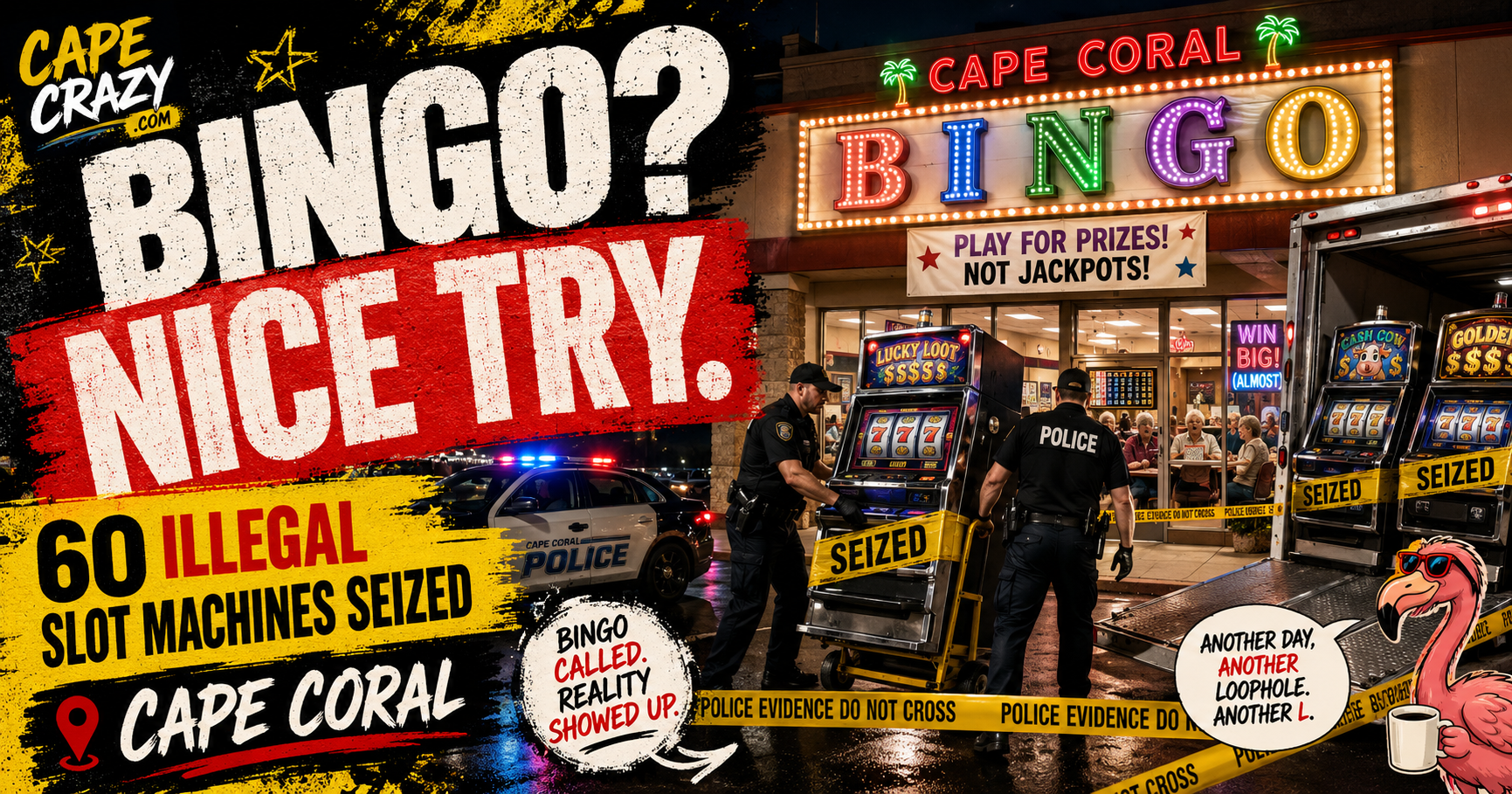
  • Cape Coral Bingo Hall Loses 60 ‘Bingo’ Machines — Regulators Say Nice Try

    Cape Coral Bingo Hall Loses 60 ‘Bingo’ Machines — Regulators Say Nice Try

    There are few things more Florida than trying to solve a legal problem with a label.

    According to WFTV, Florida gaming regulators and Cape Coral police recently seized 60 illegal slot machines from Uptown Bingo on Santa Barbara Boulevard during an enforcement effort called “Operation Going Downtown.”

    Yes.

    The business was called Uptown Bingo.

    Operation was called Going Downtown.

    Somewhere, a government employee was extremely pleased with that name.

    Apparently “Bingo” Is Not a Legal Force Field

    The Florida Gaming Control Commission says electronic machines that display bingo results through slot reels or other games of chance do not become legal simply because somebody calls them “bingo” or “instant bingo.” 

    Which is disappointing news for anyone whose legal strategy was:

    Step 1: Install slot machine.
    Step 2: Put “BINGO” sticker on it.
    Step 3: Become untouchable.

    Regulators, unfortunately, appear to have discovered Step 2.

    FGCC Commissioner Peter Cuderman said some operators use bingo themes on slot-style machines while falsely claiming the games are legal. 

    Cape Crazy translation:

    Machine:

    “I look exactly like a slot machine.”

    Operator:

    “No, no. You’re bingo.”

    Machine:

    “I have spinning reels.”

    Operator:

    “Bingo reels.”

    Regulator:

    “Everybody step away from the machine.”

    Sixty Machines Is Not Exactly an Accidental Bingo Night

    This wasn’t one suspicious machine sitting in a corner next to the coffee pot.

    Sixty machines were seized.

    At that point, you’re not really dealing with:

    “Oops, we misunderstood the rules.”

    You’re dealing with enough machines to make the phrase “bingo hall” do some very heavy lifting.

    You can almost imagine somebody walking through the building asking:

    “Where are the bingo cards?”

    Staff:

    “They’re… electronic.”

    “Where are the bingo balls?”

    “Also electronic.”

    “Why does everything say JACKPOT?”

    “Very enthusiastic bingo.”

    Florida Does Allow Bingo

    This is where the story gets slightly less ridiculous.

    The FGCC says legal bingo does exist in Florida. People 18 and older can participate in lawful bingo and instant bingo using paper cards, and traditional bingo can be offered by certain qualifying organizations such as charities, nonprofits, veterans’ groups and some residential organizations. 

    What Florida does not allow is taking a slot-style electronic gambling machine and declaring:

    “It’s bingo because we said so.”

    The commission specifically says electronic devices showing slot reels or other games of chance are prohibited as bingo. 

    Apparently semantics only gets you so far.

    Legal Slot Machines Are Pretty Limited in Florida

    WFTV reported that, according to the Gaming Control Commission, legal slot machines in Florida are restricted to eight licensed locations in Miami-Dade and Broward counties, along with facilities operated by the Seminole Tribe of Florida. 

    Cape Coral did not make that list.

    Which means Santa Barbara Boulevard has many attractions.

    Legal slot casino apparently isn’t one of them.

    Cape Coral Has Been Getting a Lot of Gambling Attention

    This also isn’t happening in isolation.

    The Florida Gaming Control Commission has been conducting a broader crackdown on illegal gambling statewide, while working with local law enforcement agencies. Its enforcement division describes itself as Florida’s only statewide law-enforcement agency dedicated specifically to investigating and dismantling illegal gambling operations. 

    And Southwest Florida has already seen other seizures this year.

    The Cape Coral Breeze, citing the Florida Attorney General’s Office, reported that statewide enforcement efforts in 2026 had already resulted in thousands of illegal machines being seized and more than $1 million in proceeds confiscated by June. 

    So regulators appear to be taking the position:

    If it spins, flashes, pays money and isn’t supposed to be there, somebody may eventually come pick it up.

    The Name of the Operation Deserves Recognition

    We need to return to this.

    Operation Going Downtown.

    At Uptown Bingo.

    Government operations don’t always get entertaining names.

    This one earned its paycheck.

    You can imagine the planning meeting:

    Agent:

    “We’re going after Uptown Bingo.”

    Supervisor:

    “We need an operation name.”

    Silence.

    One employee slowly raises a hand.

    “Going Downtown?”

    Everyone:

    “Pack it up. We’re done here.”

    The Serious Part

    Illegal gambling isn’t treated as harmless fun by state regulators.

    The FGCC says unlawful gaming can expose consumers to operations without the protections, oversight and accountability required of legal gambling businesses. The commission actively investigates suspected illegal casinos, bingo halls and other gaming operations statewide. 

    So the seizure itself isn’t really the crazy part.

    The crazy part is apparently believing that slot machine + bingo graphics = legal bingo.

    That formula did not survive inspection.

    IS THIS CRAZY OR NOT?

    Florida regulators and Cape Coral police seized 60 illegal slot machines from a business operating as a bingo hall.

    And regulators felt compelled to remind everyone:

    Calling a slot machine “bingo” does not make it bingo.

    Was that clarification really necessary?

    Apparently in Cape Coral, yes.

    Tap an icon to vote.


  • Four Mile Cove Preserve Closing for Repairs — Hurricane Damage Apparently Still Had a Punch List

    Four Mile Cove Preserve Closing for Repairs — Hurricane Damage Apparently Still Had a Punch List

    Cape Coral’s Four Mile Cove Ecological Preserve is about to become a little less accessible for a while.

    The City of Cape Coral says portions of the preserve will close from August 17 through September 30 so contractors can repair sections of boardwalk damaged by past hurricane-related storm surge. 

    And by “portions,” the city means quite a few of the parts people generally go there to use.

    The closure includes the:

    • boardwalk
    • piers
    • parking area
    • restrooms
    • visitor center
    • Veterans Memorial

    Park programs will also be postponed during the closure. 

    So if your Four Mile Cove plan was:

    “Park the car, use the restroom, walk the boardwalk, visit the pier, stop at the visitor center and see the memorial…”

    Cape Coral Parks & Recreation would currently like to suggest:

    “Perhaps kayaking?”

    The Good News: Not Everything Is Closing

    According to the City of Cape Coral, the kayak launch, docks and picnic area on Kayak Shack Road will remain open. 

    So the preserve is not completely shutting down.

    You just need to approach your outdoor recreation with a slightly more amphibious mindset.

    Walker:

    “Can I use the boardwalk?”

    City:

    “No.”

    Visitor:

    “The pier?”

    City:

    “No.”

    Visitor:

    “Visitor center?”

    City:

    “Also no.”

    Kayaker:

    “How about me?”

    City:

    “You’re good.”

    Somewhere, a kayak just became the VIP entrance.

    Hurricane Damage: The Gift That Keeps on Giving

    The city says the boardwalk was damaged by storm surge from past hurricanes, and contractors will use the closure to repair affected sections. 

    This is one of the strange realities of living in Southwest Florida.

    A hurricane blows through.

    The storm leaves.

    The weather improves.

    The cleanup begins.

    Then three years later someone says:

    “Oh yeah, we still need to fix that boardwalk.”

    Hurricanes apparently don’t just come with wind and rain.

    They come with a multiyear home-improvement list.

    Gulf Coast News Says the Same Thing: Most of the Land-Based Fun Is Taking a Break

    Gulf Coast News reported that the closure includes the preserve’s boardwalk, piers, parking, restrooms, visitor center and Veterans Memorial, while programs at the park will also be postponed. 

    That makes this less of a:

    “One little trail is closed.”

    and more of a:

    “Please enjoy this ecological preserve from the parts we haven’t surrounded with construction signs.”

    To be fair, repairing a damaged elevated boardwalk through mangroves is probably not the kind of project where you tell visitors:

    “Just step around the contractor.”

    Four Mile Cove Is Actually One of Cape Coral’s Better Nature Spots

    Four Mile Cove is one of the city’s significant preserved natural areas, known for its mangrove habitat, wildlife and elevated walking trail.

    That means repairing the boardwalk matters.

    The alternative is eventually reaching the point where your scenic nature walk includes:

    “Watch your step, this section survived a hurricane mostly through optimism.”

    A temporary closure is annoying.

    A surprise trip through a damaged boardwalk is considerably more annoying.

    Expected Reopening: September 30

    The city says all affected amenities are expected to reopen Wednesday, September 30. Signs will be posted to let visitors know about the temporary closure. 

    That gives the project roughly six weeks.

    Which means Cape Coral has officially created one of the most dangerous sentences in municipal government:

    “Expected to reopen…”

    We’re kidding.

    Mostly.

    Put September 30 on the calendar.

    Maybe use pencil.

    Cape Crazy Translation

    Hurricane:

    “I damaged the boardwalk.”

    Cape Coral:

    “We’ll fix it.”

    Hurricane:

    “When?”

    Cape Coral:

    “Eventually.”

    2026:

    “How about now?”

    Cape Coral:

    “Perfect.”

    Visitors & Snowbirds:

    “Can we still walk around?”

    Cape Coral:

    “Not really.”

    Visitors:

    “What can we do?”

    Cape Coral:

    “Do you own a kayak?”

    The Serious Part

    This is really a maintenance story more than a controversy.

    Four Mile Cove is an ecological preserve, and the boardwalk gives people access to sensitive mangrove habitat without having them tromping directly through it.

    If storm surge damaged portions of that structure, repairing it properly protects both visitors and the preserve.

    The inconvenience is temporary.

    The alternative — letting hurricane-damaged infrastructure continue deteriorating — would be considerably worse.

    So for once, Cape Crazy may have to admit:

    Closing something to repair hurricane damage is probably not crazy.

    The fact that Mother Nature can still be sending repair bills years later?

    That’s pretty Florida.

    IS THIS CRAZY OR NOT?

    Cape Coral is temporarily closing much of Four Mile Cove Preserve so crews can finally repair hurricane-damaged boardwalk sections.

    The kayak area stays open.

    Everything else?

    See you around September 30.

    Crazy?

    Or just another item on Southwest Florida’s never-ending hurricane repair list?

    Tap an icon to vote.

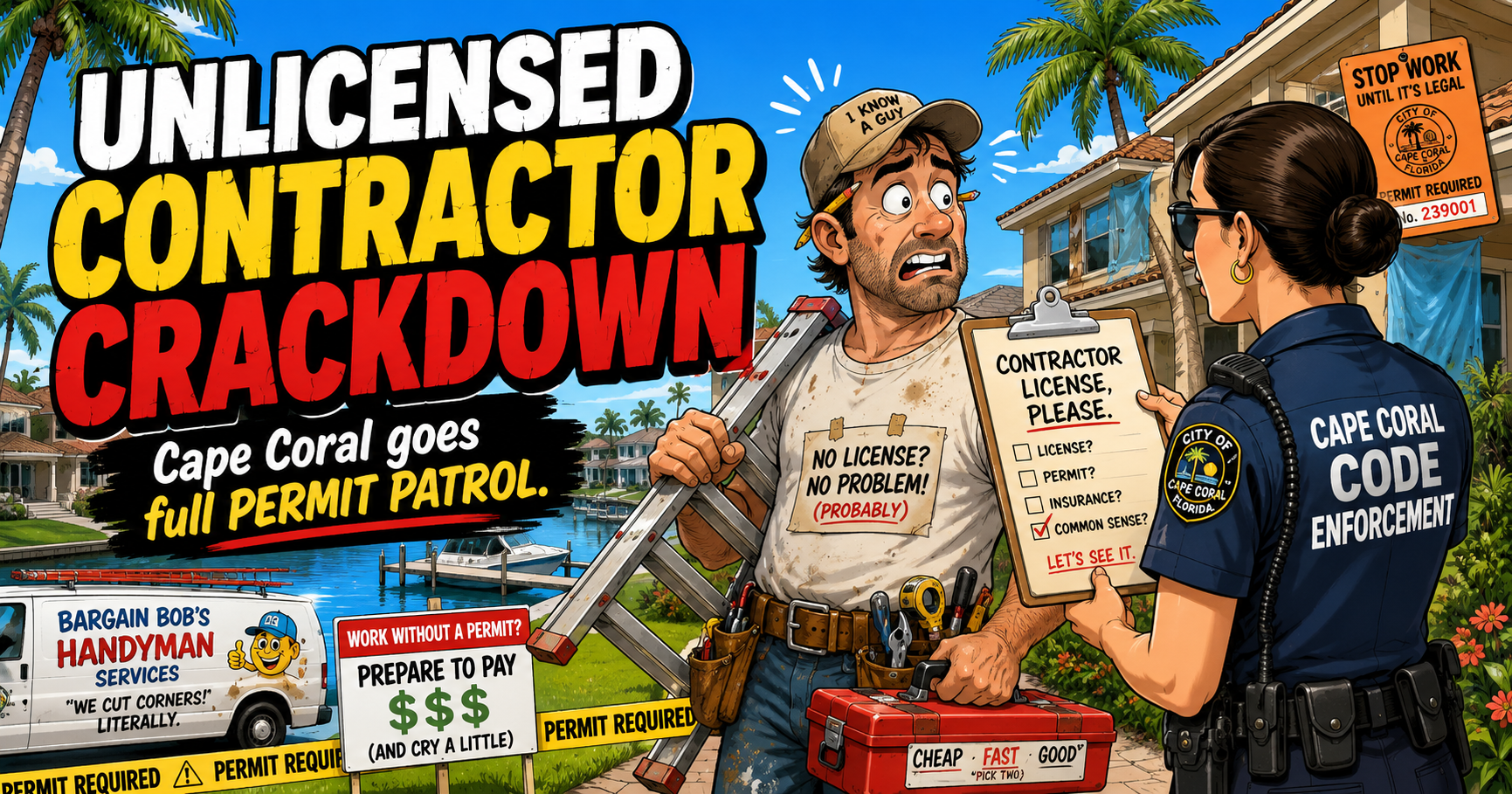
  • Cape Coral Plans Crackdown on Unlicensed Contractors — Because Apparently the Cheap Guy With a Ladder Has Had a Good Run

    Cape Coral Plans Crackdown on Unlicensed Contractors — Because Apparently the Cheap Guy With a Ladder Has Had a Good Run

    Cape Coral is preparing to get a little less friendly toward the guy who says:

    “Yeah, I can do that electrical work. My cousin has a permit somewhere.”

    The Cape Coral Breeze reports that City Council introduced Ordinance 49-26, a proposal aimed at cracking down on unlicensed contracting through code enforcement, civil citations, fines, and even sting operations. 

    In other words:

    Cape Coral has officially entered its “Show me your license” era.

    The Fines Could Get Expensive

    According to the Cape Coral Breeze, the proposed ordinance would allow a code enforcement officer to assess civil penalties of up to $2,000. A special magistrate could impose a penalty of up to $2,500 per violation. 

    That escalates quickly.

    Unlicensed contractor:

    “I can save you $800 on that job.”

    Cape Coral:

    “Excellent. We may have a $2,500 counteroffer.”

    The city defines an unlicensed contractor as someone who does not have the proper State of Florida license required for the type of work being performed. 

    Which means the classic:

    “I’ve been doing this for 20 years.”

    may soon be followed by:

    “That’s nice. Do you have a license?”

    And Yes, There May Be Stings

    The Breeze reports that City Manager Michael Ilczyszyn told council the city expects enforcement to begin reactively, with licensed contractors providing names of people they believe are doing unlicensed work. 

    Eventually, enforcement could become more proactive.

    That includes:

    stings

    and

    just driving around looking for suspicious activity.

    So somewhere in Cape Coral, there may eventually be an undercover operation that sounds like this:

    City employee:

    “Hi, I need my kitchen rewired.”

    Guy from Facebook Marketplace:

    “Sure. Cash only.”

    City employee:

    “Great. One more question.”

    “Can I see your license?”

    Guy:

    “…this feels like a trap.”

    Licensed Contractors May Become Informants

    This might be the most interesting part.

    Ilczyszyn said licensed contractors already know who is doing unlicensed work and that the city expects those names to provide the initial wave of cases. 

    Which means Cape Coral’s construction industry could soon have its own version of neighborhood watch.

    See something. Say something.

    Except instead of suspicious packages, it’s:

    “That guy is installing an electrical panel and I know damn well he isn’t licensed.”

    To be fair, licensed contractors pay for licenses, insurance, training, permits, and regulatory compliance.

    So watching somebody undercut them while skipping all of that probably does not inspire tremendous sympathy.

    Everybody Gets a $5 Souvenir

    To help pay for the enforcement effort, the proposed ordinance would add a $5 surcharge to permits, according to the Breeze. 

    So even the people doing everything correctly get to participate.

    Homeowner:

    “I hired a licensed contractor.”

    City:

    “Excellent.”

    Homeowner:

    “Pulled the proper permit.”

    City:

    “Wonderful.”

    Homeowner:

    “So I’m good?”

    City:

    “Almost. Five dollars, please.”

    Nothing says “thank you for following the rules” quite like an additional fee.

    Will Five Dollars Stop Unlicensed Contracting?

    Councilmember Rachel Kaduk raised a pretty reasonable question.

    The Breeze reports that Kaduk questioned whether a $5 surcharge would actually stop unlicensed work and emphasized that public education also needs to be part of the solution. 

    She also pointed out something painfully realistic:

    People will still hire the cheapest person.

    And therein lies the entire problem.

    Homeowner:

    Licensed contractor: $8,000

    Guy named Rick from Facebook: $3,200 and a case of beer

    Homeowner:

    “Rick seems experienced.”

    City Manager Ilczyszyn told council that enforcement and education need to work together, particularly because some unlicensed contractors prey on people who do not understand the risks. 

    That part is hard to argue with.

    Because Cheap Can Get Expensive Fast

    There is a serious reason for contractor licensing.

    Electrical work.

    Roofing.

    Plumbing.

    Structural work.

    HVAC.

    These are not exactly ideal places for:

    “I watched a YouTube video.”

    Hiring an unlicensed contractor can create problems involving safety, permits, inspections, insurance, warranties, and ultimately the homeowner’s wallet.

    A bad paint job is annoying.

    A bad electrical panel can burn your house down.

    There is a difference.

    So despite all the jokes, the city’s basic goal makes sense.

    The City Says This Will Cost About $150,000

    The Cape Coral Breeze reports that the city estimates the regulatory cost of the proposed program at about $150,000, with revenues expected to offset those costs. The city also estimated about 30,000 building permits could potentially be affected. 

    That is a significant number of permits.

    And a lot of opportunities for someone to ask:

    “Wait. Who exactly is doing this work?”

    The public hearing for Ordinance 49-26 is scheduled for Aug. 19. 

    So this is not final yet.

    Cape Coral residents still have time to weigh in before the city officially unleashes:

    Code Enforcement: Contractor Edition.

    Cape Crazy Translation

    City:

    “Unlicensed contractors are doing work.”

    Licensed contractors:

    “We know who they are.”

    City:

    “Give us the names.”

    Licensed contractors:

    “Gladly.”

    City:

    “Then we’ll do stings.”

    Unlicensed contractor:

    “Wait, what?”

    City:

    “Also fines up to $2,500.”

    Homeowner:

    “But he was cheaper.”

    City:

    “That may be why.”

    The Serious Part

    This one is funny on the surface, but there is a real consumer-protection issue behind it.

    People hire unlicensed contractors because the price is attractive, because they don’t know licensing requirements, or because they assume experience is enough.

    Sometimes it works out fine.

    Sometimes it really does not.

    If Cape Coral can target people performing work that legally requires licensing while also educating homeowners about how to verify contractors, the program could prevent expensive and potentially dangerous situations.

    The question is whether the new enforcement structure is effective enough to justify the additional bureaucracy and permit surcharge.

    IS THIS CRAZY OR NOT?

    Cape Coral wants to fight unlicensed contracting with code enforcement officers, fines up to $2,500, contractor tips, sting operations, and a new $5 permit surcharge.

    Is that smart consumer protection?

    Or are we about to get Cape Coral: Undercover Contractor Unit?

    Tap an icon to vote.

    Sources

    Cape Coral Breeze
    Reported the introduction of Ordinance 49-26, proposed fines, code-enforcement authority, contractor referrals, possible sting operations, the $5 permit surcharge, estimated regulatory costs, and the Aug. 19 public hearing.
    https://www.capecoralbreeze.com/news/local-news/2026/08/06/city-gears-up-for-unlicensed-contractor-crackdown/

  • Cape Coral School Zone Speed Cameras Are Now Active — And They’re Watching

    Cape Coral School Zone Speed Cameras Are Now Active — And They’re Watching

    Cape Coral drivers officially have one more reason to ease off the gas pedal near schools.

    The city’s new RedSpeed school-zone cameras are now active, and drivers who go more than 10 mph over the applicable speed limit during enforcement hours can receive a $100 civil violation in the mail. 

    So if you were one of those people who treated the flashing school-zone lights as a decorative suggestion…

    Congratulations.

    The sign now has backup.

    The Camera Doesn’t Need a Coffee Break

    Cape Coral Police says the cameras operate on school days only and are active:

    • 30 minutes before school starts
    • during school hours
    • 30 minutes after school ends

    When the school-zone lights are flashing, the reduced school-zone speed limit applies. When they are not flashing but school is still in session, the regular posted speed limit applies. In either case, drivers exceeding the applicable limit by more than 10 mph can receive a violation. 

    For example, the police department says driving 31 mph in a 20 mph zone is enough to trigger a citation. 

    Translation:

    20 mph sign: “Please drive 20.”

    Driver:

    “How about 31?”

    Camera:

    “How about $100?”

    Sixteen School Zones Are on the List

    Cape Coral Police says RedSpeed cameras have been permitted at 16 school zones, including Ida S. Baker High School, Challenger Middle School, Mariner Middle School, Cape Elementary, Gulf Elementary, Trafalgar Elementary and several others. 

    And these are not supposed to be mystery cameras hidden behind palm trees.

    The city says each enforced school zone includes signage warning drivers that photo enforcement is in use. 

    So the general sequence is:

    School sign.

    Flashing lights.

    Photo-enforcement warning.

    Speed-limit sign.

    Camera.

    And somehow there will still be someone saying:

    “How was I supposed to know?”

    Yes, It’s $100

    A violation carries a $100 civil penalty and is mailed to the registered owner of the vehicle. Cape Coral Police says the violation does not add points to the driver’s license and does not affect insurance. 

    Vehicle owners can also contest the violation before a local magistrate. 

    So this is not quite:

    “Straight to jail.”

    It is more:

    “Straight to the mailbox.”

    Someone Still Reviews the Ticket

    The system uses radar or laser technology to identify vehicles traveling above the threshold and records photo and video evidence. Cape Coral Police says a certified law-enforcement officer or traffic-infraction enforcement officer reviews the violation before a notice is issued. 

    That matters because the camera isn’t simply taking a picture and immediately launching a $100 invoice into cyberspace.

    There is supposed to be a human review before the citation goes out. 

    Which means somewhere in Cape Coral, a person may now spend part of the day watching motorists fly through school zones and thinking:

    “Really?”

    “Really?”

    “Seriously?”

    “Another one?”

    Where Does the Money Go?

    Cape Coral Police says revenue collected from the violations goes to the City of Cape Coral and is restricted to public-safety uses under Florida law. 

    The city says the purpose of the program is safety: consistent enforcement without having to station police officers in every school zone every day. 

    And that is the serious argument in favor of the cameras.

    Kids are walking, biking, getting dropped off and crossing streets around these schools.

    If drivers are blasting through those areas at 10, 15 or 20 mph above the limit, somebody eventually gets hurt.

    A camera doesn’t get distracted.

    It doesn’t have to answer another call.

    And it doesn’t decide:

    “Eh, I’ll let that one go.”

    But You Know What Comes Next

    There will almost certainly be a debate over whether this is really about safety or whether it becomes a revenue generator.

    That debate follows nearly every automated traffic-enforcement program.

    Supporters will say:

    “Just don’t speed and you’ll never pay a dime.”

    Opponents will say:

    “This is automated ticketing.”

    Both sides will have plenty to argue about.

    But there is one very easy way to make absolutely certain Cape Coral never makes $100 from you through one of these cameras:

    Drive the speed limit.

    It’s annoyingly simple.

    Cape Crazy Translation

    City:

    “Please slow down around schools.”

    Drivers:

    “Okay.”

    City:

    “Seriously.”

    Drivers:

    “Sure.”

    City:

    “We installed cameras.”

    Drivers:

    “Wait, what?”

    Camera:

    📸

    Mailbox three weeks later:

    “Hello.”

    IS THIS CRAZY OR NOT?

    Cape Coral now has automated speed enforcement in school zones, with a $100 penalty for going more than 10 mph over the applicable limit.

    Is it a smart way to protect kids?

    Or have we entered the era where even the school-zone sign has a billing department?

    Tap an icon to vote.