
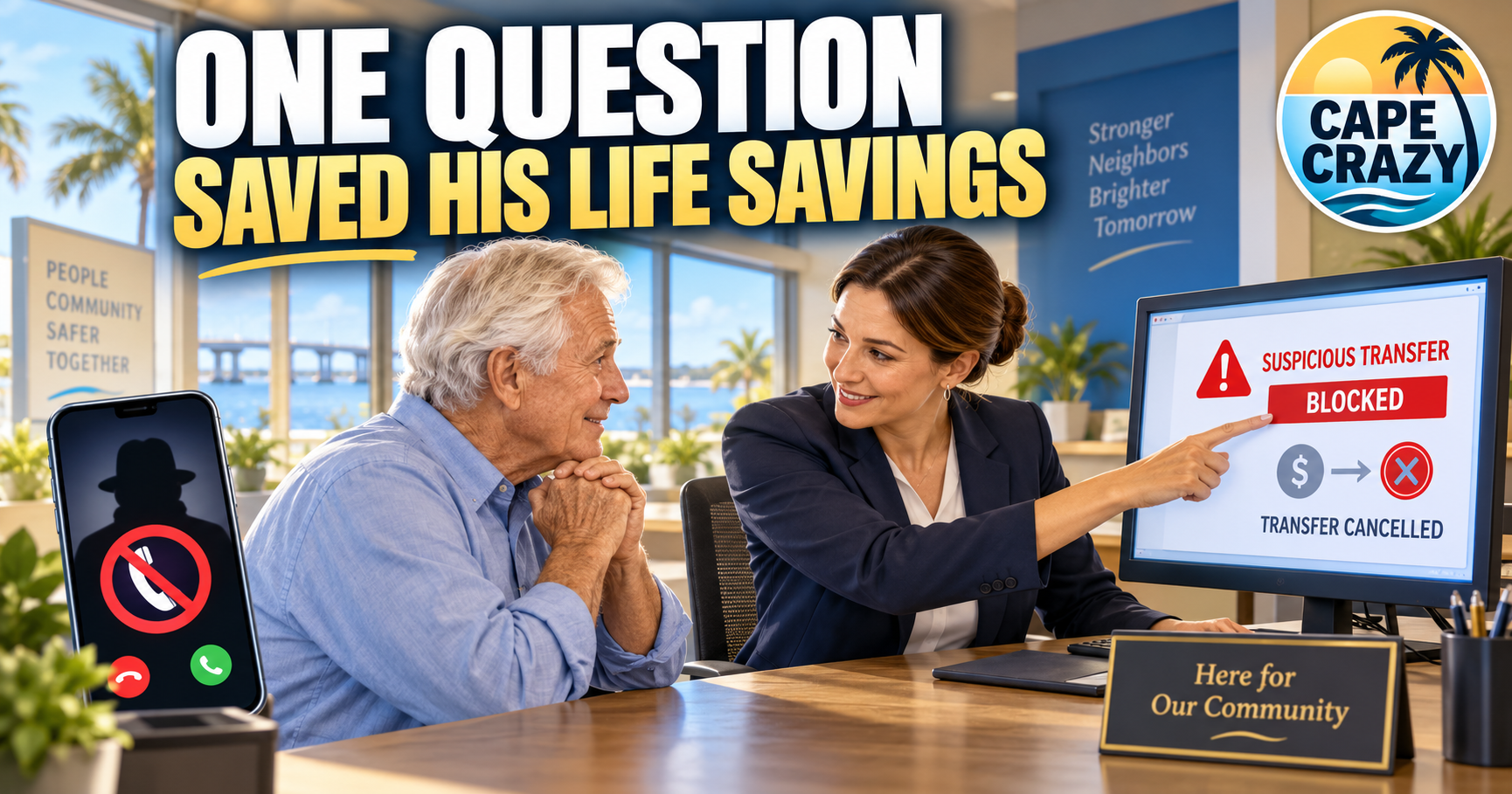



Scammers almost convinced an 88-year-old Cape Coral man to surrender his savings.
They had a convincing story. They created urgency. And they kept applying pressure—the ingredients that allow sophisticated fraud to turn an ordinary phone call into a financial emergency.
Fortunately, the scammers encountered something they had not planned for:
A banker who was paying attention.
According to WINK News, a Cape Coral resident receives a suspicious calls and text messages almost every day. This time, the people contacting him presented a sufficiently believable story to place his savings in danger.
But before the money disappeared, a banker recognized that something was wrong, slowed the situation down and prevented the transaction.
That intervention may have saved him from a devastating loss.
It also provides an important lesson for every family in Southwest Florida: Sometimes the best fraud-prevention technology is a person willing to ask one more question.
Scammers Don’t Need to Fool You Forever
A successful scam does not require someone to believe a false story for weeks.
The criminal only needs a few minutes of panic.
Modern scammers may pretend to represent a bank, government agency, law-enforcement department or major company. They can manipulate caller ID, use personal information obtained online and transfer victims between several supposed “departments” to make the operation appear legitimate.
Some even provide case numbers, employee identification numbers and official-looking documents.
None of those details prove a caller is genuine.
The story commonly begins with a frightening claim:
- Your bank account has been compromised.
- Someone used your identity.
- A suspicious purchase was made in your name.
- Your Social Security number is connected to a crime.
- Your savings must be moved immediately to keep them safe.
The solution always involves money.
The caller may demand a wire transfer, cryptocurrency purchase, cash withdrawal or payment through gift cards. In some cases, victims are told to move money into a supposedly “secure” account.
There is no secure account.
There is only the scammer’s account.
The Federal Trade Commission warns that anyone instructing you to move money to “protect it” is running a scam. A legitimate bank or government agency will not ask you to transfer your savings to resolve an unexpected phone call. The FTC explains how these money-protection scams operate.
The Banker Broke the Scam’s Most Important Tool
The most dangerous weapon in many financial scams is not advanced technology.
It is urgency.
Scammers do not want victims to stop, think or consult someone they trust. They may demand secrecy, remain on the phone during a bank visit or tell the victim that revealing the “investigation” could result in arrest.
That pressure is intentional.
A banker asking why someone needs an unusual withdrawal or transfer creates the one thing scammers cannot tolerate: time to think.
That appears to be what protected Medlock.
The banker did more than process a transaction. The employee recognized warning signs and intervened before the money left Medlock’s control.
That deserves recognition.
Bank employees occasionally face criticism for asking customers questions about their own money. In most circumstances, customers have every right to decide how their funds are used.
But an unexpected large withdrawal—especially when someone appears nervous, confused or coached by a person on the phone—can indicate exploitation.
A respectful conversation may be the final barrier between a customer and financial ruin.
Why Intelligent People Still Get Scammed
Stories involving older victims often attract unhelpful comments asking how anyone could “fall for that.”
That misses the point.
Professional scammers are not relying entirely on gullibility. They use fear, authority, isolation and carefully rehearsed scripts. They may know a victim’s name, address, relatives or financial institution before making contact.
Technology has also made impersonation easier. Phone numbers can be spoofed, documents can be convincingly reproduced and voices can be imitated.
Anyone can make a poor decision while frightened and under pressure.
The proper response is not embarrassment. It is interruption.
Scammers want victims to feel that they must solve the problem alone. Families can reduce that risk by establishing one simple rule:
No unexpected caller gets money before another trusted person hears the story.
That second person does not need to be a financial expert. They simply need enough distance from the pressure to say, “Let’s hang up and verify this ourselves.”
The Five-Minute Scam Stop
If you receive a frightening call, text or email involving money, take these steps:
1. End the conversation
Hang up—even if the caller says doing so will result in arrest, financial loss or cancellation of your account.
A legitimate organization will allow you to verify its identity.
2. Do not use the number the caller provides
Call your bank using the number printed on your debit card or statement. Contact a government agency through its official website.
Do not trust caller ID, a link in a text message or a number supplied by the person making the threat.
The FTC specifically recommends contacting your institution through a phone number, website or application you already know is authentic. See the FTC’s guidance on unexpected transfer requests.
3. Tell someone
Call a relative, friend, banker or law-enforcement agency.
Scammers demand secrecy because another person is likely to recognize the deception.
4. Never provide a verification code
A caller asking for a code sent to your phone may be attempting to enter one of your accounts. Bank employees do not need you to read them a security code during an unexpected call.
5. Do not move money to “protect” it
Do not withdraw cash, purchase gold, buy gift cards, visit a cryptocurrency ATM or transfer money into another account at an unsolicited caller’s direction.
Once money is voluntarily transferred, recovering it can be extremely difficult. The FTC warns that many transfers cannot be reversed.
What Families Can Do Today
Do not wait for a scam attempt to begin the conversation.
Ask parents, grandparents and other relatives whom they would call before making an unusual financial transaction. Write that person’s number down and place it near the telephone.
Families may also consider:
- Creating a family password for genuine emergencies.
- Adding a trusted contact to appropriate financial accounts.
- Enabling transaction alerts.
- Reviewing privacy settings on social media.
- Blocking repeated scam numbers.
- Agreeing that no legitimate emergency is too urgent for a verification call.
The goal is not to remove an older adult’s independence. It is to create a reliable pause button when someone attempts to manufacture a crisis.
If Money Has Already Been Sent
Act immediately.
Contact the bank, wire-transfer company, payment application or cryptocurrency platform used for the transaction. Ask whether it can be stopped or reversed.
Change passwords if account information was shared. If a scammer gained access to a computer or phone, disconnect the device and seek qualified technical help.
Report the incident to local law enforcement and the FTC at ReportFraud.ftc.gov. The FTC also provides payment-specific recovery instructions through its guide for scam victims.
Victims should not remain silent because they feel embarrassed. Reporting quickly may improve the chance of limiting the damage and help authorities identify patterns affecting other residents.
A Quiet Cape Coral Hero
The best part of this story is not that a sophisticated scam existed.
Unfortunately, those calls arrive every day.
The important part is that somebody noticed.
A Cape Coral banker saw enough to question what was happening. That brief intervention protected an 88-year-old resident and the savings he had spent a lifetime accumulating.
No dramatic chase was required. No computer system defeated an international criminal network.
Someone simply paid attention, asked questions and refused to treat a suspicious transaction as routine.
That is customer service at its best.
And it offers one message worth sharing with every person you care about:
If a caller frightens you, rushes you or tells you to keep a financial transaction secret, stop.
The emergency probably belongs to the scammer—not to you.
Original reporting: WINK News — Cape Coral banker stops 88-year-old man from losing his savings to sophisticated scam
This article provides general fraud-prevention information. Anyone who believes money or account information has been compromised should contact the relevant financial institution and law enforcement immediately.
Is This Crazy or Not?
- Crazy: Criminals spending their days trying to steal an 88-year-old man’s savings.
- Not Crazy: A banker pausing long enough to recognize the warning signs.
- Worth Sharing: One extra question may protect someone’s entire life savings.
Leave a Reply