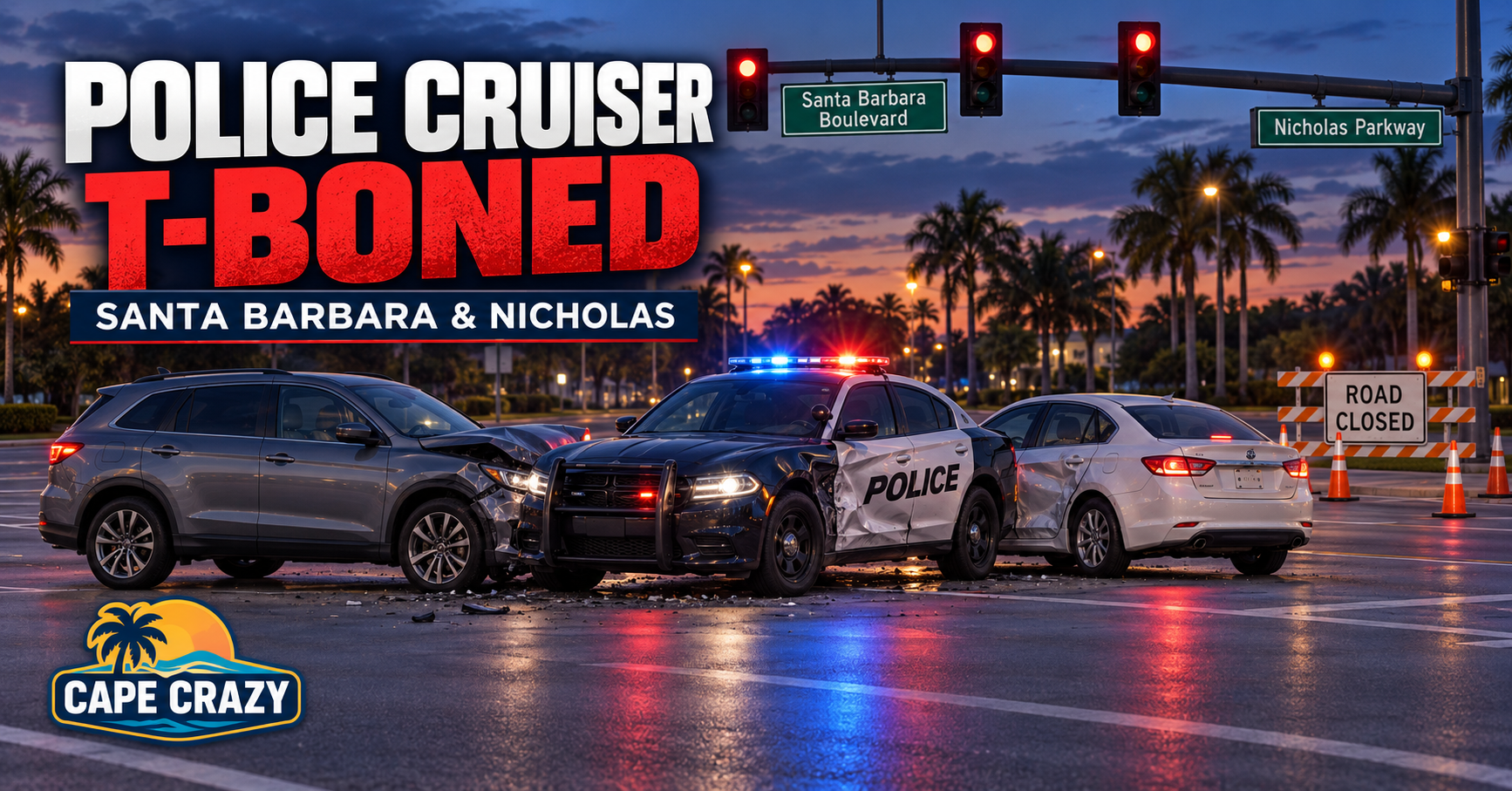



A Cape Coral police officer was hospitalized following a three-vehicle crash Thursday night at Santa Barbara Boulevard South and Nicholas Parkway West.
The collision involved a marked Cape Coral Police Department vehicle and two civilian vehicles. According to the Florida Highway Patrol, at least one non-incapacitating injury was reported. Other local reports indicated two people suffered minor injuries.
The intersection was closed in all directions while emergency crews responded and investigators examined the scene. The roads have since reopened.
Unlike many Cape Coral traffic stories, there is not much room for comedy here.
An officer went to the hospital, another person may have been injured and several vehicles were damaged. The only fortunate part is that the reported injuries do not appear to have been life-threatening.
“The Gray Car T-Boned the Officer”
Newly released 911 calls captured the confusion immediately after the crash.
One caller told dispatchers that a gray car had “completely T-boned the officer.”
Another caller reported that the officer had gotten out of the police vehicle.
Those statements provide eyewitness accounts of what people believed they saw. They do not constitute an official determination of fault.
A T-bone collision occurs when the front of one vehicle strikes the side of another. These crashes are particularly dangerous because vehicle doors provide less protection than the front or rear of a car.
At a large intersection such as Santa Barbara and Nicholas, several factors could potentially contribute to a collision, including traffic signals, turning vehicles, speed, visibility and whether an emergency vehicle was responding to a call.
Authorities have not publicly released enough information to determine exactly how this crash occurred.
That means social media will undoubtedly solve the entire case by lunchtime.
Everyone else should wait for the investigators.
The Investigation Continues
The Florida Highway Patrol is investigating the collision.
No citation, criminal charge or official finding of fault had been announced in the initial reports. Authorities also had not publicly detailed where each vehicle was traveling or whether the police cruiser’s emergency lights and siren were activated.
Those details matter.
Florida law requires drivers to yield to emergency vehicles using audible and visible signals, but emergency-vehicle operators must also drive with appropriate regard for public safety.
Without knowing whether the officer was responding to an emergency—or even which vehicle had the green light—it would be irresponsible to assign blame.
A witness can accurately describe the physical impact while still lacking information about everything that occurred before it.
“The gray car struck the police vehicle” explains where the vehicles collided.
It does not necessarily explain why.
One of Cape Coral’s Busiest Areas
Santa Barbara Boulevard is a major north-south route through central Cape Coral. Nicholas Parkway carries traffic east and west near City Hall, the police department, commercial properties and residential neighborhoods.
The intersection handles turning vehicles, through traffic and drivers moving between several busy parts of the city.
When a serious crash closes both roads, the effects spread quickly.
Motorists are redirected through side streets. Nearby intersections become congested. Drivers unfamiliar with the detour begin performing the traditional Cape Coral maneuver of slowing to eight miles per hour while arguing with the navigation system.
Emergency crews must also work in an active roadway while managing traffic, treating injuries and preserving evidence.
Closing an intersection of that size is disruptive, but it allows first responders and investigators to do their jobs safely.
The inconvenience of taking another route is minor compared with the danger of sending traffic through an unsecured crash scene.
Even the Police Are Not Protected From Cape Coral Traffic
Police officers spend much of their working day driving.
They respond to emergencies, patrol neighborhoods, conduct traffic stops and travel through congested intersections at all hours.
Their vehicles are equipped with emergency lighting, sirens and additional safety equipment—but they are not immune to crashes.
A police cruiser can be struck just as quickly as any other vehicle.
In some situations, officers face additional risks because they may need to enter intersections while responding to urgent calls. Other motorists may hear a siren without knowing where it is coming from, fail to check their mirrors or react unpredictably.
Again, officials have not confirmed that this officer was responding to an emergency. But the incident is a useful reminder of what drivers should do when they encounter emergency lights or sirens:
- Slow down.
- Look in every direction.
- Do not enter an intersection until it is safe.
- Pull over when required.
- Avoid sudden or unpredictable movements.
- Do not attempt to race an emergency vehicle through a light.
The goal is not merely to get out of the way.
It is to do so without creating another emergency.
What the 911 Callers Did Right
The people who called 911 provided dispatchers with immediate information about the location, vehicles and condition of the people involved.
That is exactly what witnesses should do after a serious collision.
When reporting a crash, callers should provide:
- The precise location
- The number of vehicles involved
- Whether anyone appears injured or trapped
- Whether there is fire, smoke or leaking fuel
- Whether lanes are blocked
- Any immediate danger to approaching traffic
Callers should avoid entering the roadway unless necessary to prevent an immediate threat. Secondary collisions frequently occur when drivers approach a crash scene without slowing down.
If someone is injured, follow the dispatcher’s instructions and avoid moving the person unless there is an urgent danger such as fire.
A cell phone can replace a vehicle.
It cannot replace a neck.
A Reminder to Pause at Every Intersection
The cause of this collision remains under investigation, so the lesson is not that one particular driver did something wrong.
The broader lesson is that intersections demand attention—even when the light appears to favor you.
Before proceeding through a green light, glance left and right.
Watch for vehicles completing turns, running a red light or entering the intersection unexpectedly. Keep music at a reasonable level so emergency sirens can be heard. Put down the phone before the vehicle begins moving.
A green light grants permission to proceed.
It does not create an invisible force field around the car.
That is especially important at large, busy Cape Coral intersections where vehicles may approach from several directions and drivers routinely compete for limited turning space.
Everyone Appears Likely to Recover
Based on the information released so far, the injuries were described as minor or non-incapacitating.
That is the best part of this story.
Vehicles can be repaired or replaced. An intersection can reopen. Traffic can return to its usual condition of moving slightly slower than residents would prefer.
The people involved matter more.
The Florida Highway Patrol will determine what happened and whether any traffic violations contributed to the crash. Until that investigation is complete, claims about fault remain speculation.
For now, Cape Coral motorists can take one practical lesson from the collision:
Slow down, pay attention and look twice before entering an intersection.
Even if the vehicle approaching from the side has “POLICE” written across it in very large letters.
Source: Gulf Coast News — Cape Coral police vehicle involved in crash
Editor’s note: The crash remains under investigation. Cape Crazy is not assigning fault to the officer or any civilian driver involved.
Is This Crazy or Not?
- Crazy: A three-vehicle collision involving a police cruiser at one of central Cape Coral’s busiest intersections.
- Not Crazy: Witnesses immediately calling 911 and reporting the officer’s condition.
- You Decide: Would one extra glance before entering an intersection prevent the next crash?
Leave a Reply