Category: Traffic

  • Cape Coral Police Cruiser T-Boned in Three-Vehicle Crash at Santa Barbara and Nicholas

    Cape Coral Police Cruiser T-Boned in Three-Vehicle Crash at Santa Barbara and Nicholas

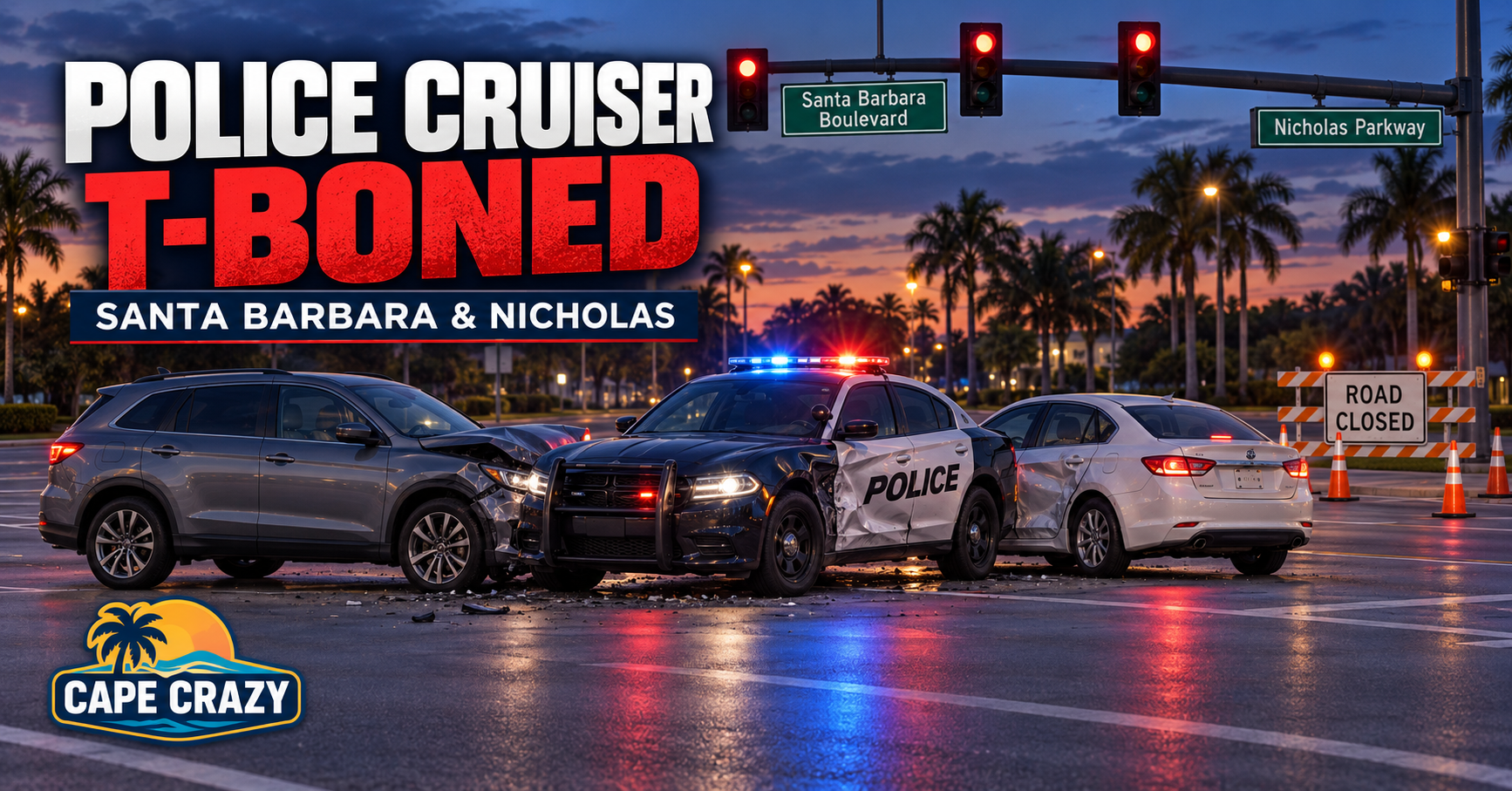
    A Cape Coral police officer was hospitalized following a three-vehicle crash Thursday night at Santa Barbara Boulevard South and Nicholas Parkway West.

    The collision involved a marked Cape Coral Police Department vehicle and two civilian vehicles. According to the Florida Highway Patrol, at least one non-incapacitating injury was reported. Other local reports indicated two people suffered minor injuries.

    The intersection was closed in all directions while emergency crews responded and investigators examined the scene. The roads have since reopened.

    Unlike many Cape Coral traffic stories, there is not much room for comedy here.

    An officer went to the hospital, another person may have been injured and several vehicles were damaged. The only fortunate part is that the reported injuries do not appear to have been life-threatening.

    “The Gray Car T-Boned the Officer”

    Newly released 911 calls captured the confusion immediately after the crash.

    One caller told dispatchers that a gray car had “completely T-boned the officer.”

    Another caller reported that the officer had gotten out of the police vehicle.

    Those statements provide eyewitness accounts of what people believed they saw. They do not constitute an official determination of fault.

    A T-bone collision occurs when the front of one vehicle strikes the side of another. These crashes are particularly dangerous because vehicle doors provide less protection than the front or rear of a car.

    At a large intersection such as Santa Barbara and Nicholas, several factors could potentially contribute to a collision, including traffic signals, turning vehicles, speed, visibility and whether an emergency vehicle was responding to a call.

    Authorities have not publicly released enough information to determine exactly how this crash occurred.

    That means social media will undoubtedly solve the entire case by lunchtime.

    Everyone else should wait for the investigators.

    The Investigation Continues

    The Florida Highway Patrol is investigating the collision.

    No citation, criminal charge or official finding of fault had been announced in the initial reports. Authorities also had not publicly detailed where each vehicle was traveling or whether the police cruiser’s emergency lights and siren were activated.

    Those details matter.

    Florida law requires drivers to yield to emergency vehicles using audible and visible signals, but emergency-vehicle operators must also drive with appropriate regard for public safety.

    Without knowing whether the officer was responding to an emergency—or even which vehicle had the green light—it would be irresponsible to assign blame.

    A witness can accurately describe the physical impact while still lacking information about everything that occurred before it.

    “The gray car struck the police vehicle” explains where the vehicles collided.

    It does not necessarily explain why.

    One of Cape Coral’s Busiest Areas

    Santa Barbara Boulevard is a major north-south route through central Cape Coral. Nicholas Parkway carries traffic east and west near City Hall, the police department, commercial properties and residential neighborhoods.

    The intersection handles turning vehicles, through traffic and drivers moving between several busy parts of the city.

    When a serious crash closes both roads, the effects spread quickly.

    Motorists are redirected through side streets. Nearby intersections become congested. Drivers unfamiliar with the detour begin performing the traditional Cape Coral maneuver of slowing to eight miles per hour while arguing with the navigation system.

    Emergency crews must also work in an active roadway while managing traffic, treating injuries and preserving evidence.

    Closing an intersection of that size is disruptive, but it allows first responders and investigators to do their jobs safely.

    The inconvenience of taking another route is minor compared with the danger of sending traffic through an unsecured crash scene.

    Even the Police Are Not Protected From Cape Coral Traffic

    Police officers spend much of their working day driving.

    They respond to emergencies, patrol neighborhoods, conduct traffic stops and travel through congested intersections at all hours.

    Their vehicles are equipped with emergency lighting, sirens and additional safety equipment—but they are not immune to crashes.

    A police cruiser can be struck just as quickly as any other vehicle.

    In some situations, officers face additional risks because they may need to enter intersections while responding to urgent calls. Other motorists may hear a siren without knowing where it is coming from, fail to check their mirrors or react unpredictably.

    Again, officials have not confirmed that this officer was responding to an emergency. But the incident is a useful reminder of what drivers should do when they encounter emergency lights or sirens:

    • Slow down.
    • Look in every direction.
    • Do not enter an intersection until it is safe.
    • Pull over when required.
    • Avoid sudden or unpredictable movements.
    • Do not attempt to race an emergency vehicle through a light.

    The goal is not merely to get out of the way.

    It is to do so without creating another emergency.

    What the 911 Callers Did Right

    The people who called 911 provided dispatchers with immediate information about the location, vehicles and condition of the people involved.

    That is exactly what witnesses should do after a serious collision.

    When reporting a crash, callers should provide:

    • The precise location
    • The number of vehicles involved
    • Whether anyone appears injured or trapped
    • Whether there is fire, smoke or leaking fuel
    • Whether lanes are blocked
    • Any immediate danger to approaching traffic

    Callers should avoid entering the roadway unless necessary to prevent an immediate threat. Secondary collisions frequently occur when drivers approach a crash scene without slowing down.

    If someone is injured, follow the dispatcher’s instructions and avoid moving the person unless there is an urgent danger such as fire.

    A cell phone can replace a vehicle.

    It cannot replace a neck.

    A Reminder to Pause at Every Intersection

    The cause of this collision remains under investigation, so the lesson is not that one particular driver did something wrong.

    The broader lesson is that intersections demand attention—even when the light appears to favor you.

    Before proceeding through a green light, glance left and right.

    Watch for vehicles completing turns, running a red light or entering the intersection unexpectedly. Keep music at a reasonable level so emergency sirens can be heard. Put down the phone before the vehicle begins moving.

    A green light grants permission to proceed.

    It does not create an invisible force field around the car.

    That is especially important at large, busy Cape Coral intersections where vehicles may approach from several directions and drivers routinely compete for limited turning space.

    Everyone Appears Likely to Recover

    Based on the information released so far, the injuries were described as minor or non-incapacitating.

    That is the best part of this story.

    Vehicles can be repaired or replaced. An intersection can reopen. Traffic can return to its usual condition of moving slightly slower than residents would prefer.

    The people involved matter more.

    The Florida Highway Patrol will determine what happened and whether any traffic violations contributed to the crash. Until that investigation is complete, claims about fault remain speculation.

    For now, Cape Coral motorists can take one practical lesson from the collision:

    Slow down, pay attention and look twice before entering an intersection.

    Even if the vehicle approaching from the side has “POLICE” written across it in very large letters.

    Source: Gulf Coast News — Cape Coral police vehicle involved in crash

    Editor’s note: The crash remains under investigation. Cape Crazy is not assigning fault to the officer or any civilian driver involved.

    Is This Crazy or Not?

    • Crazy: A three-vehicle collision involving a police cruiser at one of central Cape Coral’s busiest intersections.
    • Not Crazy: Witnesses immediately calling 911 and reporting the officer’s condition.
    • You Decide: Would one extra glance before entering an intersection prevent the next crash?
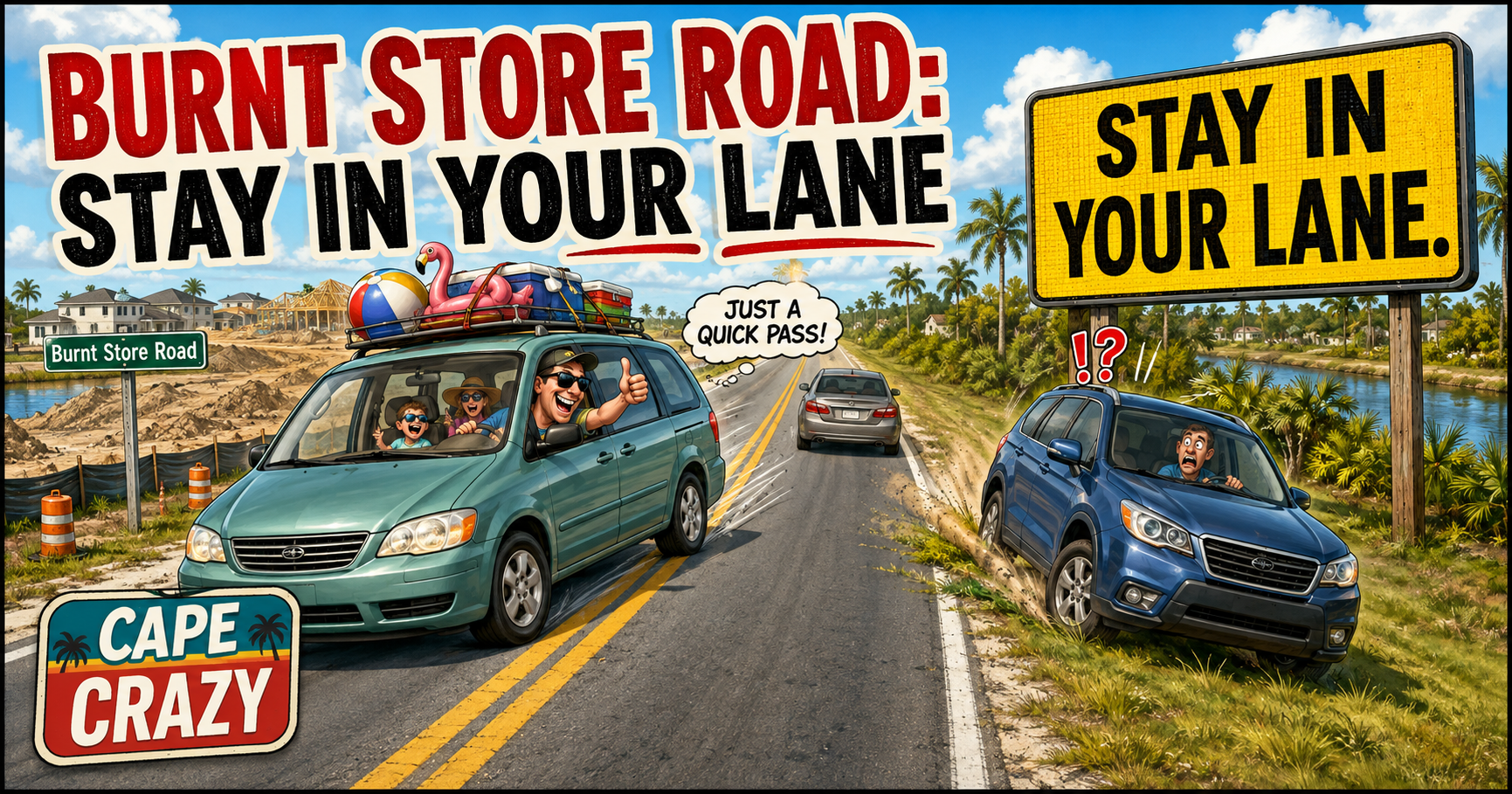
  • Burnt Store Road Driver Attempts Passing Maneuver, Nearly Discovers What “Head-On” Means

    Burnt Store Road Driver Attempts Passing Maneuver, Nearly Discovers What “Head-On” Means

    A driver on Burnt Store Road recently encountered one of Southwest Florida’s lesser-known traffic rules:

    When a vehicle is approaching in the opposite lane, that lane is not temporarily yours.

    According to Gulf Coast News, a motorist narrowly avoided a head-on collision near the Charlotte County line after a minivan reportedly pulled into the oncoming lane while attempting to pass another vehicle.

    The approaching driver was forced off the pavement to avoid being struck.

    Fortunately, the maneuver worked, and the incident was a near crash rather than another tragedy on a road that has already experienced several fatal collisions.

    Unfortunately, Burnt Store Road continues operating as Cape Coral’s unofficial test of reflexes, patience and whether your vehicle can briefly function as an all-terrain model.

    Welcome to Burnt Store Raceway

    The northern stretch of Burnt Store Road remains a two-lane highway carrying traffic between rapidly growing northwest Cape Coral and Charlotte County.

    For most drivers, “two lanes” means one lane traveling north and another traveling south.

    A small but energetic portion of the population apparently interprets it as:

    • One lane for normal travel
    • One lane for passing
    • One shoulder for whoever would prefer not to die

    The recent close call reportedly occurred when a minivan moved into the opposing lane to pass another vehicle. The oncoming driver swerved onto the roadside and avoided a collision.

    Video of the incident captured just how quickly an ordinary drive can turn into an emergency.

    One moment, you are proceeding normally.

    The next, a minivan appears in your lane with the confidence of someone who believes physics has agreed to wait.

    The approaching driver had only seconds to choose between a head-on collision and an unscheduled nature excursion.

    They chose the shoulder.

    That was the correct answer, although it should never have been a question.

    The Road Is Dangerous—But It Did Not Pass Anyone

    Burnt Store Road has become notorious for serious crashes, speeding and risky passing.

    Residents have been calling for additional safety improvements and the eventual widening of the remaining two-lane section to four lanes.

    They are right.

    Traffic has increased substantially as thousands of homes and new developments have spread through northwest Cape Coral. Burnt Store Road is also an important connection to Charlotte County, U.S. 41 and Interstate 75.

    A roadway designed for an earlier population is now expected to accommodate today’s growth, tomorrow’s development and drivers who apparently believe arriving 90 seconds earlier is worth negotiating directly with the afterlife.

    The road needs improvement.

    But it is important to note that Burnt Store Road did not seize control of the minivan and steer it into oncoming traffic.

    No road expansion can completely compensate for someone making a pass without enough room to complete it safely.

    Four lanes would separate opposing traffic and reduce the temptation to enter an oncoming lane. Paved shoulders, rumble strips and turn lanes can also make the corridor safer.

    But engineers have not yet invented a pavement marking capable of physically stopping a driver from making a terrible decision.

    Perhaps that will be included in Phase II.

    Lee County Has Begun Making Improvements

    Lee County commissioners previously approved safety work along approximately five miles of the remaining two-lane section, running north from Delilah Drive to Vincent Avenue.

    The project includes:

    • Four-foot paved shoulders on both sides
    • Rumble stripes along the center and pavement edges
    • New turn lanes at Caloosa Parkway
    • Guardrails
    • Additional signs and pavement markings

    The initial construction agreement was approximately $3 million, while the broader safety program has been reported at about $5.7 million.

    The work was expected to begin in June and take roughly nine months to complete.

    These are meaningful improvements.

    Paved shoulders give motorists more recovery space. Rumble stripes alert drivers when they drift from their lane. Turn lanes reduce conflicts between through traffic and vehicles slowing to enter side roads.

    In the recent incident, having enough roadside space may have helped the oncoming motorist escape the minivan’s unannounced lane-sharing experiment.

    Of course, rumble strips only work when drivers respond to the noise.

    For some motorists, the unmistakable vibration of tires crossing the centerline apparently translates to:

    “Congratulations. You have unlocked the passing lane.”

    The $300 Million Question

    The permanent solution residents want is widening the remaining section of Burnt Store Road from two lanes to a four-lane divided roadway.

    The estimated cost has been reported at approximately $300 million.

    That is a substantial amount of money, even by Cape Coral infrastructure standards, where projects sometimes begin with a reasonable estimate and eventually require their own line of credit.

    County officials consider the widening a high-priority transportation project, but funding for the full construction has not been secured.

    The Florida Department of Transportation completed its environmental and planning study for the northern segment in 2025. The next challenge is identifying the money needed to design and build it.

    In the meantime, Cape Coral continues adding homes and businesses throughout the northwest.

    That creates the familiar local planning sequence:

    1. Approve development.
    2. Add thousands of residents.
    3. Observe that traffic has increased.
    4. Discover the road is inadequate.
    5. Search couch cushions for $300 million.

    Cape Coral did not invent this system, but it has become remarkably proficient at it.

    “No Passing” Is More Than a Suggestion

    While officials pursue funding and safety projects, drivers still possess one surprisingly effective tool:

    Judgment.

    Before passing on a two-lane road, motorists must have a clear view, sufficient distance and enough time to return safely to their lane.

    If an oncoming vehicle is visible and your plan requires that driver to leave the pavement, you do not have sufficient distance.

    That is not a close call.

    That is an incorrect answer with headlights approaching.

    The few seconds saved by passing a slower vehicle are insignificant compared with the consequences of a head-on crash. At typical highway speeds, two vehicles traveling toward each other close the distance extremely quickly.

    Burnt Store Road is not a video game. There is no restart button, and the people approaching in the other lane did not agree to participate in your speedrun.

    Wait for a legal and safe opportunity.

    If one does not appear, remain behind the slower vehicle.

    You may arrive at your destination slightly later, but you will enjoy the considerable advantage of arriving.

    The Shoulder Should Not Be the Safety Plan

    The motorist who swerved away from the minivan deserves credit for reacting quickly.

    But “hopefully the other driver can escape onto the grass” cannot become Burnt Store Road’s primary collision-prevention strategy.

    A different shoulder condition, drainage ditch, utility pole, pedestrian or moment of hesitation could have produced a much worse outcome.

    This is why the planned road improvements matter.

    It is also why enforcement and personal responsibility matter.

    The county can widen shoulders.

    It can install rumble stripes.

    It can add turn lanes, guardrails and flashing speed signs.

    Eventually, it may find $300 million and build the four-lane divided road residents have requested.

    But until every improvement is complete, motorists must operate the existing road as though other people’s lives depend upon their decisions.

    Because they do.

    A Near Miss Should Be the Warning

    Burnt Store Road has already been the scene of deadly crashes. There is nothing humorous about the lives lost or the families affected by them.

    The recent near collision is worth discussing precisely because it did not end that way.

    The oncoming driver reacted in time.

    There was enough room to leave the road.

    The minivan completed its maneuver.

    Everyone apparently continued home instead of being transported to a hospital—or worse.

    That makes this incident a free warning.

    Cape Coral should continue pushing for safety improvements and the eventual widening of the road. Lee County should pursue the necessary funding as growth places more pressure on the corridor.

    And drivers should remember that a double yellow line is not merely decorative road-themed artwork.

    Until Burnt Store Road receives four lanes, the current arrangement remains quite simple:

    Stay in yours.

    Sources: Gulf Coast News — Near crash on Burnt Store Road sparks safety push and Cape Coral Breeze — Lee County approves Burnt Store Road safety improvements

    Cape Crazy commentary is satire based on publicly reported information. The humor targets dangerous driving and delayed infrastructure—not crash victims or their families.

    Is This Crazy or Not?

    • Crazy: Attempting a pass that forces an oncoming driver completely off the road.
    • Not Crazy: Widening the corridor and adding shoulders, rumble strips and turn lanes.
    • You Decide: Should the $300 million project include a giant sign explaining what the yellow line means?
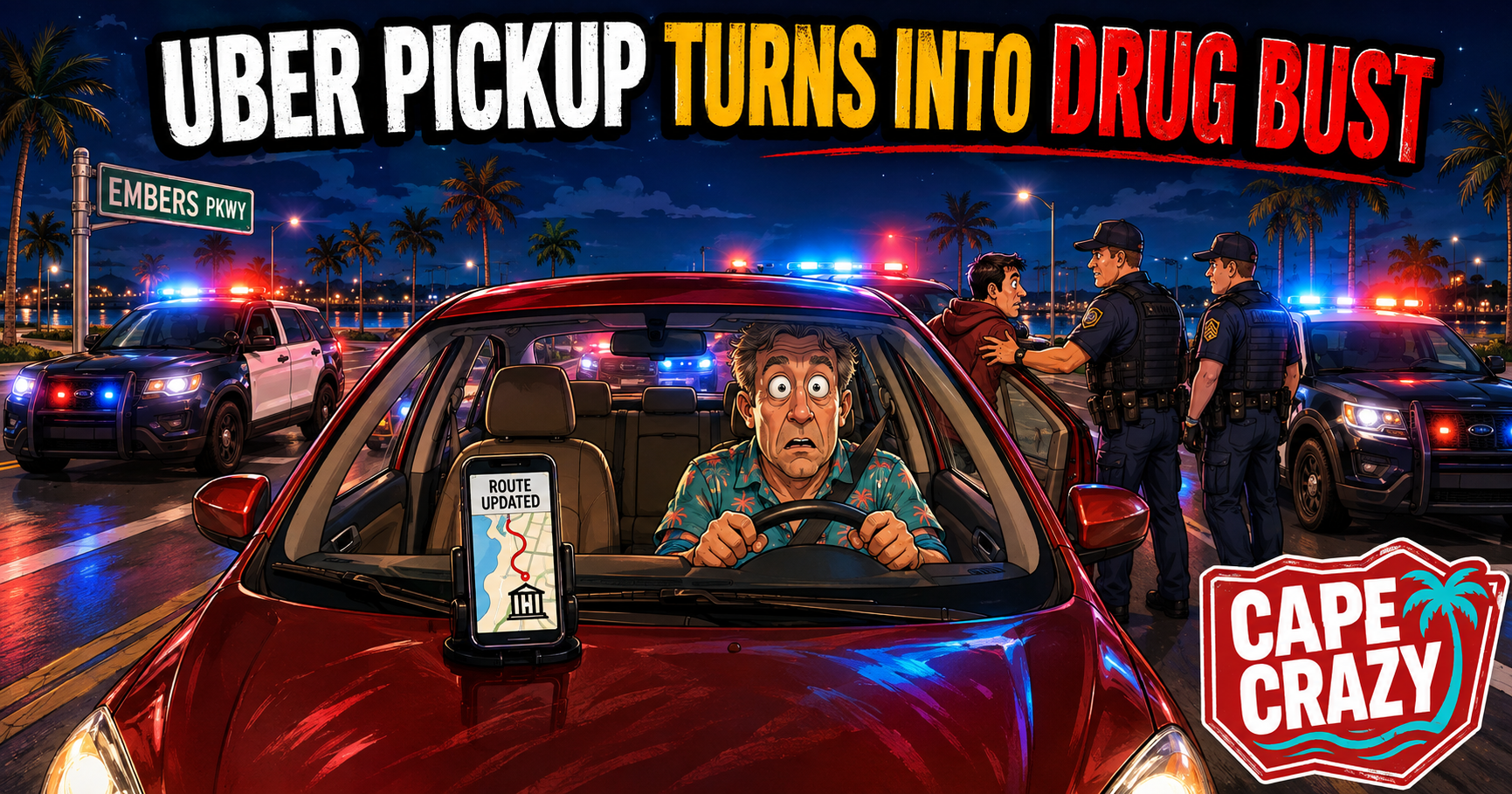
  • Cape Coral Uber Driver Accepts Ride, Accidentally Joins Drug Bust

    Cape Coral Uber Driver Accepts Ride, Accidentally Joins Drug Bust

    Every Uber driver expects the occasional difficult passenger.

    Some talk too much. Some slam the door. Some insist they know a faster route despite having no idea where they are.

    One Cape Coral driver encountered a slightly more complicated situation: His passenger was reportedly the target of an undercover narcotics investigation.

    According to WINK News, Uber driver Daniel Markham had just picked up a passenger and turned onto Embers Parkway when a Cape Coral police officer pulled him over near Northwest 17th Place.

    Then more police vehicles arrived.

    And more.

    Within moments, Markham’s routine Uber ride had been upgraded—at no additional charge—to a full-scale police takedown.

    Your Driver Has Arrived—Along With the Police

    Markham told WINK that officers surrounded his vehicle to arrest the passenger, identified in the report as Michael Hennessy.

    Police reportedly had been conducting an undercover narcotics investigation targeting the passenger. Hennessy now faces more than a dozen charges, including drug trafficking.

    Markham was not accused of participating in the alleged criminal activity. He appears to have simply accepted a ride request and arrived at one of the worst possible pickup locations at exactly the wrong time.

    Uber’s app probably described the trip as something like:

    Pickup: Cape Coral
    Destination: Unknown
    Unexpected stop: Surrounded by police
    Passenger status: No longer needs ride

    There is currently no button in the Uber app for “My passenger has been removed by a narcotics unit.”

    Perhaps there should be.

    Please Confirm Your Passenger

    Imagine the situation from the driver’s perspective.

    You accept a routine fare.

    You arrive.

    A passenger gets into your vehicle.

    You begin driving.

    Then your mirrors fill with flashing lights, police vehicles surround you and officers conduct a takedown of the person sitting in your back seat.

    At that moment, several questions probably enter your mind:

    • Did I use the correct pickup address?
    • Is this going to affect my acceptance rate?
    • Am I still supposed to complete the trip?
    • Does the passenger get charged a cancellation fee?
    • Should I ask the officers to leave a five-star review?

    Markham was reportedly caught entirely by surprise. That seems reasonable. Most drivers would not anticipate that their next passenger comes bundled with an undercover investigation and a police motorcade.

    Uber warns customers that fares may increase during periods of high demand.

    It says considerably less about surge law enforcement.

    The Most Cape Coral Rideshare Experience Possible

    Cape Coral is a large city, and rideshare drivers encounter all kinds of passengers. But this trip deserves its own service category.

    UberX gets you an everyday vehicle.

    Uber-Comfort gives you extra room.

    Uber-Black provides a luxury ride.

    Uber Bust apparently includes multiple police cars and an immediate change of destination.

    The app could even provide status updates:

    Your driver is approaching.

    Driver has arrived.

    Passenger has entered the vehicle.

    Cape Coral Police have also arrived.

    Your trip has ended earlier than expected.

    The only thing missing was the app asking Markham whether the pickup area felt safe and well-lit.

    A Driver’s Worst-Case Pickup

    The funny part of this story is the unbelievable situation—not the alleged drug activity itself.

    Drug trafficking is serious, and the criminal charges against the passenger will be resolved through the legal system. The allegations should not be treated as proof of guilt unless established in court.

    Markham, meanwhile, appears to have been an uninvolved driver doing exactly what rideshare drivers do: picking up the person the app told him to pick up.

    Drivers rarely know much about their passengers before they arrive. They receive a name, location and destination—not a full criminal-background report or advance notification that detectives may be following the customer.

    That creates an uncomfortable reality for rideshare workers. A driver may unknowingly transport someone involved in criminal activity and suddenly find themselves in the middle of a dangerous police encounter.

    Fortunately, this incident ended with officers arresting their intended passenger and the driver being recognized as the person caught in the middle—not part of the investigation.

    Would You Like to Add a Tip?

    After an experience like this, Markham deserves more than the standard fare.

    He deserves hazard pay, a complimentary car cleaning and perhaps a permanent exemption from accepting any future pickup on Embers Parkway.

    He should also be allowed to add a new reason for canceling a ride:

    • Passenger did not arrive
    • Vehicle problem
    • Unsafe pickup location
    • Passenger surrounded by narcotics officers

    Cape Coral drivers already navigate canals, construction, confusing addresses and motorists who treat red lights as optional suggestions.

    Now they apparently need to check whether their next passenger is being followed by an undercover police unit.

    The rideshare economy promises that anyone can get a convenient ride with the tap of a button.

    It does not promise where the ride will end.

    Source: WINK News — Uber driver caught in middle of drug bust on Embers Parkway

    Cape Crazy commentary is satire based on publicly reported information. Criminal charges are allegations, and defendants are presumed innocent unless proven guilty.

    Is This Crazy or Not?

    • Crazy: Accepting an ordinary Uber request and becoming surrounded by police.
    • Not Crazy: The driver had no apparent reason to know who he was picking up.
    • You Decide: Does Uber give loyalty points when the destination unexpectedly changes to jail?
  • Cape Coral Flock Cameras Cut Down — Because Apparently the Cameras Needed Protection Too

    Cape Coral Flock Cameras Cut Down — Because Apparently the Cameras Needed Protection Too

    Cape Coral police are investigating after four Flock license-plate reader cameras were damaged at the intersection of Diplomat Parkway East and Santa Barbara Boulevard. The cameras were reportedly cut down, taking them out of service and potentially eliminating investigative leads they otherwise might have provided police. 

    Yes.

    Someone apparently looked at equipment designed to help police investigate crime and thought:

    “You know what would be a good idea? Committing a crime against it.”

    Welcome back to Cape Coral.

    Step One: Find the Crime-Fighting Cameras

    Flock cameras are automated license-plate readers. They capture license plates and vehicle characteristics that law enforcement can use when investigating crimes, locating missing people or searching for wanted vehicles. 

    They are also the subject of an ongoing debate over privacy and government surveillance. Some Cape Coral-area residents have raised concerns about how widespread the cameras have become and how information collected by them might be used. 

    Those are legitimate issues to debate.

    You can contact elected officials.

    You can attend meetings.

    You can argue for stricter privacy rules.

    You can demand transparency.

    You can even advocate for removing the cameras.

    There are many options.

    Cutting the poles down is not generally considered the advanced civic-engagement option.

    Apparently Two Wasn’t Enough

    Initial reports indicated that two cameras had been found on the ground near Diplomat Parkway East and Santa Barbara Boulevard. Police later said the total was actually four damaged cameras. 

    So somebody apparently didn’t get halfway through this project and think:

    “You know, perhaps I’ve made my point.”

    Nope.

    Keep going.

    Camera number three.

    Camera number four.

    At that point you aren’t removing surveillance equipment.

    You’re working a shift.

    The Irony Is Doing Most of the Work Here

    There is something spectacularly Cape Crazy about damaging cameras whose entire purpose is helping police investigate suspicious activity.

    It’s like stealing a shoplifting-awareness poster.

    Or breaking into a locksmith.

    Or speeding past a sign announcing increased traffic enforcement.

    Actually, based on some of our recent stories, maybe scratch that last example.

    The Flock cameras themselves have generated controversy because automated license-plate readers can create records of where vehicles have been seen. Privacy advocates worry that large networks of these cameras could allow detailed tracking of people’s movements, while law enforcement agencies argue they are valuable investigative tools rather than systems for indiscriminate surveillance. 

    That’s a debate worth having.

    But whatever your position on Flock cameras, introducing a saw into the discussion does tend to weaken the intellectual portion of your argument.

    One Tiny Problem With the Master Plan

    There’s another possibility worth considering.

    If you are going to damage surveillance equipment located at a major intersection…

    …there may be other cameras nearby.

    Businesses.

    Traffic cameras.

    Doorbell cameras.

    Dashcams.

    Phones.

    Other license-plate readers.

    Cape Coral in 2026 isn’t exactly an abandoned dirt road in 1937.

    So the hypothetical planning meeting may have gone something like this:

    “We need to get rid of the cameras.”

    “Good idea.”

    “How?”

    “Go directly to the camera and cut it down.”

    “What about all the other cameras?”

    …

    Meeting adjourned.

    But There Is a Serious Side

    As funny as the irony is, intentionally damaging the equipment is still property damage and could interfere with legitimate police investigations.

    The underlying privacy question shouldn’t be dismissed either. Residents absolutely have the right to ask where these cameras are located, who can access the information, how long data is retained and under what circumstances agencies can search it.

    Those questions should be answered publicly.

    But there is a considerable distance between:

    “I have concerns about government surveillance.”

    and

    “Hand me the Sawzall.”

    That’s generally where Cape Crazy enters the story.

    Cape Crazy Translation

    Police:

    “These cameras help us investigate crimes.”

    Someone:

    “I don’t like the cameras.”

    Police:

    “You can challenge their use through normal legal and political channels.”

    Someone:

    “Counteroffer: I cut down four of them.”

    Police:

    “We are now investigating a crime.”

    And somewhere, an undamaged Flock camera is quietly thinking:

    “You guys aren’t going to believe what I just saw.”

    IS THIS CRAZY OR NOT?

    Whatever you think about automated license-plate readers, is cutting down four crime-fighting cameras a particularly crazy way to make your point?


    Source: Gulf Coast News reported July 31 that Cape Coral police were investigating damage to four Flock cameras at Diplomat Parkway East and Santa Barbara Boulevard. 

  • Cape Coral Resident Says Del Prado Has Become a Daily Speeding Problem

    Cape Coral Resident Says Del Prado Has Become a Daily Speeding Problem

    If you live along a busy road in Cape Coral, apparently there’s the posted speed limit.

    And then there’s the speed limit some drivers have personally selected for themselves.

    A longtime Cape Coral resident is asking city leaders to do something about speeding along Del Prado Boulevard South, saying drivers routinely fly past his home at all hours of the day and night. 

    Ron Collins, who has lived in Cape Coral for nearly 30 years, told Gulf Coast News that the speeding has become an everyday problem outside his home. He has even collected videos showing traffic passing by his property. 

    Which does raise an interesting question:

    How many home videos of speeding cars does a resident need before the problem officially becomes a problem?

    Del Prado: Where 30 MPH Is Apparently a Suggestion

    The speed limit in the area highlighted by the report is 30 mph. Gulf Coast News observed traffic there and reported that while they did not witness any truly extreme speeds during their visit, some motorists were still traveling faster than the posted limit. 

    And that distinction is important.

    Nobody has to be doing 90 mph for speeding to create a dangerous situation.

    A residential stretch of road with homes, driveways, pedestrians and people trying to pull into traffic can become considerably less forgiving when drivers start treating 30 mph as merely the opening bid.

    Collins described the situation as a daily problem and said the speeding happens both during the day and at night. 

    So this apparently isn’t:

    Friday Night at the Del Prado International Speedway.

    It’s more like:

    Every Day at the Del Prado International Speedway.

    The Cape Coral Traffic Equation

    There is something uniquely frustrating about living on a road where everyone else is trying to get somewhere three minutes faster.

    You pull out of your driveway.

    Someone appears in your rearview mirror approximately 0.4 seconds later.

    They are six inches from your bumper.

    You are doing the speed limit.

    They appear personally offended by this.

    Welcome to Cape Coral traffic.

    And before somebody says, “Everybody speeds a little,” that is probably true.

    But there is a difference between drifting a few miles per hour over the limit and creating a roadway environment where residents don’t feel comfortable entering or leaving their own property.

    What Exactly Is the Solution?

    That’s where things get more complicated.

    Police enforcement can help, but officers cannot sit on every street around the clock.

    Additional signs can help, although Cape Coral already possesses one of mankind’s most advanced traffic-control technologies:

    the speed-limit sign.

    Unfortunately, those only work if people read them.

    Other options sometimes used to address neighborhood speeding include increased enforcement, electronic speed-feedback signs, traffic studies or roadway changes designed to naturally slow vehicles.

    Whatever the answer is, Collins appears to be asking for something fairly basic:

    Take a look at what is happening and determine whether something needs to change.

    That doesn’t seem unreasonable.

    Cape Crazy Translation

    Resident:

    “People keep speeding past my house.”

    Resident produces videos:

    “Here are people speeding past my house.”

    Road sign:

    “30 MPH.”

    Drivers:

    “Interesting suggestion.”

    At some point, perhaps the problem isn’t a lack of information.

    Maybe people just need to remove their foot from the accelerator.

    IS THIS CRAZY OR NOT?

    Is speeding along Del Prado Boulevard becoming a serious enough problem that Cape Coral needs to take additional action?

    Source: Gulf Coast News, Cape Coral resident urges city to address speeding on Del Prado Boulevard. The report was published August 6, 2026, by Muhammad Abdul Qawee. 

  • Two Drivers Arrested After Alleged Street Race on Pine Island Road

    Two Drivers Arrested After Alleged Street Race on Pine Island Road

    Apparently 50 mph wasn’t exciting enough.

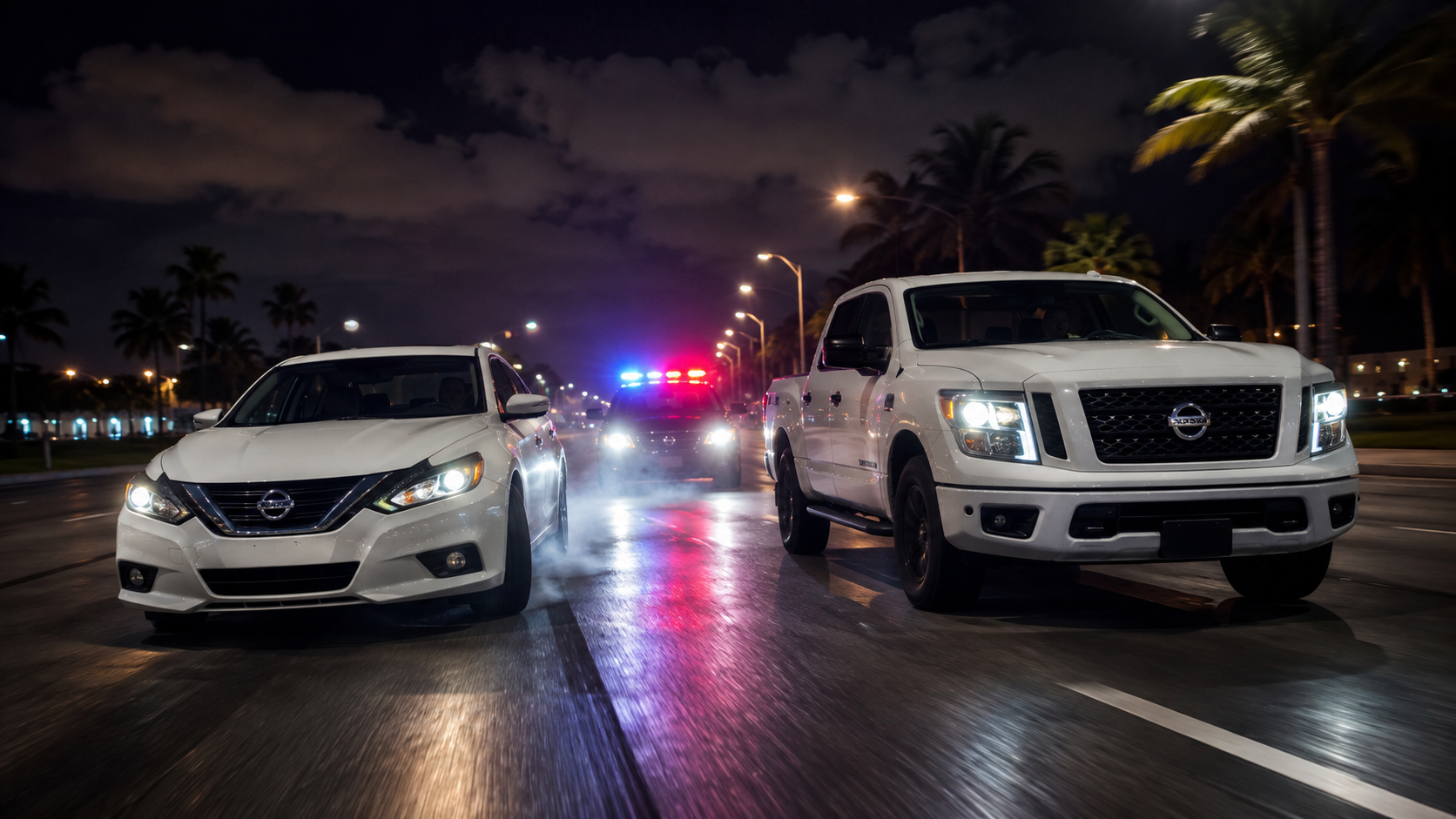
    According to the Cape Coral Police Department, a DUI Unit officer was traveling eastbound on SW Pine Island Road near Nicholas Parkway just before midnight on July 25 when he noticed two vehicles traveling side by side: a white Nissan Altima and a white Nissan Titan.

    Police say the two vehicles slowed to roughly 10–15 mph in a 50 mph zone and appeared to be communicating with each other while driving.

    Then things allegedly escalated.

    As the vehicles approached Nicholas Parkway, police say they lined up side by side and rapidly accelerated.

    In other words, what had been a late-night drive allegedly turned into a street race.

    During the acceleration, the Nissan Titan reportedly lost traction and fishtailed, although the driver managed to regain control and continued accelerating.

    There was just one problem.

    A Cape Coral Police DUI officer was right behind them.

    The officer caught up, activated his lights and siren, and both drivers pulled over near the 900 block of SW Pine Island Road.

    According to CCPD, both drivers were arrested and charged with Racing on a Highway.

    No crash was reported in the police account, despite the Titan reportedly losing traction during the incident.

    Is This Crazy or Not?

    Allegedly lining up for a street race on Pine Island Road is one thing.

    Doing it with a DUI Unit officer directly behind you?

    That might make this one especially easy for Cape Crazy voters.

    Source/Credit: Cape Coral Police Department. Information is based on a CCPD Facebook post and video regarding the July 25, 2026 arrests. The charges described are allegations; an arrest does not establish guilt.

  • SUV Takes an Unplanned Swim at Burnt Store Boat Ramp

    SUV Takes an Unplanned Swim at Burnt Store Boat Ramp

    Apparently the jet ski wasn’t the only thing planning to get wet.

    According to a Facebook post from Gulf Coast News anchor Peter Busch, an SUV was attempting to unload a jet ski at the Burnt Store Boat Ramp when it slid down the ramp and ended up in the water.

    The SUV reportedly slid down the ramp and ended up partially submerged in the water.

    The photo tells most of the story. Instead of a jet ski floating beside the dock, there’s a full-size SUV sitting in the canal looking like it suddenly decided it identifies as a boat.

    Fortunately, the post didn’t mention anyone being injured.

    Boat ramps can be slick, steep, and unforgiving, and this one apparently decided to provide a reminder.

    The jet ski may have eventually made it into the water.

    The SUV just beat it there.

    Cape Crazy verdict?

    You decide.

    Is this Crazy or Not?