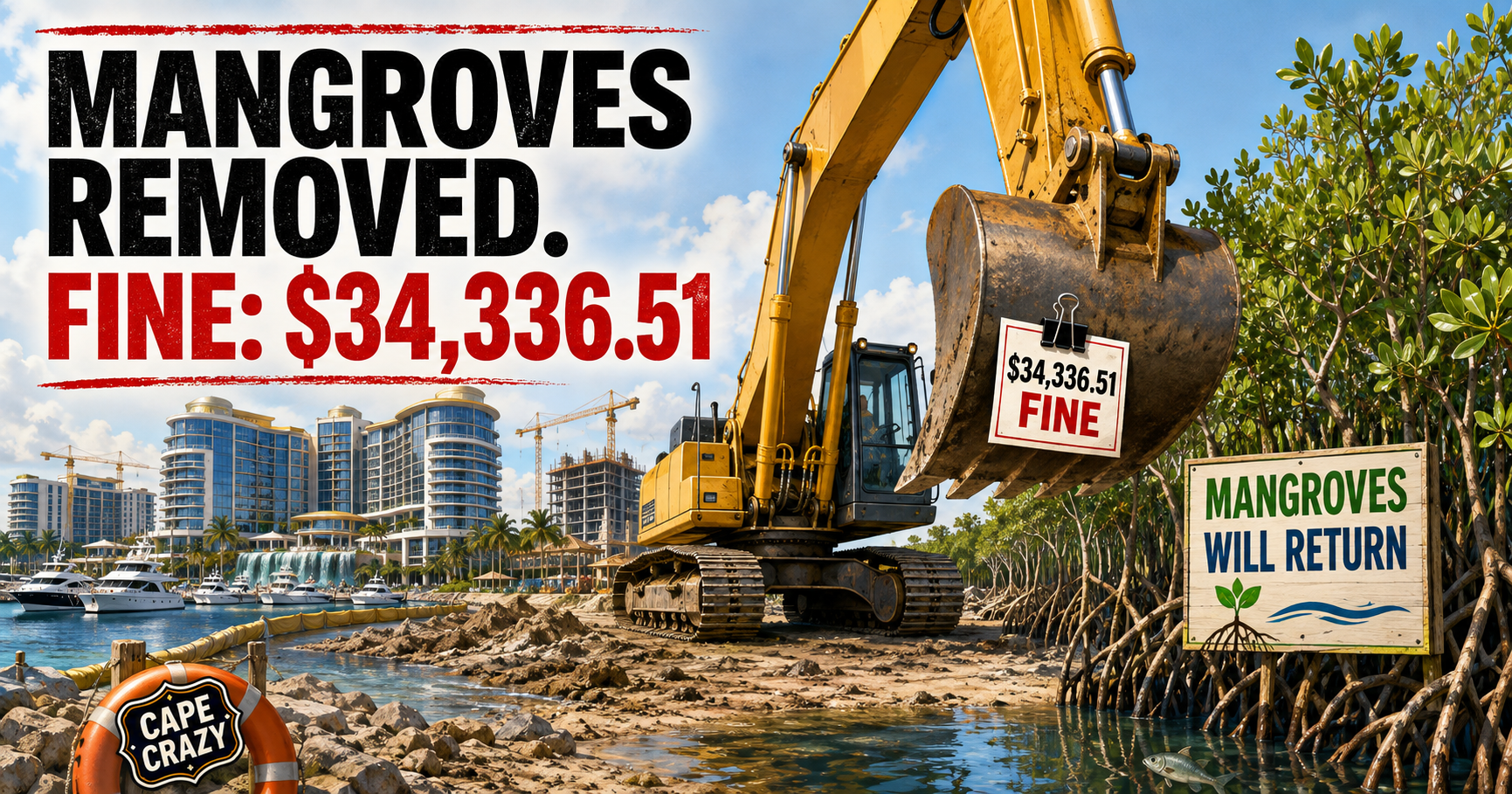



The developer behind Cape Coral’s massive Seven Islands project has been fined $34,336.51 after protected mangroves were removed from the property without the required permits.
That number includes civil penalties and the cost of investigating the violation, according to the South Florida Water Management District.
The developer must also stabilize the shoreline and replant mangroves.
It is an important enforcement action.
It also raises an uncomfortable question:
When the proposed project includes a 240-room hotel, condominiums, apartments, restaurants, a marina, a resort lagoon and enough waterfront development to require its own vacation brochure, does a $34,336 fine function as a deterrent—or get entered into the spreadsheet under “miscellaneous landscaping”?
The Mangroves Were Not on the Demolition Guest List
The Seven Islands property consists of approximately 48 acres along Old Burnt Store Road and the North Spreader Waterway in northwest Cape Coral.
Gulf Gateway Resort & Marina Village is planned as a large mixed-use waterfront destination featuring residences, commercial space, restaurants, public amenities, a hotel, marina facilities and recreational attractions.
The development has been discussed, planned, revised and presented to the community for years.
During land-clearing work in June, a contractor removed protected mangroves along the shoreline of one of the man-made islands.
There was one small administrative complication:
No state or federal agency had issued a permit authorizing the mangroves’ removal.
The City of Cape Coral had issued a land-clearing permit, but city officials said it covered nuisance vegetation, invasive species, dead trees, underbrush and stump removal.
Protected mangroves were not included.
Apparently, the contractor reached the edge of the approved clearing area and decided the shoreline looked suspiciously unfinished.
“Inadvertently Removed”
A spokesperson for Forest Development said the mangroves were “inadvertently removed” and that the company has been coordinating with local, state and federal agencies on restoration.
“Inadvertently” is an exceptionally versatile word.
You can inadvertently leave your sunglasses at a restaurant.
You can inadvertently send a text message to the wrong person.
One can inadvertently purchase regular coffee when your spouse clearly requested decaf.
Removing hundreds of feet of protected mangrove shoreline with heavy equipment feels like a more ambitious accident.
Nobody accidentally backs over approximately 545 linear feet of vegetation while searching for the cup holder.
Still, mistakes do happen on construction sites. Contractors may misunderstand permit boundaries, communicate poorly or perform work that was never authorized by the developer.
The public reporting does not establish that Gulf Gateway intentionally ordered anyone to violate environmental regulations.
What it does establish is that the mangroves were removed, the required permits had not been issued and environmental agencies determined that restoration and enforcement were necessary.
Intent may be debated.
The empty shoreline is considerably less ambiguous.
One Resident Noticed What the System Did Not
Cape Coral resident and professional geologist David Scott was among the people who alerted the U.S. Army Corps of Engineers after observing clearing activity along the shoreline.
Scott has decades of experience with mangroves and told local media that he saw equipment working near the water. He contacted regulators after recognizing that protected vegetation was being removed.
In other words, a resident driving past the property appears to have become an essential component of the environmental compliance system.
The official process involved:
- A city clearing permit that did not cover mangroves
- State and federal permits that had not been issued
- A contractor removing mangroves
- A resident noticing
- The resident contacting regulators
- Agencies ordering the work stopped
- Restoration plans
- A $34,336.51 penalty
Cape Coral may want to add “concerned guy looking out his window” to the official development-review flowchart.
Without Scott’s intervention, it is unclear how long the clearing would have continued or when regulators would have discovered it.
The mangroves could not report the violation themselves.
They had already been removed from the meeting.
How Many Mangroves Were Lost?
The precise number of mangroves removed has not been officially established in the reports.
Scott estimated that approximately 1,000 trees may have been removed, based partly on aerial photographs and the vegetation that remained.
He acknowledged that it is impossible to prove the exact number because the excavation destroyed much of the evidence.
If his estimate is reasonably close, the $34,336.51 assessment works out to roughly $34 per mangrove—before accounting for investigative costs included in the total.
That is not an official per-tree calculation, but it helps explain why some residents consider the penalty insufficient.
A protected mangrove may therefore carry a smaller financial consequence than an improperly parked vehicle during a major event.
To be fair, the fine is not the developer’s only cost.
The company must perform shoreline stabilization, complete the approved restoration work, replant mangroves and comply with additional agency requirements. Construction delays and corrective work may cost substantially more than the civil penalty itself.
But the public sees a major waterfront development, a strip of protected shoreline cleared without permits and a five-figure fine.
It is reasonable for residents to wonder whether the punishment is large enough to prevent similar violations elsewhere.
The $34,336.51 Wrist Slap
The South Florida Water Management District said the amount was calculated according to procedures in its enforcement manual.
That means the agency did not reach into a hat and pull out a number with 51 cents attached.
The oddly precise total suggests serious administrative mathematics occurred.
Civil penalty: calculated.
Investigative costs: calculated.
Environmental concern: calculated.
Fifty-one cents: absolutely nonnegotiable.
As of the Cape Coral Breeze’s August 26 report, the developer had not yet paid the assessment.
Scott characterized the fine as a “slap on the wrist” and argued that a penalty of that size could encourage other developers to view environmental violations as an affordable risk.
That concern goes beyond Seven Islands.
If restoring damage and paying a fine costs less than the time, redesign or expense of avoiding the problem, enforcement risks becoming merely another development fee.
Nobody should be able to approach a protected shoreline with an excavator and mentally ask:
“Would you like to add mangrove removal to your project for $34,336.51?”
Restoration Is Underway
The South Florida Water Management District and U.S. Army Corps of Engineers approved a bank-stabilization plan for the affected shoreline.
The work covers approximately 545 linear feet and includes reshaping and stabilizing the bank to help prevent erosion.
Once that work is complete and the agencies approve the mangrove-restoration plan, replanting can begin.
That is the most important part of the response.
Mangroves are not decorative weeds occupying valuable waterfront views. They stabilize shorelines, reduce erosion, provide habitat for wildlife, improve water quality and help protect coastal areas from storm impacts.
Their complicated root systems serve as nurseries for fish and shelter for other marine life.
They also possess a remarkable natural ability to survive salt water, intense sun, flooding and hurricanes.
Their primary vulnerability appears to be contractors with incomplete permit information.
Replanting will not instantly reproduce the habitat that was removed. Young mangroves need time to become established and develop the root systems and canopy of mature vegetation.
Restoration is necessary.
Prevention would have been better.
Seven Islands Still Moves Forward
The violation does not appear to have ended the Seven Islands project.
The development remains one of the most ambitious proposals in northwest Cape Coral. Plans include waterfront residences, dining, entertainment, a marina, public recreational areas and a large resort component.
If completed as envisioned, it could bring amenities, economic activity and greater public access to an area residents have waited years to see developed.
That makes environmental compliance more important—not less.
A project marketed around waterfront living depends upon a healthy waterfront.
Cape Coral’s canals, wetlands and mangrove shorelines are not obstacles accidentally positioned between developers and their renderings. They are part of what makes the property valuable in the first place.
It would be strange to promote a luxury coastal destination while treating the actual coast as construction debris.
The Permit Process Exists for a Reason
Environmental permitting can be slow, complicated and frustrating.
Developers may deal with the city, state agencies, federal regulators and overlapping jurisdictions. Plans can require repeated revisions, studies and long waits for approval.
But protected mangroves are not governed by an honor system.
The permit process allows agencies to determine what may be removed, what must remain, how damage can be minimized and what mitigation is required.
The city’s clearing permit did not authorize shoreline mangrove removal. Cape Coral officials have emphasized that mangrove regulation falls under state and federal authority.
This means everyone technically performed the work assigned to their jurisdiction—except the part where the mangroves disappeared before the necessary agencies approved it.
The restoration plan may eventually repair much of the physical damage.
The larger challenge is restoring public confidence that future work will stay within the approved boundaries.
The Mangroves Will Return—Slowly
The Seven Islands developer now faces a fine, corrective construction, restoration requirements and continued public scrutiny.
That is better than allowing the violation to pass without consequences.
Whether $34,336.51 represents an adequate penalty is a fair subject for debate.
For an ordinary resident, it is a significant amount of money.
For a development featuring a resort hotel, apartments, condominiums, restaurants and marina facilities, it may be closer to what accounting professionals call “Tuesday.”
The true consequence will depend on the total cost of stabilization, replanting, delays and agency compliance—not merely the civil penalty.
Cape Coral residents should watch the restoration closely.
The developer should complete it properly.
Regulators should verify that the replanted mangroves survive.
And contractors throughout Southwest Florida should learn one simple lesson:
If a plant is growing at the water’s edge with tangled roots and several government agencies interested in its continued existence, perhaps pause the excavator and check the permit.
Sources: Gulf Coast News — Florida developer fined for mangrove removal without permits, Cape Coral Breeze — Fine levied for mangrove removal at Seven Islands and City of Cape Coral — Seven Islands project
Cape Crazy commentary is satire based on publicly reported information. The developer has described the removal as inadvertent and is working with regulators on shoreline stabilization and mangrove restoration.
Is This Crazy or Not?
- Crazy: Removing protected mangroves before receiving the permits required to remove them.
- Not Crazy: Ordering stabilization, replanting and environmental restoration.
- You Decide: Is $34,336.51 a meaningful deterrent—or just the waterfront-development equivalent of a parking ticket?
Leave a Reply