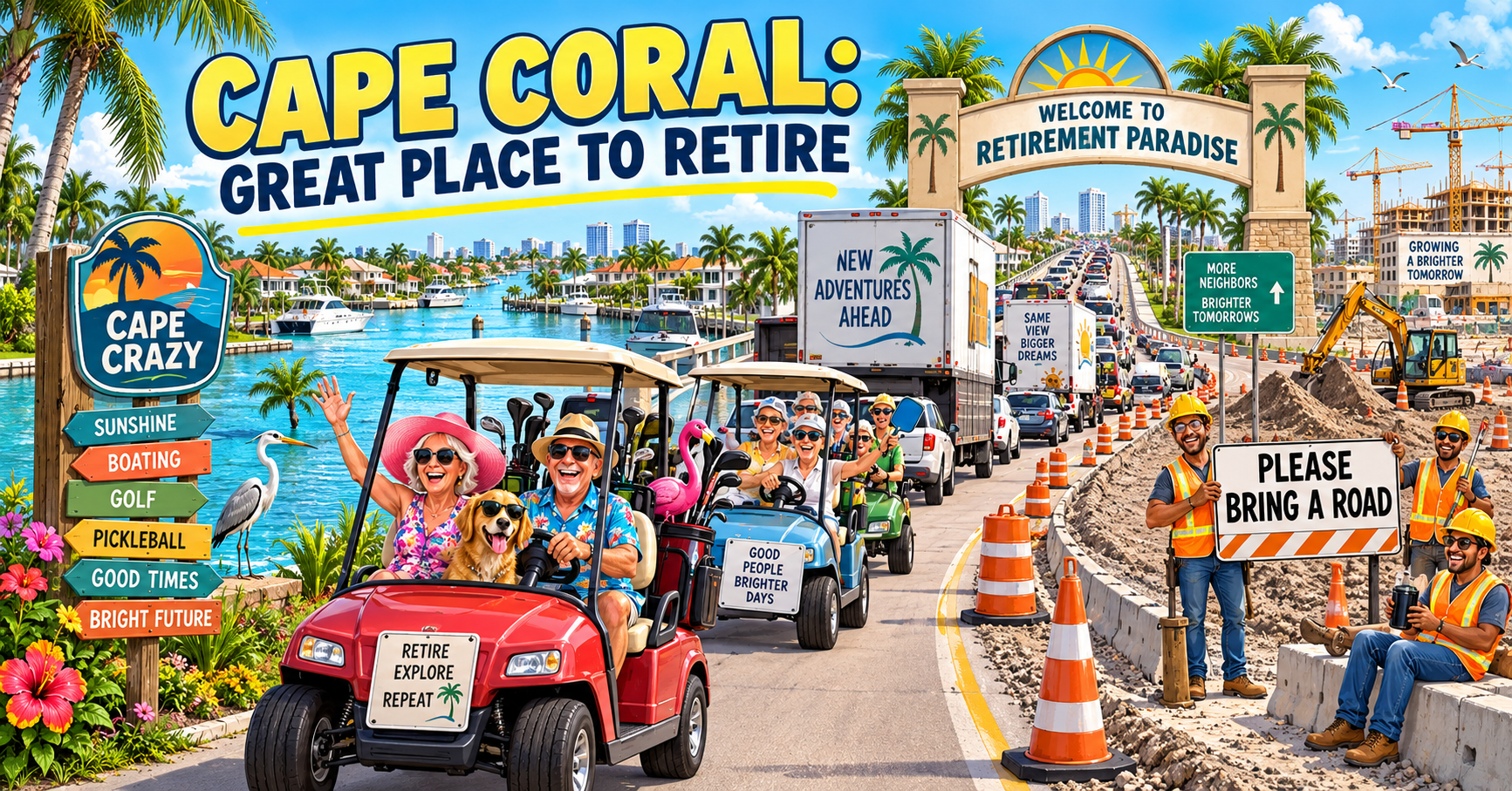
Cape Coral has once again received national recognition as a desirable place to retire.
WalletHub ranked the city No. 13 among more than 180 American cities in its 2026 list of the best places to retire. Cape Coral also finished fifth among Florida cities, behind Orlando, Miami, Tampa and Fort Lauderdale.
That is impressive.
It means retirees across America may now begin packing their golf clubs, fishing poles, medications and entire collection of clothing suitable for temperatures between 82 and 94 degrees.
Local residents have offered one small request:
Could everyone please wait until we finish the roads?
Welcome to Retirement Paradise
Cape Coral has many qualities retirees understandably find attractive.
There is no Florida state income tax. Winters are warm. The city has more than 400 miles of canals, dozens of parks, boating, fishing, golf and enough waterfront property to convince a person from Ohio that owning a boat is a simple and inexpensive hobby.
Residents can wear shorts in January, watch sunsets over the Caloosahatchee and spend their mornings deciding whether lunch should occur before or after pickleball.
Snow shovels are unnecessary.
Ice scrapers are mysterious objects from another civilization.
The only white powder falling from the sky is sand being launched by a leaf blower.
For someone who has spent 40 years waking before sunrise, commuting through sleet and scraping frozen precipitation from a windshield, Cape Coral can look like the reward at the end of a very long game.
Unfortunately, thousands of other people have reached the same conclusion.
No. 13 in the Nation
WalletHub compared 182 cities using 45 measures organized into four broad categories:
- Affordability
- Activities
- Quality of life
- Health care
Cape Coral finished No. 13 overall.
Its strongest category was affordability, where it ranked No. 14. The city placed No. 26 for quality of life, No. 72 for activities and No. 82 for health care.
Those numbers tell a more complete story than the overall ranking.
Cape Coral performs very well as a place where retirees may be able to stretch their income, enjoy warm weather and maintain a comfortable lifestyle.
But the rankings also suggest that anyone expecting a compact retirement destination filled with museums, public transportation and nationally renowned medical institutions on every corner should examine the map carefully.
Cape Coral is geographically enormous.
It contains more land than Miami, Tampa or Fort Lauderdale, but much of it is composed of residential neighborhoods, canals and roads that appear considerably shorter when viewed on Google Maps than when driven during season.
The city’s unofficial measurement system is not miles.
It is traffic lights.
Everyone Found the Secret
For decades, Cape Coral was marketed as an affordable waterfront community where people could purchase a home, enjoy Florida weather and escape the density and expense of larger coastal cities.
The marketing worked.
Possibly too well.
Cape Coral’s population has surpassed 225,000 and continues growing. New homes, apartment complexes, stores, restaurants and developments are appearing throughout the city—particularly in the north and northwest.
Growth brings jobs, businesses, tax revenue and amenities residents have requested for years.
It also brings traffic, construction, crowded medical offices, infrastructure demands and the occasional realization that the quiet two-lane road leading to your neighborhood now serves 6,000 additional homes.
Cape Coral is experiencing the municipal equivalent of posting a peaceful vacation photo online and accidentally inviting everyone you have ever met.
The city remains attractive because it has space.
That space is now attracting people.
Those people require roads.
The roads require money.
The money requires meetings.
The meetings require consultants.
By the time everything is finished, another 20,000 people have arrived.
Bring Your Own Cardiologist
Health care is especially important when judging a retirement destination.
Cape Coral has a hospital, emergency services, primary-care practices, specialists and a growing network of medical facilities. A new HCA hospital is also planned for the city.
But many residents still cross the river for specialists, procedures and medical services located in Fort Myers.
This can turn an 11 a.m. appointment into a regional transportation exercise.
First, locate the office.
Then determine which bridge is least likely to betray you.
Add time for seasonal traffic, road construction and the driver in front of you who has stopped six car lengths short of the light.
Finally, arrive 30 minutes early so the physician can see you 45 minutes late.
Cape Coral’s No. 82 health-care ranking does not mean the city lacks good doctors or medical services. It does suggest that access, availability and proximity may vary considerably depending on where someone lives and what care they need.
A healthy retiree seeking sunshine and recreation may find everything necessary nearby.
A person managing several chronic conditions should investigate doctors, hospitals, insurance networks and travel times before selecting a home simply because the lanai has a pleasant canal view.
The view may be excellent.
Your cardiologist may be three bridges and a roundabout away.
Affordable—With Several Asterisks
Cape Coral’s high affordability score is another major advantage.
Housing prices are generally lower than in many famous Florida retirement destinations. A buyer may find a single-family home, pool and even canal access for far less than comparable property in Naples, Miami or parts of Sarasota.
Florida also does not tax personal income, Social Security benefits or retirement distributions at the state level.
But “affordable” in Florida comes with footnotes.
Homeowners must account for:
- Property insurance
- Flood insurance
- Windstorm exposure
- Roof age
- Utility assessments
- Property taxes
- Pool maintenance
- Seawall maintenance
- Boat maintenance
- The mysterious ability of air-conditioning systems to fail during the hottest week of August
A canal home may appear affordable until the seawall requests early retirement of its own.
Insurance costs can vary dramatically from one home to another. Flood zones, construction dates, elevation, storm protection and roof condition all matter.
New residents should obtain actual insurance quotes before purchasing—not rely on a national ranking that does not know whether the roof was last replaced during the Reagan administration.
Activities Depend on Your Definition
Cape Coral ranked No. 72 for activities.
That sounds average until you ask what someone considers an activity.
If you enjoy boating, fishing, kayaking, gardening, golf, pickleball, parks, outdoor dining or observing your neighbors’ increasingly elaborate landscape lighting, Cape Coral offers plenty to do.
If you expect Broadway shows, major-league sports, expansive museums and a different cultural event every night, you will probably be crossing the river or driving farther.
Cape Coral’s primary attraction is the lifestyle itself.
People move here to sit by pools, cruise canals, grill outside, watch sunsets and explain to visiting relatives why Sanibel is not technically “right down the street.”
Retirement does not require constant entertainment.
Sometimes the perfect afternoon consists of sitting on a lanai, listening to music and watching an iguana evaluate your seawall.
Cape Coral excels at that.
The Growth Paradox
The qualities attracting retirees also create pressure on the qualities they came to enjoy.
People want Cape Coral because it feels more relaxed than larger Florida cities.
Then enough people arrive that traffic becomes less relaxed.
They want affordable homes.
Demand raises prices.
They want quiet neighborhoods.
Development fills the vacant land nearby.
They want shopping and restaurants closer to home.
Those businesses attract more traffic.
They want improved roads.
Road construction makes driving temporarily worse.
This is not unique to Cape Coral. Every desirable fast-growing community eventually confronts the same contradiction:
People move somewhere because they like what it is, then their arrival helps change what it was.
The solution is not to place a guard at the Cape Coral Bridge and require new residents to prove they knew the city before Pine Island Road had traffic.
Growth must be planned and managed.
Roads, utilities, drainage, public safety, parks and health-care capacity need to expand alongside housing.
Approving development is the easy part.
Making sure the surrounding city continues working afterward is where the actual test begins.
Retire Here—But Perform Due Diligence
Cape Coral deserves its strong ranking.
It offers sunshine, recreation, canals, relatively attainable housing and a laid-back lifestyle that many retirees spend decades dreaming about.
But no national ranking can determine whether a city is right for one particular person.
Before relocating, future retirees should investigate:
- Insurance costs for the exact property
- Flood and evacuation zones
- Distance to doctors and hospitals
- Medicare plan networks
- Traffic during winter season
- Utility assessments
- Roof and seawall condition
- Whether the canal actually provides the boating access they expect
- How long it takes to reach groceries, restaurants and the nearest bridge
They should also visit in August.
Anyone can fall in love with Cape Coral during a sunny February afternoon.
True commitment means stepping outside in late summer and discovering that the air has become a warm beverage.
Paradise Is Getting Crowded
Cape Coral finishing No. 13 nationally is something residents can be proud of.
The city remains one of Florida’s most appealing combinations of affordability, water access, warm weather and relaxed living.
The challenge is protecting those advantages as the population continues growing.
New development must be matched with infrastructure. Medical access must expand. Roads must keep pace. Public spaces and environmental resources must not become afterthoughts.
Otherwise, Cape Coral may continue climbing every national retirement ranking while longtime residents sit in traffic wondering whether the judges actually attempted to turn left onto Pine Island Road.
For now, the message to America’s future retirees is simple:
Cape Coral is sunny.
Cape Coral is beautiful.
Cape Coral is highly ranked.
And Cape Coral would appreciate it if you could stagger your arrival times.
Sources: WINK News — Cape Coral ranks high for retirees, but growth brings pressure and WalletHub — Best and Worst Places to Retire in 2026
Cape Crazy commentary is satire based on publicly reported rankings and local growth concerns.
Is This Crazy or Not?
- Not Crazy: Retiring somewhere with sunshine, canals and no state income tax.
- Crazy: Approving thousands of new homes and acting surprised when the roads become crowded.
- You Decide: Should Cape Coral advertise its No. 13 ranking—or keep quiet before everyone’s parents move here?
